What Is Minimum Efficient Scale and Its Market Impact?
TL;DR
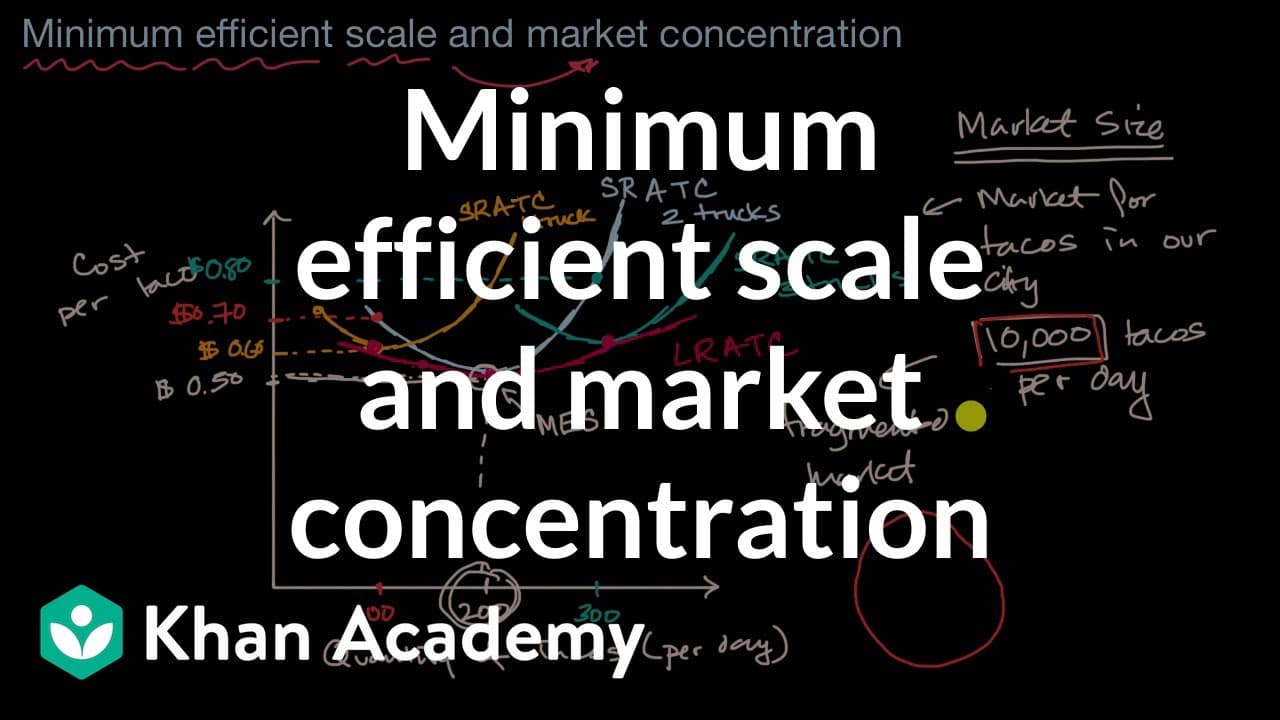
Minimum efficient scale (MES) is the lowest production level where economies of scale cease, directly affecting market competition. If MES is small compared to market size, fragmentation occurs with many competitors; however, if MES is close to or exceeds market size, it leads to market concentration and potential natural monopolies.
Transcript
- [Narrator] In this video, we're going to think about the concept of minimum efficient scale and then how that impacts market concentration. And we're going to make sure we understand what both of these ideas are. So first of all, minimum efficient scale, you can view it as the smallest scale at which we stop getting economies of scale, or another... Read More
Key Insights
- 🪘 Minimum efficient scale (MES) represents the point at which economies of scale are no longer achieved, and the long-run average total cost curve stops declining.
- 👨💼 Businesses operating below MES may struggle to participate in highly competitive markets.
- 🖐️ Market size plays a significant role in determining market concentration.
- 🥺 A small fraction of MES in relation to the market size leads to a fragmented market with numerous competitors.
- 😚 When MES is close or larger than the market size, the market becomes concentrated.
- ✊ A concentration of market power can result in a natural monopoly.
- 🉐 Natural monopolies occur when only one player can efficiently operate in the market due to cost advantages.
Install to Summarize YouTube Videos and Get Transcripts
Explore YouTube Video Summarizer or Get YouTube Transcript Extractor
Questions & Answers
Q: What is minimum efficient scale (MES)?
MES refers to the point at which economies of scale are no longer achieved and the long-run average total cost curve stops declining. It represents the smallest scale at which a business can be efficient and competitive.
Q: How does MES impact market participation?
Businesses operating below MES may struggle to participate in a highly competitive market. Only those operating at or above MES can achieve cost-efficiency and stay competitive in such markets.
Q: How does market size affect market concentration?
Market size is vital in determining market concentration. If MES is a small fraction of the market size, the market tends to be fragmented with multiple competitors. Conversely, if MES is close or larger than the market size, the market becomes concentrated, potentially leading to a natural monopoly.
Q: What is a natural monopoly?
A natural monopoly occurs when market dynamics, such as continuous economies of scale up to the market size, make it efficient for only one player to operate. In such cases, there may be no other competitors due to the high efficiency and cost advantage of the dominant player.
Summary & Key Takeaways
-
Minimum efficient scale (MES) refers to the smallest scale at which economies of scale are no longer achieved, indicating the point where the long-run average total cost curve stops declining.
-
MES is important for businesses to be competitive and efficient in the market. Those operating below MES may not be able to participate in a highly competitive market.
-
The market size, defined by the specific market being considered, plays a crucial role in determining market concentration. If MES is a small fraction of the market, fragmentation occurs, leading to numerous competitors. However, if MES is close or larger than the market size, the market becomes concentrated, potentially resulting in a natural monopoly.
Read in Other Languages (beta)
Share This Summary 📚
Summarize YouTube Videos and Get Video Transcripts with 1-Click
Try YouTube Summary with ChatGPT & Claude or YouTube Transcript Generator
Explore More Summaries from Khan Academy 📚



Summarize YouTube Videos and Get Video Transcripts with 1-Click
Try YouTube Summary with ChatGPT & Claude or YouTube Transcript Generator