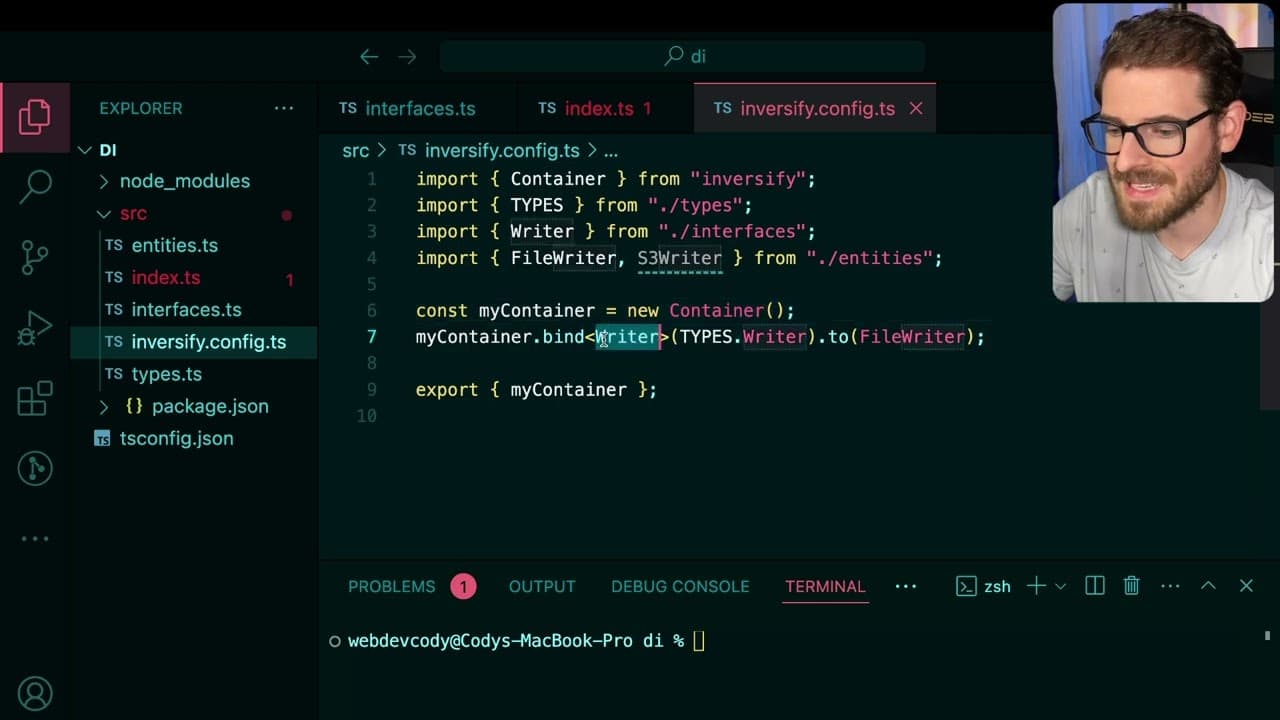
Why I dislike inversion of control containers
TL;DR
Dependency injection enhances modular code by inverting dependencies and improving testability.
Transcript
so recently I made a video talking about dependency injection and a lot of people left comments saying that this is a dependency injection you're doing it wrong I would honestly say that you all don't know what dependency injection is let's have a little lesson to talk about dependency injection so when you're writing out code your code is basicall... Read More
Key Insights
- 👻 Dependency injection improves code modularity by allowing components to be easily swapped out through interfaces rather than direct dependencies.
- 🏆 It enhances unit testing as components can be tested in isolation with mock implementations, reducing the setup complexity typically involved with direct imports.
- 👨💻 Utilizing functional dependency injection offers clarity as dependencies are explicitly passed as parameters, making the code more readable and streamlined.
- 👋 Dependency inversion is an essential concept that promotes best practices in designing maintainable software systems, ensuring modules depend on abstractions rather than concrete implementations.
- 👨💻 Inversion of control containers automate dependency management but can obscure code logic, making systems less transparent and harder to debug.
- 😒 Effective use of dependency injection requires a balance between complexity and maintainability, particularly regarding the choice of containerized versus functional approaches.
- ⚾ Switching between implementations at runtime based on configuration or environment variables enhances versatility and adaptability within applications.
Install to Summarize YouTube Videos and Get Transcripts
Explore YouTube Video Summarizer or Get YouTube Transcript Extractor
Questions & Answers
Q: What is dependency injection and why is it important?
Dependency injection is a design pattern that allows a developer to remove hard-coded dependencies, maintaining a clear separation between different modules. It promotes flexibility, making it easier to swap implementations without altering the codebase. This approach simplifies testing, as mocks or stubs can easily be injected during unit tests.
Q: How does dependency inversion relate to dependency injection?
Dependency inversion is a key principle where higher-level modules should not depend on lower-level modules, but rather both should depend on abstractions, such as interfaces or types. In dependency injection, this principle leads to more modular and maintainable code, enabling easier replacements of parts without changing the whole system.
Q: What are the advantages of using an inversion of control (IoC) container like Inversify?
An IoC container like Inversify automates the management of dependencies, simplifying the injection process and allowing for cleaner code architecture. It enables configurability at runtime, improving scalability and making it easier to manage complex dependencies in larger applications without manually wiring everything.
Q: What are some drawbacks of using IoC containers in dependency injection?
A significant drawback of IoC containers is increased complexity, which can make the code harder to understand and maintain. Developers may find it challenging to trace through layers of abstraction, leading to confusion when debugging or trying to understand the flow of data and function calls in the application.
Q: How can dependency injection improve the testability of a codebase?
By decoupling dependencies, dependency injection allows developers to easily substitute real implementations with mock objects during tests. This means tests can run in isolation, validating functionality without unnecessary dependencies, ultimately leading to more robust, reliable, and maintainable code.
Q: What is functional dependency injection, and how does it differ from traditional methods?
Functional dependency injection refers to passing dependencies directly as arguments to functions rather than importing them statically. This approach enhances readability and simplifies testing, as functions can receive any implementation of a dependency that conforms to an expected interface, thus removing hard dependencies on specific modules.
Q: In what scenarios would you avoid using IoC containers for dependency injection?
If the project is small or has a straightforward architecture, using IoC containers might add unnecessary complexity. They're more suitable for larger projects with a clear need for managing complex dependencies. If simplicity and explicitness in the codebase are prioritized, manual dependency management may be more beneficial.
Q: Why might developers misinterpret the principles of dependency injection?
Misunderstandings can stem from the varying approaches and terminologies used across different programming languages and paradigms. Developers who are accustomed to frameworks like Java Spring might apply those principles without fully grasping the concept of dependency inversion and functional injection, leading to incorrect implementations.
Summary & Key Takeaways
-
Dependency injection simplifies code management by decoupling modules, allowing for easier swapping of implementations, particularly with interfaces. This is beneficial for testing and adapting code to new requirements.
-
The concept of dependency inversion is crucial for effective dependency injection, as it ensures modules depend on abstractions instead of concrete implementations, improving maintainability and flexibility.
-
The video discusses different methods of dependency injection, including functional injection and the use of inversion of control containers, weighing their pros and cons in code complexity and understanding.
Read in Other Languages (beta)
Share This Summary 📚
Summarize YouTube Videos and Get Video Transcripts with 1-Click
Try YouTube Summary with ChatGPT & Claude or YouTube Transcript Generator
Explore More Summaries from Web Dev Cody 📚


Summarize YouTube Videos and Get Video Transcripts with 1-Click
Try YouTube Summary with ChatGPT & Claude or YouTube Transcript Generator