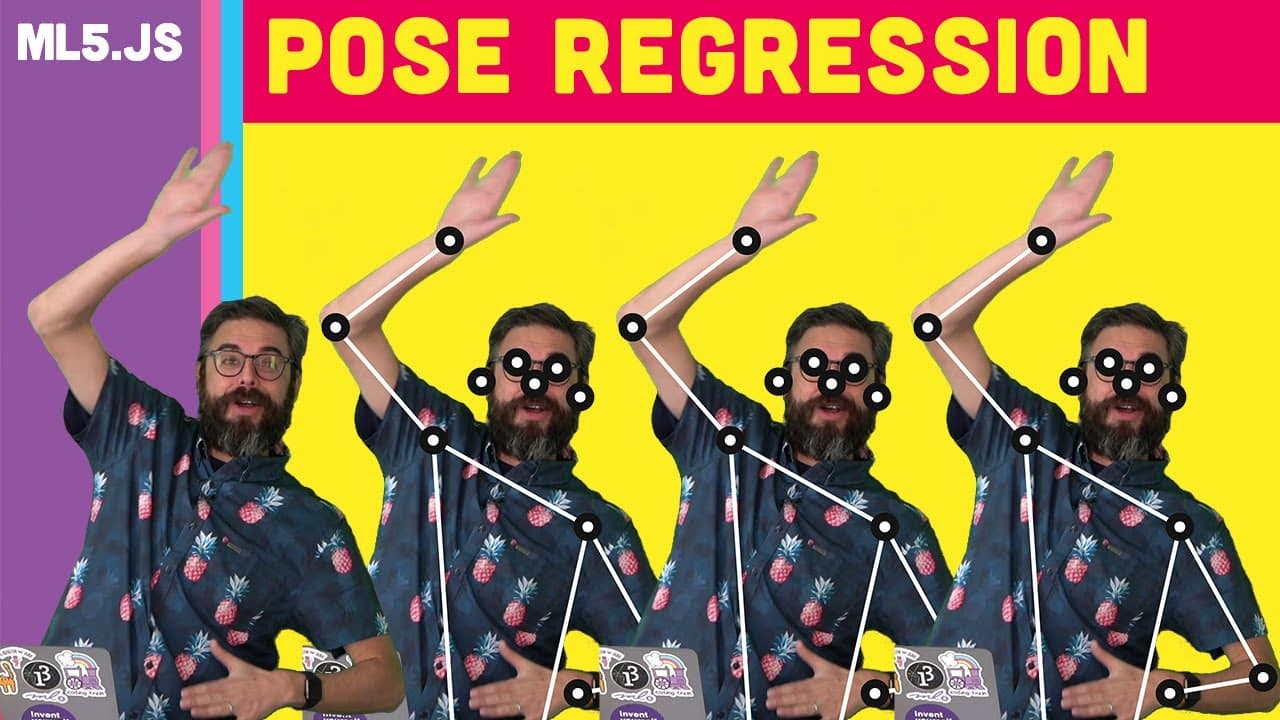
ml5.js: Pose Regression with PoseNet and ml5.neuralNetwork()
TL;DR
Implementing regression with ML5.js to control sliders with body poses for creative color output.
Transcript
Hello and welcome to another beginner's guide to machine learning with ML5.js video on pose estimation and posenet. So this is the third, the last one that I'll do in this series here about posenet. First I looked at just what posenet is and how it works and how you can get the key points of a human skeleton. Then I took the output of the posenet m... Read More
Key Insights
- ⚾ Regression with ML5.js can be used creatively to control sliders based on body poses for unique outputs like color mapping.
- 👨💻 Async and await in JavaScript improve code readability and sequencing, making asynchronous events more manageable.
- 👻 The regression process involves training a model to map body poses to specific values, allowing for diverse outputs beyond traditional classifications.
- 🎼 Exploring different outputs such as music frequencies or other interactive interfaces is possible by leveraging regression creatively.
- 😒 The use of sliders controlled by body poses demonstrates an innovative approach to utilizing machine learning for interactive experiences.
- 🎮 The video emphasizes the importance of thoughtful design in training models for regression tasks to achieve desired outcomes.
Install to Summarize YouTube Videos and Get Transcripts
Explore YouTube Video Summarizer or Get YouTube Transcript Extractor
Questions & Answers
Q: What is the main focus of the video?
The video focuses on using regression with ML5.js to control sliders based on body poses for creative outputs, moving beyond traditional classification tasks.
Q: How does the regression process work in the context of controlling colors?
Regression in this case involves mapping body poses to RGB values, allowing the sliders to adjust based on the pose, creating a unique color output for each pose.
Q: How does async and await improve the code structure in the video?
Async and await help in making asynchronous events more sequential and readable, enhancing the code structure and simplifying the process of setting target values for regression.
Q: What are some creative applications of regression demonstrated in the video?
The video showcases using regression for controlling colors based on body poses, but users can explore other creative applications like music frequencies by training the model accordingly.
Summary & Key Takeaways
-
The video demonstrates implementing regression with ML5.js to control sliders using body poses for creative color output.
-
The process involves training a model to recognize body poses and mapping them to RGB values for slider control.
-
By creatively using regression, users can explore different outputs beyond color, like music frequencies.
Read in Other Languages (beta)
Share This Summary 📚
Summarize YouTube Videos and Get Video Transcripts with 1-Click
Try YouTube Summary with ChatGPT & Claude or YouTube Transcript Generator
Explore More Summaries from The Coding Train 📚




Summarize YouTube Videos and Get Video Transcripts with 1-Click
Try YouTube Summary with ChatGPT & Claude or YouTube Transcript Generator