Inverse variation application | Rational expressions | Algebra II | Khan Academy
TL;DR
String length on a string instrument is inversely proportional to its frequency, and the vibrations of the string affect the air, resulting in sound perceived by our eardrums.
Transcript
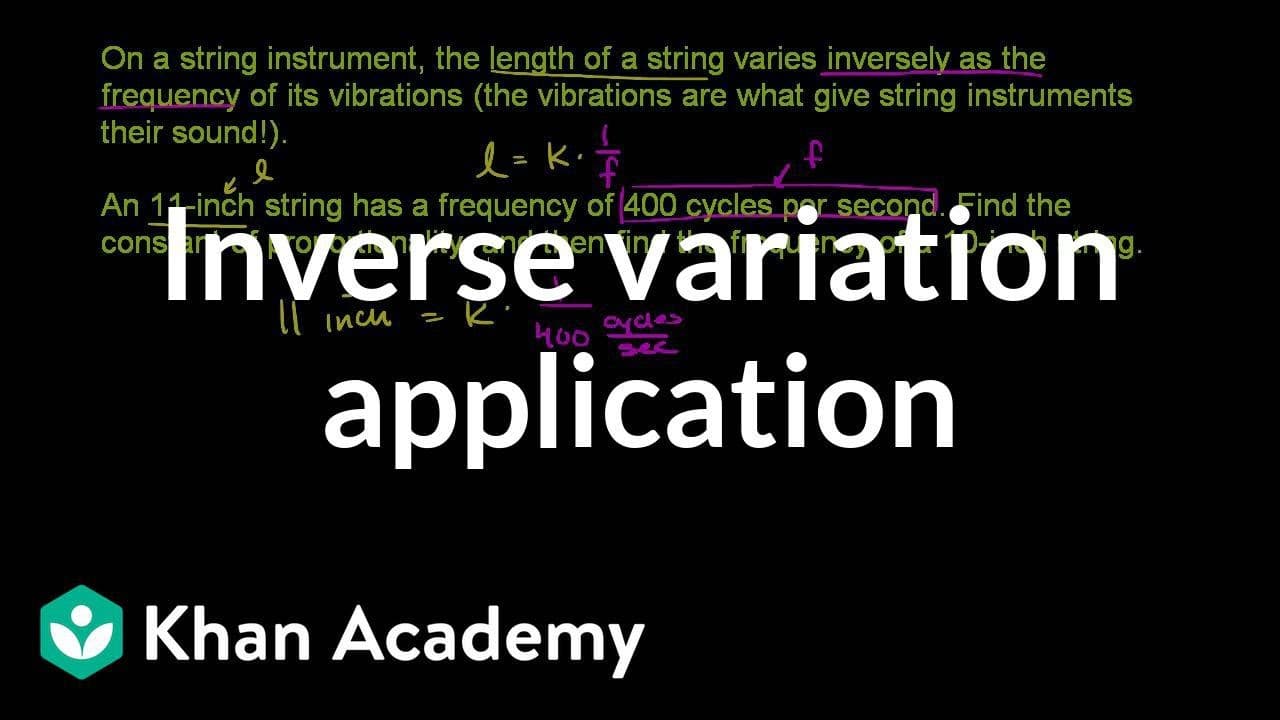
We're told in this question that on a string instrument, the length of a string-- so let's call that l-- the length of a string l varies inversely as the frequency, so varies inversely as the frequency. So l is going to be equal to some constant times the inverse of the frequency. And I'll use f for frequency-- the frequency of its vibrations. And ... Read More
Key Insights
- ❓ The length of a string on a string instrument and its frequency have an inverse relationship.
- 👂 Vibrations of the string are responsible for creating sound waves that reach our ears.
- ❓ A known length and frequency can be used to find the constant of proportionality.
- ❓ The constant of proportionality can be used to find the frequency of strings with different lengths.
- 🧑🏭 String length and frequency are crucial factors in determining the pitch of a string instrument.
- 😘 Longer strings produce lower frequencies and lower pitches.
- 👂 The perceived sound of a string instrument is a result of air compressions caused by vibrating strings.
Install to Summarize YouTube Videos and Get Transcripts
Explore YouTube Video Summarizer or Get YouTube Transcript Extractor
Questions & Answers
Q: What is the relationship between the length of a string on a string instrument and its frequency?
The length of a string on a string instrument is inversely proportional to its frequency. As the string length increases, the frequency decreases, and vice versa.
Q: How do the vibrations of the string affect the sound produced by a string instrument?
The vibrations of the string on a string instrument create compressions and rarefactions in the air, resulting in sound waves that eventually reach our eardrums, allowing us to perceive the sound.
Q: What is the constant of proportionality in the relationship between string length and frequency?
The constant of proportionality (k) represents the relationship between string length and frequency. It can be determined by multiplying the length and frequency of a known string.
Q: How can the constant of proportionality be used to find the frequency of a different length string?
Once the constant of proportionality (k) is known, it can be used to calculate the frequency of a string with a different length. By rearranging the equation l = k/f, we can solve for the frequency.
Summary & Key Takeaways
-
The length of a string on a string instrument (l) varies inversely with its frequency (f), as l = k/f, where k is the constant of proportionality.
-
An 11-inch string has a frequency of 400 cycles per second.
-
To find the constant of proportionality (k), we multiply the length and frequency of the string.
-
Using the constant (k), we can find the frequency of a 10-inch string, which in this case is 440 cycles per second.
Read in Other Languages (beta)
Share This Summary 📚
Summarize YouTube Videos and Get Video Transcripts with 1-Click
Try YouTube Summary with ChatGPT & Claude or YouTube Transcript Generator
Explore More Summaries from Khan Academy 📚



Summarize YouTube Videos and Get Video Transcripts with 1-Click
Try YouTube Summary with ChatGPT & Claude or YouTube Transcript Generator