Formal definition of limits Part 2: building the idea | AP Calculus AB | Khan Academy
TL;DR
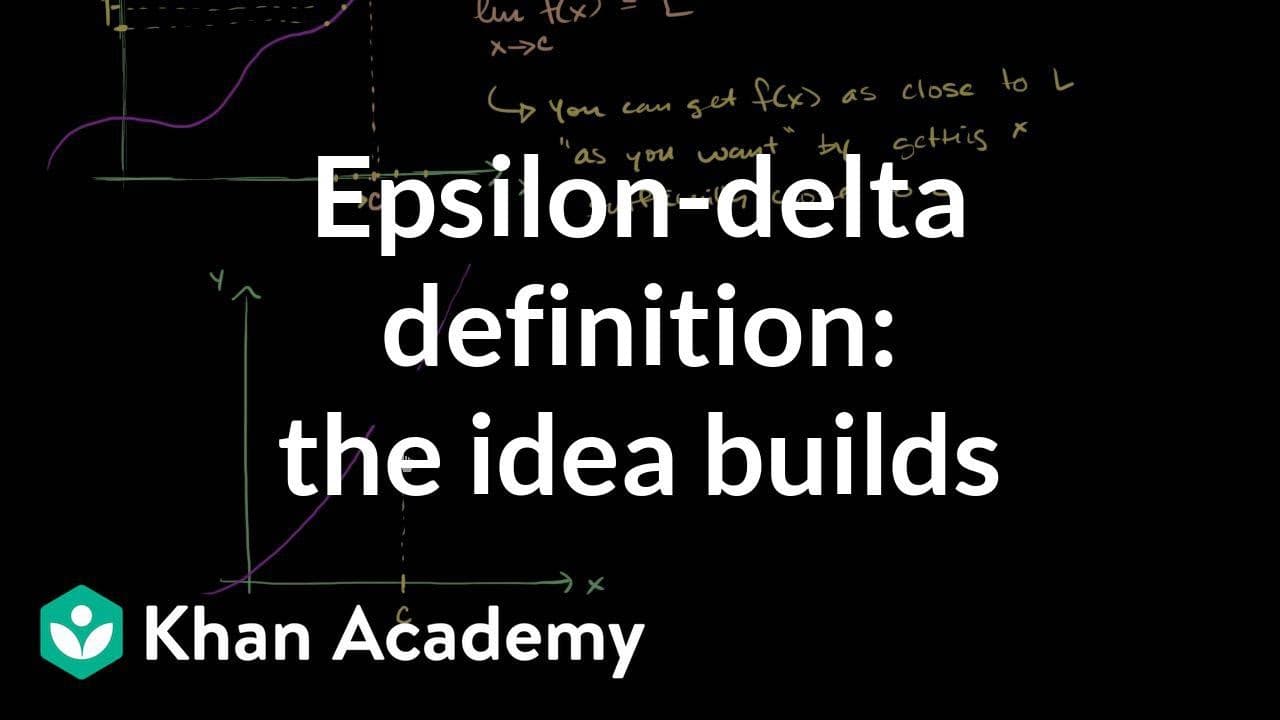
The limit of a function as x approaches a certain value can be defined as the ability to make the function's output as close as desired to a specific value by getting x sufficiently close to the given value.
Transcript
Let's try to come up with a mathematically rigorous definition for what this statement means. The statement that the limit of f of x as x approaches c is equal to L. So let's say that this means that you can get f of x as close to L as you want. I'll put that in quotes right over here, because it's kind of a little loosey goosey as how close is tha... Read More
Key Insights
- 📫 The limit of a function as x approaches a certain value measures the ability to make the function's output as close as desired to a specific value.
- 🧡 Graphically, the limit represents a vertical range around the desired value.
- 🧡 The definition of a limit involves finding a range around the given value of x that ensures the function's outputs fall within any desired range around the limit value.
Install to Summarize YouTube Videos and Get Transcripts
Explore YouTube Video Summarizer or Get YouTube Transcript Extractor
Questions & Answers
Q: What does it mean for the limit of a function to be L as x approaches a certain value?
It means that as x gets closer and closer to the specified value, the function's output can be made as close as desired to L. This concept deals with the behavior of the function near the specified point.
Q: How is the limit concept visualized graphically?
Graphically, the limit represents the range of y-values around the limit value. The objective is to find a range around the specified x-value where the function's outputs fall within the desired range.
Q: How can the definition of a limit be proved for a specific range around L?
To prove the limit for a specific range around L, one needs to find a corresponding range around the given value of x. This range should ensure that all x values within it produce function outputs within the desired range around L.
Q: Can the limit concept be applied to all functions?
Yes, the concept of a limit can be applied to all functions, although the process of finding the range around the given value of x may vary for different types of functions.
Summary & Key Takeaways
-
The limit of a function as x approaches a specific value, denoted as L, means that the function's output can be made arbitrarily close to L by selecting x values close enough to the given value.
-
Graphically, the limit represents the vertical range around L, and the objective is to prove that for any desired range around L, there exists a corresponding range around the given value of x where the function's output falls within the desired range.
-
The process involves selecting a desired range around L and finding a range around the given value of x such that all x values within that range produce function outputs within the desired range.
Read in Other Languages (beta)
Share This Summary 📚
Summarize YouTube Videos and Get Video Transcripts with 1-Click
Try YouTube Summary with ChatGPT & Claude or YouTube Transcript Generator
Explore More Summaries from Khan Academy 📚



Summarize YouTube Videos and Get Video Transcripts with 1-Click
Try YouTube Summary with ChatGPT & Claude or YouTube Transcript Generator