Newton's 2nd Law, The Force of Friction, An Explanation (Best Explanation Ever)
TL;DR
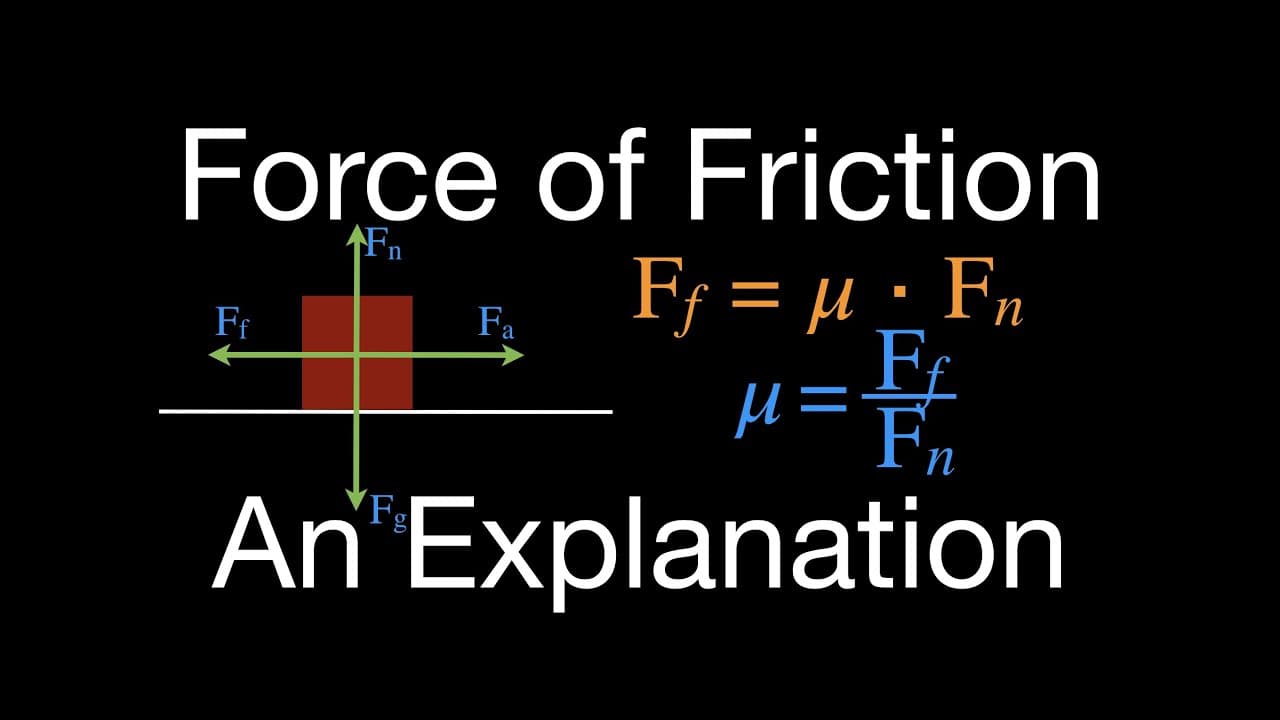
Force of friction opposes motion, with static and kinetic components, determined by coefficients of friction.
Transcript
in today's video we are going to be going over the amazing topic of a force of friction now don't forget before we go any further to subscribe to my channel step by step signs click on the notifications Bell get all my excellent physics chemistry and math videos you can subscribe you can share you can comment you can give me a thumbs up and you can... Read More
Key Insights
- ❓ Friction opposes motion, with static and kinetic components, impacting the movement of objects.
- ❓ Coefficients of friction define the amount of resistance between surfaces, affecting the force of friction.
- ❓ Understanding the relationship between static and kinetic friction is crucial in analyzing motion scenarios.
- ❓ Calculating the force of friction involves considerations of normal force and coefficients of friction.
- ❓ The force of friction can be used to determine the acceleration of objects in motion.
- ❓ Coefficients of friction are crucial in determining the friction force between surfaces.
- ❓ Static friction is necessary to overcome to initiate motion, while kinetic friction influences the movement of objects.
Install to Summarize YouTube Videos and Get Transcripts
Explore YouTube Video Summarizer or Get YouTube Transcript Extractor
Questions & Answers
Q: What is the force of friction, and how does it affect the motion of an object?
The force of friction is a resistance that opposes the motion of an object, either keeping it stationary (static friction) or acting against its movement (kinetic friction).
Q: How do coefficients of friction play a role in determining the force of friction?
Coefficients of friction describe the amount of friction between two surfaces, influencing the magnitude of the friction force experienced by an object.
Q: What is the difference between static and kinetic friction, and how are they related?
Static friction prevents the initial movement of an object, while kinetic friction acts on moving objects, with static friction typically being greater than kinetic friction.
Q: How can the force of friction be calculated using coefficients of friction and normal force?
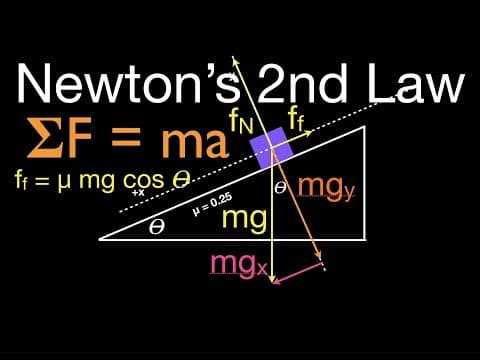
The force of friction can be determined by multiplying the coefficient of friction by the normal force, providing insights into the resistance encountered by objects in motion.
Summary & Key Takeaways
-
Force of friction is the resistance exerted by a surface on an object as it moves or attempts to move across it.
-
There are two types of friction: static, which prevents motion, and kinetic, which acts on moving objects.
-
Friction force depends on coefficients of friction, with static being greater than kinetic.
Read in Other Languages (beta)
Share This Summary 📚
Summarize YouTube Videos and Get Video Transcripts with 1-Click
Try YouTube Summary with ChatGPT & Claude or YouTube Transcript Generator
Explore More Summaries from Step by Step Science 📚

Summarize YouTube Videos and Get Video Transcripts with 1-Click
Try YouTube Summary with ChatGPT & Claude or YouTube Transcript Generator