2-dimensional momentum problem (part 2) | Physics | Khan Academy
TL;DR
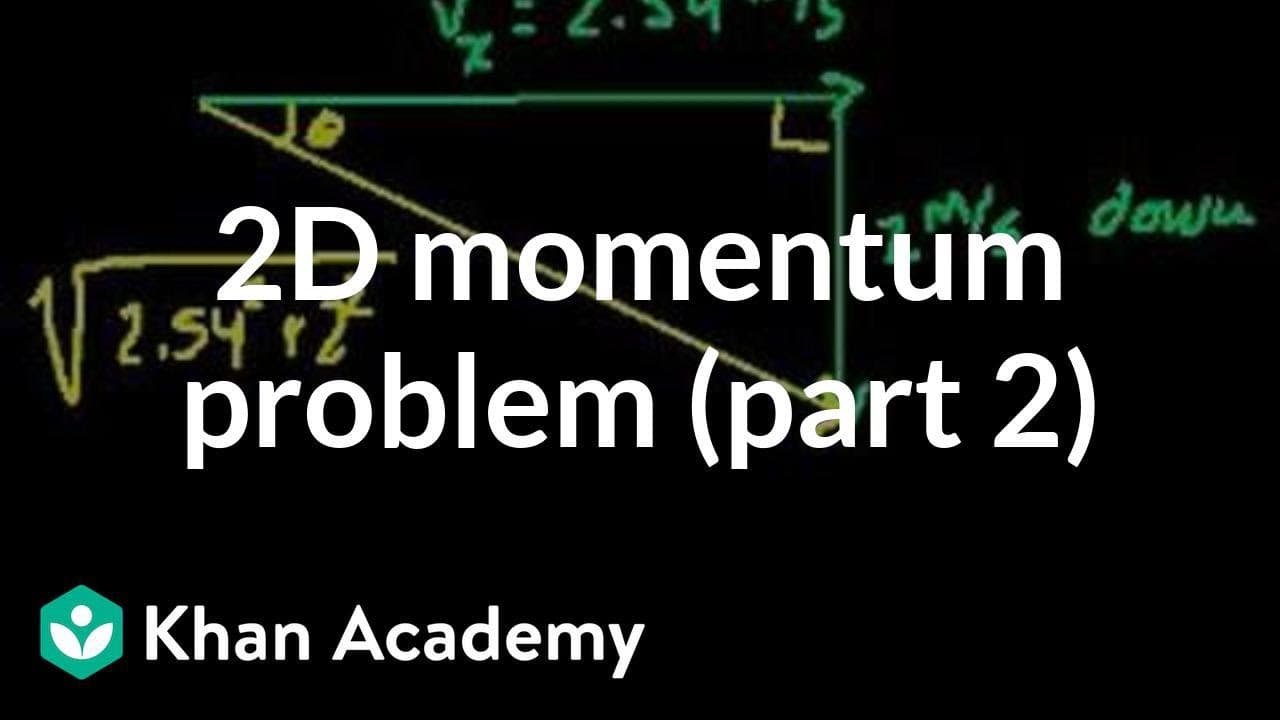
Review of the conservation of momentum in two dimensions, solving for the velocity and angle of two balls after collision using trigonometry.
Transcript
Welcome back. When I left off I was rushing at the end of this problem because I tend to rush at the end of problems when I am getting close to the YouTube 10 minute limit. But I just wanted to review the end of it because I feel like I rushed it. And then, actually continue with it and actually solve for the angle and then, introduce a little bit ... Read More
Key Insights
- 💥 Momentum is conserved separately in each dimension in two-dimensional collisions.
- ❣️ Trigonometry can be used to determine the x and y components of velocity.
- 💥 The Pythagorean theorem is used to find the resulting velocity after collision.
- 🥳 Trigonometric ratios can be used to calculate the angle of the resulting velocity.
- 💥 The mass and angle of collision affect the resulting velocities of the balls.
- 💥 The conservation of momentum explains how the velocities of the balls change after collision.
- 💬 A lighter ball will experience a larger change in velocity compared to a heavier ball in a collision.
Install to Summarize YouTube Videos and Get Transcripts
Explore YouTube Video Summarizer or Get YouTube Transcript Extractor
Questions & Answers
Q: How does the conservation of momentum work in two dimensions?
In two dimensions, momentum is conserved separately in the x and y directions. This means that the initial momentum in each direction equals the final momentum in that direction.
Q: How can the x and y components of a ball's velocity be determined?
The x and y components can be found by using trigonometry. The magnitude of the velocity multiplied by the cosine of the angle gives the x component, and the magnitude multiplied by the sine of the angle gives the y component.
Q: How can the resulting velocity and angle of a ball after collision be calculated?
By using the Pythagorean theorem, the magnitude of the resulting velocity can be found. The angle can be determined using trigonometric ratios such as sine, cosine, or tangent.
Q: Why does the velocity of a ball change after a collision?
The velocity of a ball changes after collision because momentum is transferred between the balls. The change in velocity depends on the masses of the balls and the angle at which they collide.
Summary & Key Takeaways
-
Momentum is conserved in two dimensions, meaning it is conserved in each dimension individually.
-
The initial momentum of the system can be calculated by considering the momentum of each ball.
-
The x and y components of a ball's velocity can be determined using information about its angle and magnitude.
-
Trigonometry can be used to find the resulting velocity and angle of a ball after collision.
Read in Other Languages (beta)
Share This Summary 📚
Summarize YouTube Videos and Get Video Transcripts with 1-Click
Try YouTube Summary with ChatGPT & Claude or YouTube Transcript Generator
Explore More Summaries from Khan Academy 📚



Summarize YouTube Videos and Get Video Transcripts with 1-Click
Try YouTube Summary with ChatGPT & Claude or YouTube Transcript Generator