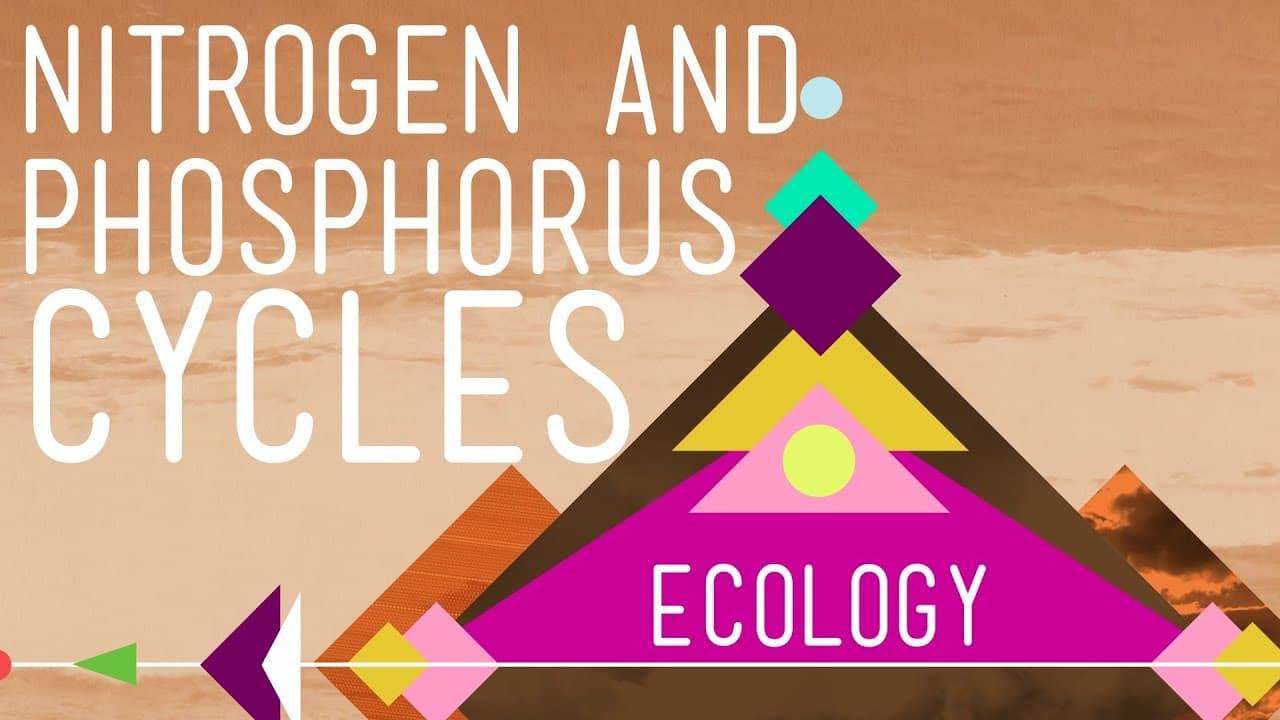
Nitrogen & Phosphorus Cycles: Always Recycle! Part 2 - Crash Course Ecology #9
TL;DR
Explains how organisms obtain nitrogen and phosphorus through their cycles.
Transcript
There's nothing quite so terrible as needing something that's sitting right in front of you but not being able to get it. Like say you're on a lifeboat in the ocean and you're super thirsty, and there's 300,000,000 cubic miles of water sitting right in front of you, but you can't drink any of it. Or having to sit next to Megan Kale every day in mat... Read More
Key Insights
- Nitrogen and phosphorus are essential nutrients for organisms, but they are often not in a biologically available form.
- Nitrogen makes up 78% of the atmosphere, but its triple bond makes it difficult for organisms to utilize directly.
- Nitrogen-fixing bacteria convert atmospheric nitrogen into ammonia, which plants can then use.
- Nitrifying bacteria convert ammonia into nitrates and nitrites, making nitrogen more accessible to plants.
- Denitrifying bacteria return nitrogen to the atmosphere, completing the nitrogen cycle.
- Phosphorus does not cycle through the atmosphere but is found abundantly in the earth's crust as phosphates.
- Plants assimilate dissolved phosphates from eroded rocks, which then enter the food chain.
- Human activities, such as the use of synthetic fertilizers, have altered natural nitrogen and phosphorus cycles, impacting ecosystems.
Install to Summarize YouTube Videos and Get Transcripts
Explore YouTube Video Summarizer or Get YouTube Transcript Extractor
Questions & Answers
Q: Why is nitrogen difficult for organisms to utilize directly from the atmosphere?
Nitrogen is difficult for organisms to utilize directly from the atmosphere because it exists as nitrogen gas (N2), which has a very strong triple bond between the nitrogen atoms. This bond is challenging to break, making it difficult for most organisms to access the nitrogen in a form they can use for biological processes.
Q: What role do nitrogen-fixing bacteria play in the nitrogen cycle?
Nitrogen-fixing bacteria play a crucial role in the nitrogen cycle by converting atmospheric nitrogen gas (N2) into ammonia (NH3), a form that plants can assimilate. These bacteria often form symbiotic relationships with the root nodules of legumes, allowing plants to access the nitrogen necessary for building proteins, DNA, and other essential biomolecules.
Q: How do nitrifying bacteria contribute to the nitrogen cycle?
Nitrifying bacteria contribute to the nitrogen cycle by converting ammonia into nitrites (NO2-) and then into nitrates (NO3-), which are more readily absorbed by plants. This process further facilitates the availability of nitrogen to plants, which is then passed through the food chain to other organisms, ensuring the continuous flow of nitrogen within ecosystems.
Q: What is the significance of denitrifying bacteria in the nitrogen cycle?
Denitrifying bacteria are significant in the nitrogen cycle because they convert nitrates back into nitrogen gas (N2), releasing it into the atmosphere. This process completes the nitrogen cycle by returning nitrogen to its gaseous state, ensuring that it remains a renewable resource for nitrogen-fixing bacteria and maintaining the balance of nitrogen in ecosystems.
Q: How does phosphorus cycle through ecosystems without involving the atmosphere?
Phosphorus cycles through ecosystems primarily through the lithosphere, as it is found in rocks as inorganic phosphates. When rocks erode, phosphates dissolve into water and are absorbed by plants. These plants are then consumed by animals, and when organisms die or excrete waste, decomposers release phosphates back into the soil or water, continuing the cycle.
Q: What impact do synthetic fertilizers have on the nitrogen and phosphorus cycles?
Synthetic fertilizers have a significant impact on the nitrogen and phosphorus cycles by introducing large amounts of these nutrients into ecosystems. This can lead to nutrient pollution, causing algal blooms and disrupting aquatic ecosystems. Overuse of fertilizers can also deplete soil health and contribute to greenhouse gas emissions, affecting the natural balance of these cycles.
Q: Why are aquatic and marine ecosystems particularly dependent on phosphorus?
Aquatic and marine ecosystems are particularly dependent on phosphorus because it is a limiting nutrient for the growth of algae and other aquatic organisms. Phosphorus is essential for energy transfer and cellular function, and its availability can significantly influence the productivity and biodiversity of these ecosystems. Once phosphorus enters these systems, it can remain in biological cycles for extended periods.
Q: How do human activities alter the natural cycling of nitrogen and phosphorus?
Human activities, such as agriculture and industrial processes, alter the natural cycling of nitrogen and phosphorus by increasing their levels in the environment through the use of synthetic fertilizers and fossil fuel combustion. These activities can lead to nutrient imbalances, pollution, and eutrophication in water bodies, disrupting ecosystems and contributing to climate change through increased greenhouse gas emissions.
Summary & Key Takeaways
-
Nitrogen and phosphorus are crucial nutrients that organisms need but are often not readily available in forms they can use. Bacteria play a significant role in converting these elements into accessible forms, allowing plants and subsequently animals to incorporate them into their biological processes.
-
The nitrogen cycle involves nitrogen-fixing bacteria converting atmospheric nitrogen into ammonia, which plants can use. Nitrifying bacteria further convert ammonia into nitrates and nitrites, while denitrifying bacteria release nitrogen back into the atmosphere, completing the cycle.
-
Phosphorus cycles through the lithosphere, with rocks releasing phosphates through erosion. These phosphates are absorbed by plants and transferred through the food chain. Humans have significantly impacted these cycles through the use of synthetic fertilizers, affecting ecosystems worldwide.
Read in Other Languages (beta)
Share This Summary 📚
Summarize YouTube Videos and Get Video Transcripts with 1-Click
Try YouTube Summary with ChatGPT & Claude or YouTube Transcript Generator
Explore More Summaries from CrashCourse 📚




Summarize YouTube Videos and Get Video Transcripts with 1-Click
Try YouTube Summary with ChatGPT & Claude or YouTube Transcript Generator