TU Wien Rendering #35 - Stochastic Progressive Photon Mapping
TL;DR
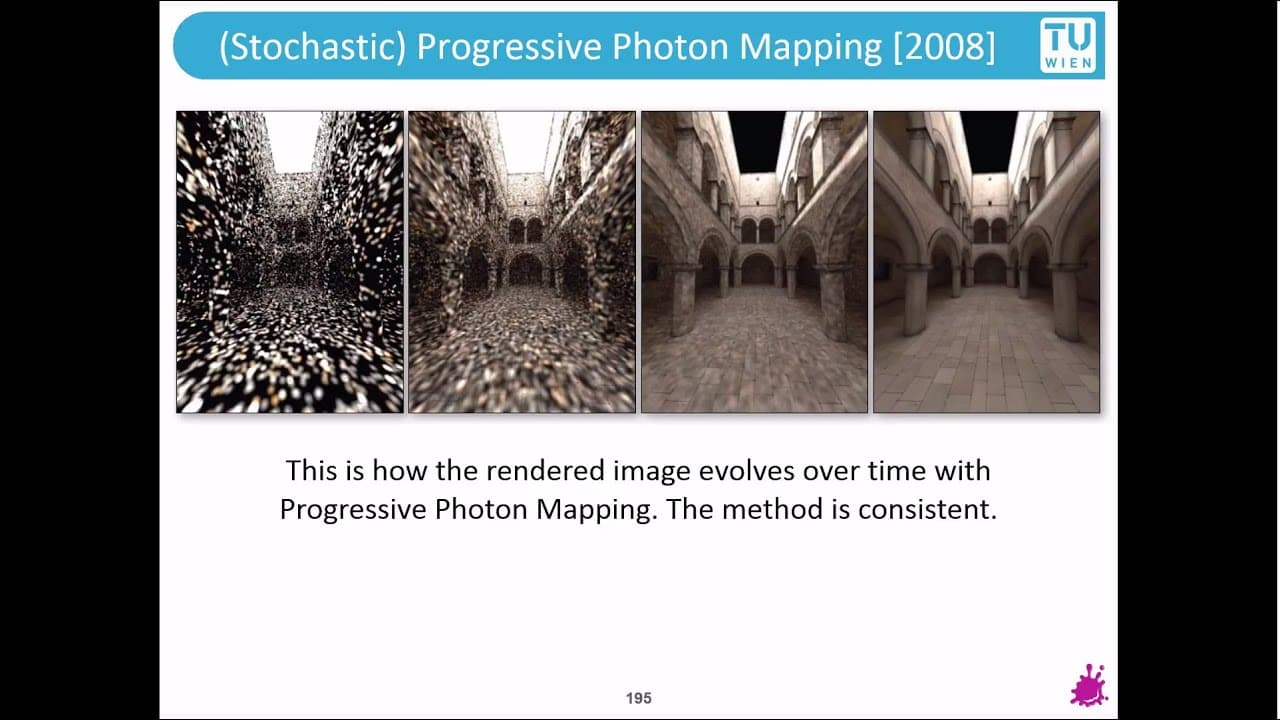
Progressive Photo Mapping (PPM) improves image consistency and sharpness in rendering through evolving photon maps over time.
Transcript
stochastic Progressive photo mapping what is this thing about well you would need an infinite amount of photons to ensure consistency you cannot do that but what you could do is that you could from time to time generate a new photo map and use that and this means discarding previous symbols and creating new ones so we start out with a regular Ray t... Read More
Key Insights
- 🍁 Progressive Photo Mapping constantly evolves photon maps for improved rendering consistency.
- ⌛ PPM enhances image sharpness by starting with larger photons that shrink over time.
- ❓ PPM offers a more efficient and consistent previewing algorithm for rendering.
- ⌛ Adjusting the starting radius in PPM is crucial for balancing image sharpness and render time.
- 🍉 PPM outperforms traditional photo mapping algorithms in terms of image quality and consistency.
- 🏛️ PPM requires more parameters to consider and is more complex to implement than classical methods.
- 🥺 Improper parameter settings in PPM can lead to over-blurred or incorrect image results.
Install to Summarize YouTube Videos and Get Transcripts
Explore YouTube Video Summarizer or Get YouTube Transcript Extractor
Questions & Answers
Q: What is Progressive Photo Mapping and how does it work?
Progressive Photo Mapping (PPM) is a rendering technique that continuously generates new photon maps to improve image consistency and sharpness over time. It starts with larger photons that evolve into smaller, more accurate representations of the scene.
Q: What are the advantages of using Progressive Photo Mapping over traditional photo mapping methods?
PPM offers improved image sharpness and consistency in rendering compared to classical algorithms. It efficiently handles SDS light paths and provides a quick preview of the scene, although with more complexity and parameters to consider.
Q: How does the starting radius affect Progressive Photo Mapping results?
Setting the starting radius too high in PPM can lead to over-blurred images, while setting it too low can result in sharper but slower renders. Finding the right balance is crucial for optimal rendering output.
Q: Who developed Progressive Photo Mapping and what makes it stand out?
Progressive Photo Mapping was developed by Toshiya Haisa and his colleagues. It stands out for its ability to efficiently render SDS light paths, improve image sharpness, and provide consistent results over time.
Summary & Key Takeaways
-
Progressive Photo Mapping (PPM) constantly generates new photon maps to improve rendering consistency.
-
PPM starts with larger photons that gradually shrink over time for sharper images.
-
PPM is a complex but efficient algorithm that outperforms traditional photo mapping methods.
Read in Other Languages (beta)
Share This Summary 📚
Summarize YouTube Videos and Get Video Transcripts with 1-Click
Try YouTube Summary with ChatGPT & Claude or YouTube Transcript Generator
Explore More Summaries from Two Minute Papers 📚


Summarize YouTube Videos and Get Video Transcripts with 1-Click
Try YouTube Summary with ChatGPT & Claude or YouTube Transcript Generator