Session 6: Estimating Hurdle Rates - Equity Risk Premiums - Historical & Survey

TL;DR
This content discusses the concept of equity risk premium and its significance in investment decisions, highlighting two methods of estimation: surveys and historical data.
Transcript
- In this, Session Six of a 36 session corporate finance class, I'd like to talk about a second input into every risk and return model in finance, which is the equity risk premium. After defining what we'd like to measure with that estimate, we're going to look at two ways in which people come up with that number. Doing a survey and looking at the ... Read More
Key Insights
- ✳️ Equity risk premium measures the additional return an investor demands for taking on average risk compared to a risk-free investment.
- ✳️ Risk aversion, influenced by individual characteristics, impacts the equity risk premium.
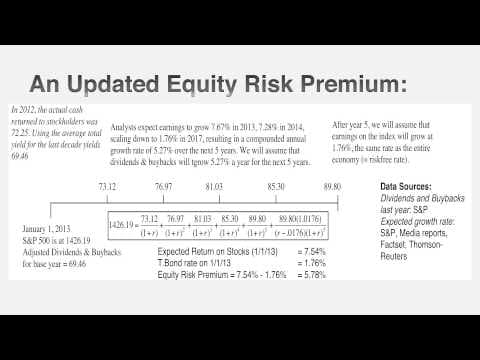
- ✳️ Estimating equity risk premiums relies on surveys and historical data, with the latter considered more widely used.
- 🍝 Surveys are subjective and influenced by past performance and reactions, while historical risk premiums come with uncertainties due to statistical estimation.
Install to Summarize YouTube Videos and Get Transcripts
Explore YouTube Video Summarizer or Get YouTube Transcript Extractor
Questions & Answers
Q: What is equity risk premium?
Equity risk premium is the extra return investors demand for taking on the average risk of an investment, relative to a risk-free rate. It accounts for the uncertainty and potential loss associated with investing in stocks or other riskier assets.
Q: How does risk aversion impact the equity risk premium?
Risk aversion, influenced by factors like age and gender, affects an individual's willingness to take on risk. Generally, higher risk aversion leads to a higher equity risk premium, as individuals demand a greater premium for investing in riskier assets.
Q: What are the different methods used to estimate equity risk premiums?
Two common methods are surveys and historical data analysis. Surveys involve asking subsets of investors about their expected returns, while historical data analysis compares the returns from stocks and risk-free investments over a specific period. Both methods have limitations, including volatility and reliance on past data.
Q: Why are historical risk premiums considered uncertain?
Historical risk premiums are statistical estimates, and therefore, subject to standard errors. The standard error indicates the range within which the true risk premium could fall. Additionally, historical data may not accurately reflect future market conditions, making predictions more challenging.
Key Insights:
- Equity risk premium measures the additional return an investor demands for taking on average risk compared to a risk-free investment.
- Risk aversion, influenced by individual characteristics, impacts the equity risk premium.
- Estimating equity risk premiums relies on surveys and historical data, with the latter considered more widely used.
- Surveys are subjective and influenced by past performance and reactions, while historical risk premiums come with uncertainties due to statistical estimation.
- Estimating equity risk premiums for markets with limited historical data requires alternative approaches, such as using default spreads and scaling for equity risk.
Summary & Key Takeaways
-
The equity risk premium is the additional return an investor demands for investing in an average risk investment compared to a risk-free rate.
-
Risk aversion and individual characteristics, such as age and gender, play a role in determining the equity risk premium.
-
Two methods of estimating equity risk premiums are surveys of investors and analyzing historical data, both of which have limitations and uncertainties.
Read in Other Languages (beta)
Share This Summary 📚
Summarize YouTube Videos and Get Video Transcripts with 1-Click
Try YouTube Summary with ChatGPT & Claude or YouTube Transcript Generator
Explore More Summaries from Aswath Damodaran 📚


Summarize YouTube Videos and Get Video Transcripts with 1-Click
Try YouTube Summary with ChatGPT & Claude or YouTube Transcript Generator