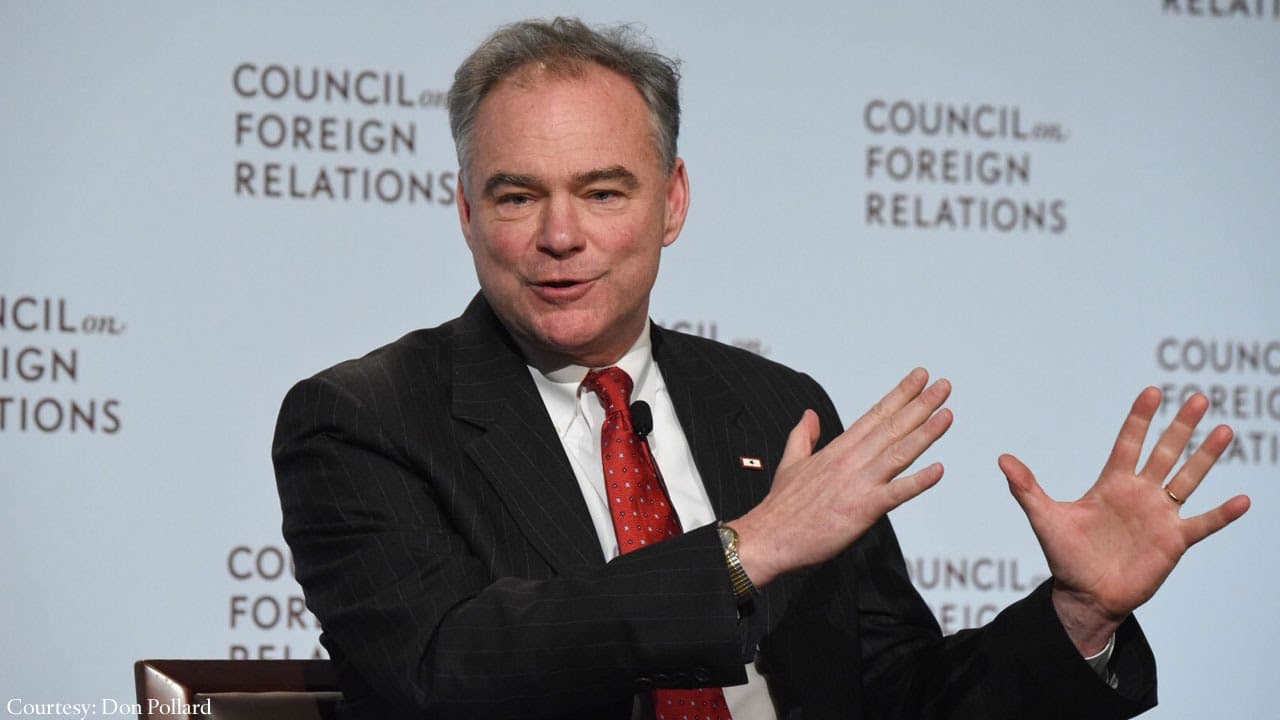
A Conversation With Tim Kaine
TL;DR
Tim Kaine discusses U.S. policy and military action in the Middle East.
Transcript
CHANG: The housekeeping notes will be done by someone else, Richard, right? RICHARD N. HAASS: It�s done. CHANG: It�s done already, OK. So welcome, and I hope you�re enjoying your lunch. Welcome to the meeting today with Tim Kaine. We�re thrilled to be here. You have his bio in front of you, so I�ll give you a brief description. One of the factoids ... Read More
Key Insights
- Tim Kaine emphasizes the constitutional importance of Congress declaring war, citing historical perspectives from Madison and Jefferson to argue against executive overreach in military matters.
- Kaine criticizes Congress for not authorizing military action against ISIS, highlighting the lack of consensus and urgency despite significant threats and attacks.
- He describes the effectiveness of coalition airstrikes in specific regions like Kurdistan and northern Syria, while acknowledging challenges in Sunni-dominated areas due to the absence of reliable ground forces.
- Kaine supports humanitarian zones in Syria, advocating for military-enforced aid delivery to prevent further refugee crises, stressing the need for international cooperation.
- He critiques the SAFE Act, which he views as unfairly labeling refugees as enemies, while Congress has hesitated to officially declare ISIS an enemy.
- Kaine discusses the delicate balance between privacy and security in cybersecurity policy, particularly concerning encryption and the ability of law enforcement to access communications.
- He acknowledges the complexities of the Iran nuclear deal, advocating for its diplomatic approach while remaining vigilant about Iran's non-nuclear aggressive behaviors.
- Kaine highlights the need for regional forces to take the lead in the fight against ISIS, emphasizing that it cannot be framed as a U.S. or Western crusade against Islam.
Install to Summarize YouTube Videos and Get Transcripts
Explore YouTube Video Summarizer or Get YouTube Transcript Extractor
Questions & Answers
Q: Why does Tim Kaine emphasize the need for Congress to declare war?
Tim Kaine emphasizes the need for Congress to declare war to uphold the constitutional balance of power between the legislative and executive branches. He cites historical figures like Madison and Jefferson, who designed the Constitution to prevent the executive from unilaterally engaging in war, a power historically reserved for monarchs. Kaine believes that requiring congressional approval ensures a democratic consensus and accountability before risking American lives.
Q: What are Tim Kaine's views on the effectiveness of coalition airstrikes against ISIS?
Tim Kaine acknowledges that coalition airstrikes have been effective in certain regions, such as Kurdistan and northern Syria, where local ground forces are capable and coordinate well with U.S. forces. However, he points out challenges in Sunni areas like Anbar Province in Iraq and parts of Syria, where finding reliable ground forces to partner with has been difficult. Kaine believes that while airstrikes are part of the right strategy, they must be complemented by strong regional ground forces.
Q: How does Tim Kaine view the SAFE Act concerning Syrian and Iraqi refugees?
Tim Kaine strongly opposes the SAFE Act, which he believes unfairly labels Syrian and Iraqi refugees as 'foreign enemies.' He argues that the act was hastily passed and contrasts Congress's willingness to target refugees with its reluctance to officially declare ISIS an enemy. Kaine highlights the rigorous vetting process refugees undergo and suggests that other visa programs, like the Visa Waiver Program, may pose greater security risks and require more scrutiny.
Q: What is Tim Kaine's stance on the Iran nuclear deal?
Tim Kaine supports the Iran nuclear deal as a critical diplomatic measure to prevent Iran from acquiring nuclear weapons. He co-authored the Iran Nuclear Review Act to ensure congressional oversight of the deal. Kaine argues that pursuing diplomacy first is essential to maintaining international credibility and providing a legal basis for military action if necessary. He acknowledges the risks but believes the deal offers an opportunity to monitor Iran's nuclear activities closely.
Q: How does Tim Kaine propose addressing cybersecurity challenges related to encryption?
Tim Kaine recognizes the complex balance between privacy and national security in cybersecurity policy. He discusses the challenge of requiring encryption technologies to have accessible pathways for law enforcement, which could also be exploited by hackers. Kaine suggests that while Congress should consider requirements for U.S. providers, they must also be cautious of driving communications to foreign providers with full encryption. He emphasizes the need for thoughtful legislation that considers both privacy rights and security needs.
Q: What role does Tim Kaine see for regional forces in the fight against ISIS?
Tim Kaine believes that regional forces must take the lead in the fight against ISIS to avoid framing the conflict as a Western crusade against Islam. He cites leaders like King Abdullah of Jordan, who assert that the battle against ISIS is primarily the region's responsibility. Kaine supports U.S. involvement in airstrikes, training, and logistics but insists that ground forces should come from regional actors to ensure long-term stability and legitimacy in the fight against extremism.
Q: What are Tim Kaine's thoughts on the U.S.-Saudi relationship concerning the fight against ISIS?
Tim Kaine acknowledges the complexities of the U.S.-Saudi relationship, noting Saudi Arabia's focus on threats from Iran-backed Houthis in Yemen while seemingly underutilizing military assets against ISIS. He criticizes the lack of Saudi and Gulf States' involvement in refugee resettlement from Syria. Kaine stresses the importance of demanding public resolve from regional partners against Sunni extremism, asserting that the region must lead the fight against ISIS while the U.S. provides support.
Q: How does Tim Kaine view the involvement of Iran in Syria and Iraq?
Tim Kaine sees Iran's involvement in Syria and Iraq as a complex issue, with Iran supporting militias that sometimes align with U.S. interests against ISIS but also contribute to regional instability. He believes the U.S. must address Iran's non-nuclear aggressive behaviors with the same seriousness as the nuclear issue. Kaine advocates for a strategic approach that supports reformers within Iran while maintaining pressure on hardliners and addressing Iran's destabilizing actions in the region.
Summary & Key Takeaways
-
Tim Kaine stresses the constitutional requirement for Congress to declare war, arguing that executive power should not unilaterally decide military action. He criticizes Congress for failing to authorize action against ISIS, despite the urgent threats posed by the group.
-
Kaine discusses the effectiveness of U.S. military strategy in the Middle East, particularly coalition airstrikes in specific regions. He advocates for humanitarian zones in Syria to address the refugee crisis and criticizes the SAFE Act for unfairly targeting refugees.
-
Kaine supports the Iran nuclear deal as a necessary diplomatic effort to prevent nuclear proliferation, while remaining vigilant about Iran's non-nuclear activities. He emphasizes the importance of regional forces leading the fight against ISIS and the need for balanced cybersecurity policies.
Read in Other Languages (beta)
Share This Summary 📚
Summarize YouTube Videos and Get Video Transcripts with 1-Click
Try YouTube Summary with ChatGPT & Claude or YouTube Transcript Generator
Explore More Summaries from Council on Foreign Relations 📚


Summarize YouTube Videos and Get Video Transcripts with 1-Click
Try YouTube Summary with ChatGPT & Claude or YouTube Transcript Generator