Difference Between Homogeneous Catalysis and Heterogeneous Catalysis - Surface Chemistry
TL;DR
Understanding the differences between homogeneous and heterogeneous catalysts and their roles in chemical reactions.
Transcript
click the bell icon to get latest videos from equator currents in the previous lecture we have understood that is what is catalyst and how does it plays a very metal rule game basically increasing the rate of reaction and now we are going to discuss about the two types of catalyst that is homogeneous and heterogeneous catalyst and now let us unders... Read More
Key Insights
- ☠️ Catalysts increase reaction rates by lowering activation energy.
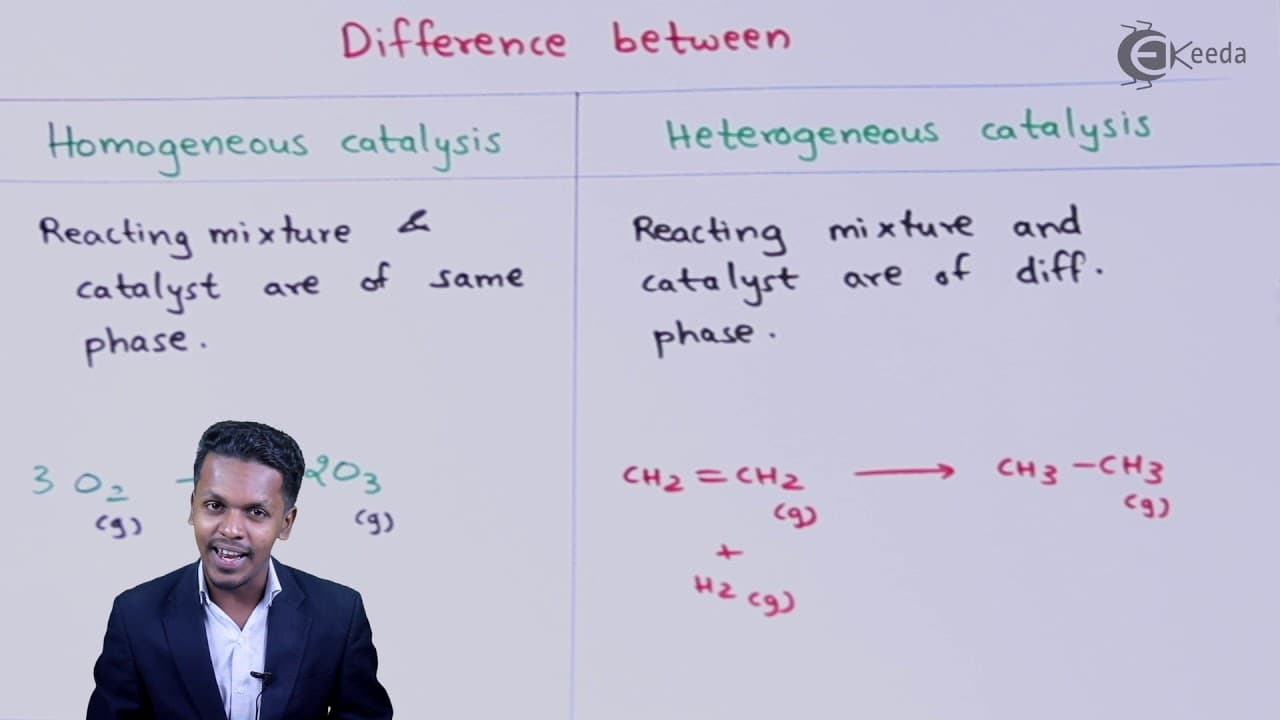
- ❓ Homogeneous catalysts are in the same phase as reactants, while heterogeneous catalysts are in a different phase.
- 💁 Examples of homogeneous catalysis include ozone formation, while heterogeneous catalysis includes alkene conversion.
- ❓ Heterogeneous catalysis reactions occur on the surface of a solid catalyst.
- 🫗 Homogeneous catalysis reactions occur in liquid or gaseous phases.
- ❓ Catalyst involvement in chemical reactions differs between homogeneous and heterogeneous catalysis.
- ❓ Separating heterogeneous catalysts from reactants is easier compared to homogeneous catalysts.
Install to Summarize YouTube Videos and Get Transcripts
Explore YouTube Video Summarizer or Get YouTube Transcript Extractor
Questions & Answers
Q: What is the main difference between homogeneous and heterogeneous catalysts?
The main difference lies in the phase relationship between the catalyst and reactants; homogeneous catalysts are in the same phase, while heterogeneous catalysts are in a different phase.
Q: How do catalysts affect reaction rates?
Catalysts increase reaction rates by providing an alternative pathway with lower activation energy.
Q: Can you provide examples of homogeneous and heterogeneous catalysis?
Homogeneous catalysis examples include ozone formation from oxygen with nitric oxide as catalyst. Heterogeneous catalysis examples include alkene to alkane conversion using platinum catalyst.
Q: Why are heterogeneous catalysts easier to separate after the reaction?
Heterogeneous catalysts are in a different phase from reactants, making their separation easier compared to homogeneous catalysts that are in the same phase.
Summary & Key Takeaways
-
Catalysts increase reaction rates.
-
Homogeneous catalysts are in the same phase as reactants.
-
Heterogeneous catalysts are in a different phase from reactants.
Read in Other Languages (beta)
Share This Summary 📚
Summarize YouTube Videos and Get Video Transcripts with 1-Click
Try YouTube Summary with ChatGPT & Claude or YouTube Transcript Generator
Explore More Summaries from Ekeeda 📚





Summarize YouTube Videos and Get Video Transcripts with 1-Click
Try YouTube Summary with ChatGPT & Claude or YouTube Transcript Generator