Solution of Higher Order Differential Equation when R H S = 0
TL;DR
Learn to solve higher order differential equations with a right-hand side of 0 step by step.
Transcript
hello students so after understanding how to find out the solution to higher order differential equation now we are going to start with the type 1 of higher order differential equation in which we will be having right hand side of the given higher order differential equation as 0 so now i'm going to teach you how to find solution of such type of eq... Read More
Key Insights
- ✋ The method for solving higher order differential equations with a right-hand side of 0 involves finding the complementary function and roots using the auxiliary equation.
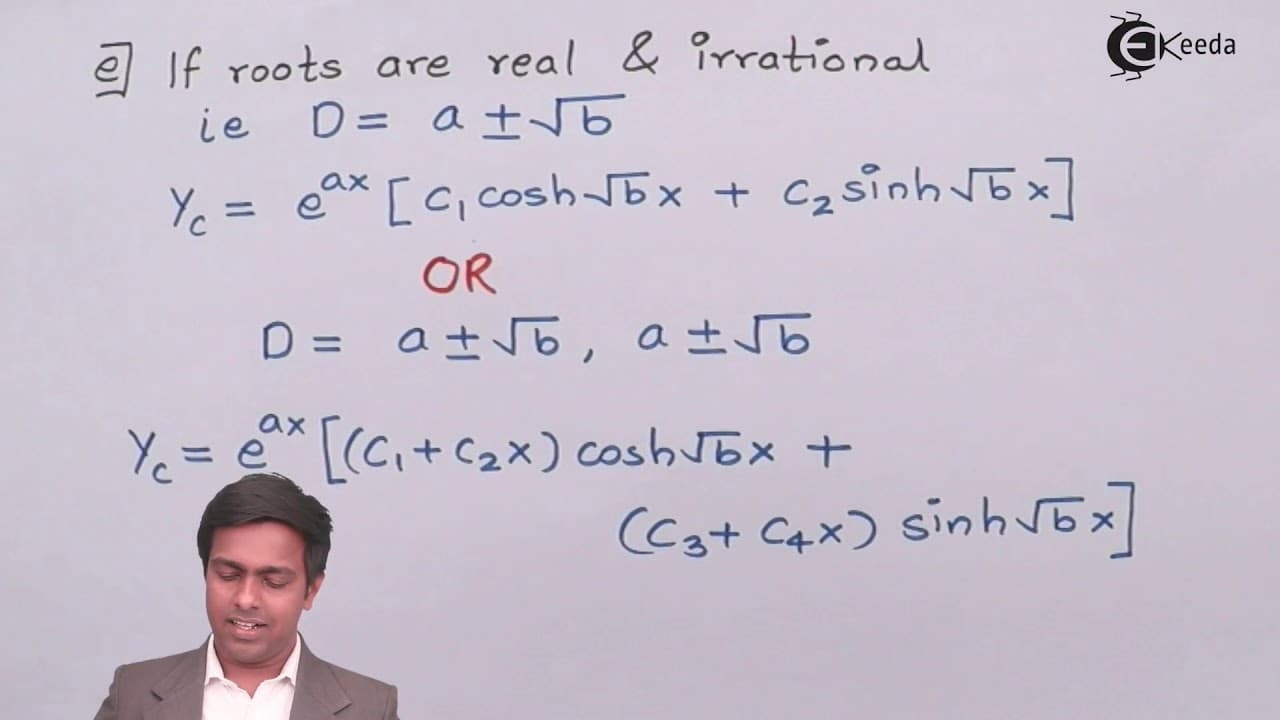
- 💁 Real and irrational roots are used to calculate the complementary function in the form of e^(ax).
- 🫱 The particular integral is determined based on the right-hand side, which is 0 in this scenario.
- 🫱 The complete solution for a differential equation with a right-hand side of 0 is the complementary function.
- ♿ Subscribing to educational channels like Ekeeda can provide access to step-by-step tutorials on solving mathematical problems.
- 🆘 Sharing educational content with friends can help spread knowledge and benefit others.
- ✋ Understanding the steps to solve higher order differential equations can improve mathematical problem-solving skills.
Install to Summarize YouTube Videos and Get Transcripts
Explore YouTube Video Summarizer or Get YouTube Transcript Extractor
Questions & Answers
Q: What is the first step in solving a higher order differential equation with a right-hand side of 0?
The first step is to find the complementary function, denoted as yc, by determining the auxiliary equation and roots obtained from the differential equation.
Q: How are the roots of the given equation used to find yc?
The real and irrational roots of the equation are used to calculate yc using the method of real and irrational roots, resulting in the form e^(ax).
Q: What is the particular integral, and how is it related to the right-hand side of the differential equation?
The particular integral, denoted as yp, is the solution corresponding to the right-hand side of the equation, which is 0 in this case, making yp 0.
Q: Why is the complementary function the complete solution for a differential equation when the right-hand side is 0?
When the right-hand side is 0, the particular integral yp is 0, leading to the final solution being equal to the complementary function yc.
Summary & Key Takeaways
-
Understand how to solve higher order differential equations with a right-hand side of 0 through step-by-step instructions.
-
Find the complementary function and particular integral to obtain the complete solution.
-
The final solution for a differential equation with a right-hand side of 0 is the complementary function.
Read in Other Languages (beta)
Share This Summary 📚
Summarize YouTube Videos and Get Video Transcripts with 1-Click
Try YouTube Summary with ChatGPT & Claude or YouTube Transcript Generator
Explore More Summaries from Ekeeda 📚






Summarize YouTube Videos and Get Video Transcripts with 1-Click
Try YouTube Summary with ChatGPT & Claude or YouTube Transcript Generator