What Are Independent and Dependent Events in Probability?
TL;DR
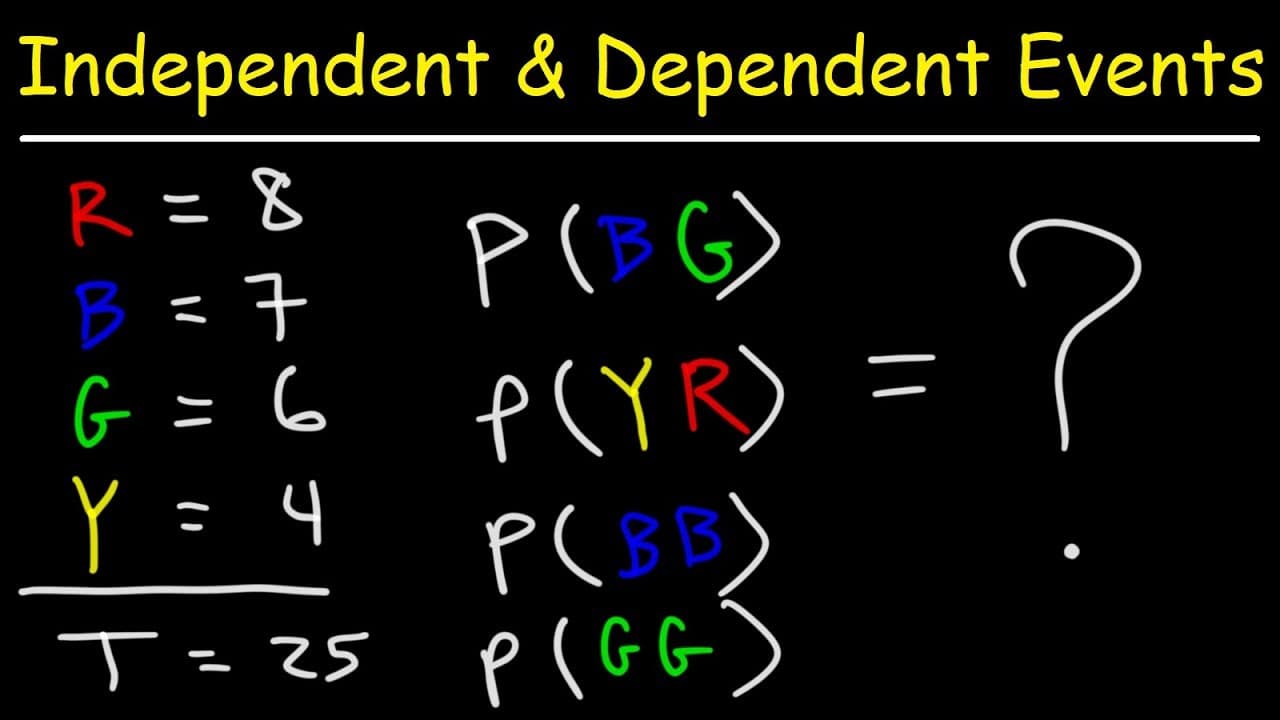
Independent events are those where the outcome of one event does not affect the outcome of another, while dependent events do rely on previous events. The probability of selecting a specific item is calculated by dividing the number of favorable outcomes by the total possible outcomes, with the inclusion or exclusion of items affecting subsequent probabilities in dependent scenarios.
Transcript
in this video we're going to talk about two types of events independent events and dependent events now you might be wondering what is the difference between it - as a name suggests independent events are events that do not depend on each other dependent events are events that do depend on each other and we're going to use this example to illustrat... Read More
Key Insights
- ❓ Independent events do not rely on each other and their probabilities can be calculated separately.
- ⏮️ Dependent events are affected by the outcome of previous events, resulting in changing probabilities.
- 🗂️ The probability of an event occurring is calculated by dividing the number of favorable outcomes by the total possible outcomes.
- #️⃣ With replacement means the number of marbles in the bag remains the same, while without replacement reduces the total number of marbles for subsequent events.
- 💱 Independent events have consistent probabilities throughout the sequence, while dependent events may have changing probabilities.
- #️⃣ The probability of selecting specific marbles can be calculated using the number of marbles of that color divided by the total number of marbles.
Install to Summarize YouTube Videos and Get Transcripts
Explore YouTube Video Summarizer or Get YouTube Transcript Extractor
Questions & Answers
Q: What is the difference between independent and dependent events?
Independent events are those that do not rely on each other, while dependent events are events that do depend on each other. In independent events, the outcome of one event does not affect the outcome of the other event, whereas in dependent events, the outcome of the first event affects the probability or outcome of the second event.
Q: How do you calculate the probability of selecting a specific colored marble?
To calculate the probability of selecting a specific colored marble, you need to calculate the number of favorable outcomes (number of marbles of the desired color) divided by the total possible outcomes (total number of marbles).
Q: What is the difference between sequential selections with replacement and without replacement?
Sequential selections with replacement means that after selecting a marble, it is put back into the bag, maintaining the original number of marbles. Sequential selections without replacement means that after selecting a marble, it is not put back into the bag, reducing the total number of marbles for the subsequent selections.
Q: How do you determine if events are independent or dependent?
In independent events, the probability or outcome of the second event does not depend on the outcome of the first event. In dependent events, the probability or outcome of the second event is affected by the outcome of the first event.
Summary & Key Takeaways
-
The video introduces the concept of independent and dependent events, where independent events do not rely on each other, while dependent events do.
-
An example with different colored marbles is used to illustrate these concepts.
-
The video covers scenarios such as calculating the probability of selecting a specific colored marble, selecting two marbles in sequence with or without replacement, and determining independent and dependent events.
Read in Other Languages (beta)
Share This Summary 📚
Summarize YouTube Videos and Get Video Transcripts with 1-Click
Try YouTube Summary with ChatGPT & Claude or YouTube Transcript Generator
Explore More Summaries from The Organic Chemistry Tutor 📚


Summarize YouTube Videos and Get Video Transcripts with 1-Click
Try YouTube Summary with ChatGPT & Claude or YouTube Transcript Generator