Representing systems of any number of equations with matrices | Precalculus | Khan Academy
TL;DR
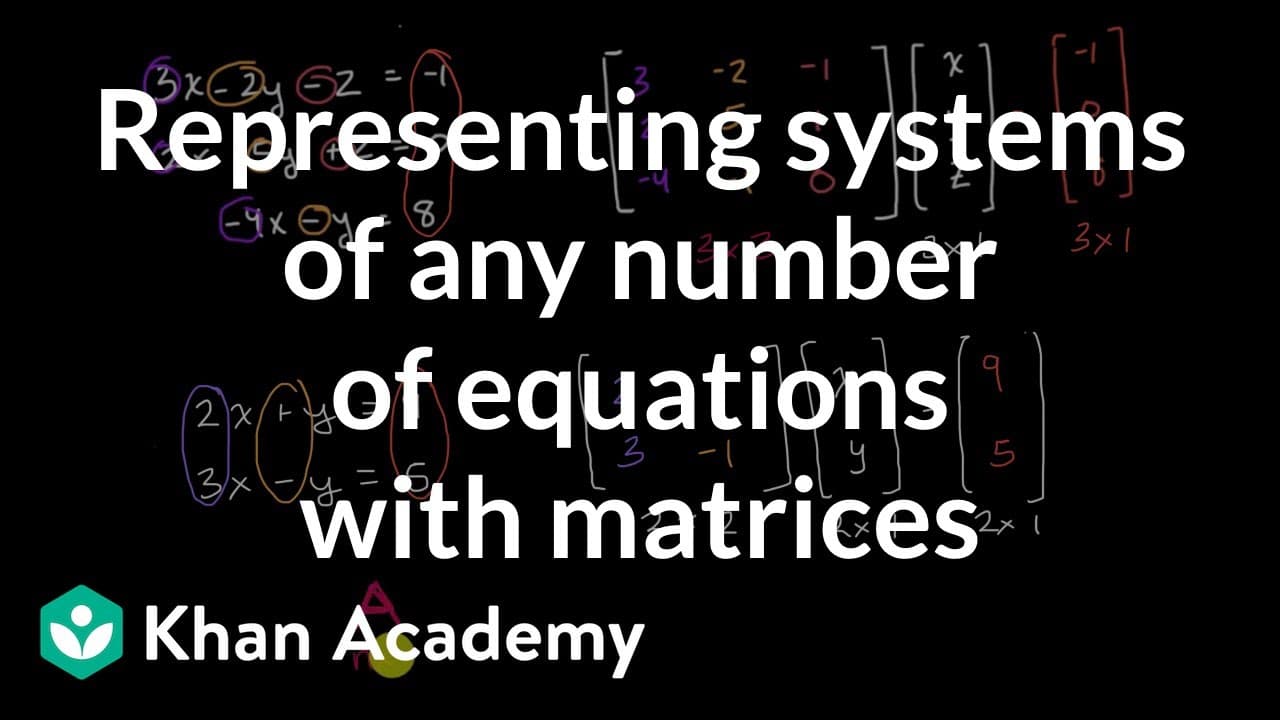
Matrix vector equations can be used to represent systems of equations with multiple unknowns, and this concept can be generalized to N equations and N unknowns.
Transcript
- [Instructor] In a previous video, we saw that if you have a system of three equations with three unknowns like this, you can represent it as a matrix vector equation, where this matrix right over here is a three-by-three matrix. That is essentially a coefficient matrix. It has all of the coefficients of the Xs, the Ys, and the Zs as its various c... Read More
Key Insights
- 👻 Matrix vector equations can represent systems of equations with multiple unknowns, allowing for efficient manipulation and solutions.
- 💁 The form of matrix vector equations can be generalized to systems of equations with any number of equations and unknowns.
- 🏑 Matrix vector equations have applications in various fields, including data science and computer graphics, where transformations of vectors are common.
- 🥺 Unraveling the transformation in matrix vector equations can lead to determining the unknown vectors and solving the system of equations.
Install to Summarize YouTube Videos and Get Transcripts
Explore YouTube Video Summarizer or Get YouTube Transcript Extractor
Questions & Answers
Q: How can matrix vector equations be used to represent systems of equations?
Matrix vector equations represent systems of equations by using a matrix to represent the coefficients of the unknown variables, a vector to represent the unknown variables, and another vector to represent the constants on the right-hand side of the equations.
Q: Can matrix vector equations be generalized to systems of equations with more than three unknowns?
Yes, matrix vector equations can be generalized to systems of equations with any number of equations and unknowns. The matrix will be an N-by-N matrix, and the vectors will be N-by-one vectors.
Q: How can matrix vector equations be useful in fields like data science and computer graphics?
Matrix vector equations are useful in these fields because they can represent transformations of vectors in N dimensions. By solving for the unknown vector, it is possible to determine the original vector that was transformed.
Q: What is the significance of unraveling the transformation in matrix vector equations?
Unraveling the transformation allows for the determination of the unknown vectors in the system of equations. This process can be applied in two dimensions, three dimensions, and even N dimensions, making it a powerful tool in solving systems of equations.
Summary & Key Takeaways
-
Matrix vector equations represent systems of equations with unknown variables as a matrix multiplied by a vector.
-
This concept can be extended to systems of equations with any number of equations and unknowns.
-
By generalizing the form of matrix vector equations, it becomes possible to solve for unknown vectors in N dimensions.
Read in Other Languages (beta)
Share This Summary 📚
Summarize YouTube Videos and Get Video Transcripts with 1-Click
Try YouTube Summary with ChatGPT & Claude or YouTube Transcript Generator
Explore More Summaries from Khan Academy 📚



Summarize YouTube Videos and Get Video Transcripts with 1-Click
Try YouTube Summary with ChatGPT & Claude or YouTube Transcript Generator