How Can Parallax Help Measure Star Distances?
TL;DR
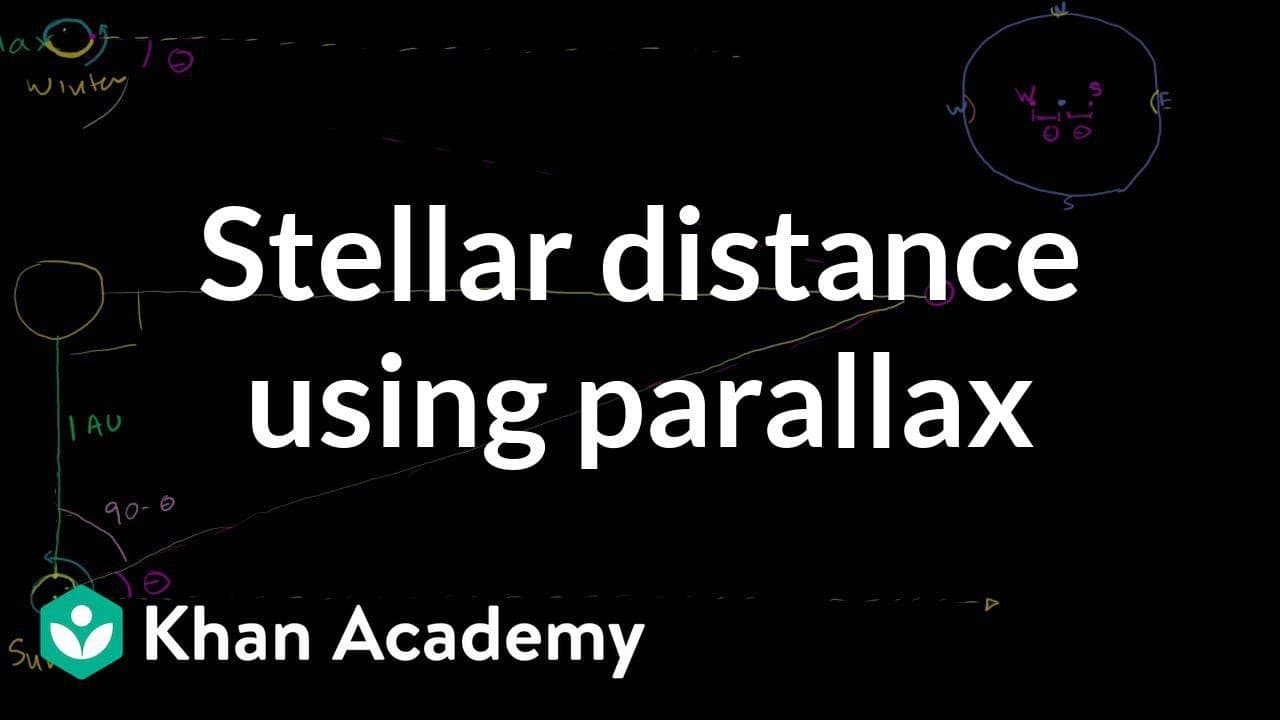
Parallax is a technique used to determine the distances of stars by observing their apparent shift in position relative to stationary objects in the night sky. By measuring the change in angle over time and applying trigonometric calculations, we can accurately calculate how far away a star is from Earth.
Transcript
In the last video, we talked about how parallax is the apparent change in position of something based on your line of sight. And if you experience parallax in your everyday life, if you look outside of the car window while it's moving, you see that nearby objects seem to be moving faster than far away objects. So in the last video, we measured the ... Read More
Key Insights
- 👾 Parallax is used to measure distances in space by observing the change in position of objects over time.
- 🥡 Trigonometry can be used to calculate distances by taking the tangent of the angle and dividing it by a known distance.
- 🔺 The angles measured in astronomy are extremely small and require precise instruments to accurately measure.
Install to Summarize YouTube Videos and Get Transcripts
Explore YouTube Video Summarizer or Get YouTube Transcript Extractor
Questions & Answers
Q: What is parallax and how is it used to measure distances in space?
Parallax is the apparent change in position of an object based on line of sight. By measuring the change in angle of a star's position over time, relative to straight up or other stationary objects, its distance can be determined using trigonometry.
Q: Can you explain how trigonometry is used to calculate the distance to a star?
Trigonometry is used to calculate the distance to a star by taking the tangent of the angle and dividing it by the distance from the sun to the Earth. This gives the distance in astronomical units, which can then be converted to light years.
Q: How small are the angles that are measured in order to calculate distances to stars?
The angles measured are extremely small. For example, in the video, the change in angle was 1.5374 arc seconds, which is a tiny fraction of a degree. As stars get further away, the angles become even smaller and more difficult to measure.
Q: What is the closest star to Earth and how far away is it?
The closest star to Earth is about 4.25 light years away. This measurement was made using trigonometry to calculate the distance based on the star's change in angle over time.
Summary & Key Takeaways
-
Parallax is the apparent change in position based on line of sight, and it can be used to measure distances in space.
-
By measuring the change in angle of a star's position over time, relative to straight up or other stationary objects in the night sky, it is possible to determine its distance.
-
Trigonometry can be used to calculate the distance by taking the tangent of the angle and dividing it by the distance from the sun to the Earth.
Read in Other Languages (beta)
Share This Summary 📚
Summarize YouTube Videos and Get Video Transcripts with 1-Click
Try YouTube Summary with ChatGPT & Claude or YouTube Transcript Generator
Explore More Summaries from Khan Academy 📚



Summarize YouTube Videos and Get Video Transcripts with 1-Click
Try YouTube Summary with ChatGPT & Claude or YouTube Transcript Generator