Unadopted amendments to the Bill of Rights | US government and civics | Khan Academy
TL;DR
The original draft of the Bill of Rights contained 12 amendments, instead of the commonly known 10. Two unadopted amendments focused on apportionment of seats in Congress and salaries for members. They failed to be ratified due to lack of interest and non-essential nature.
Transcript
- [Kim] Hi, this is Kim from Khan Academy. Did you know that what we call the First Amendment today was actually the third amendment in the original draft of the Bill of Rights? In fact, there were more than 200 proposed amendments which were whittled down to just 12. That's right, 12, not 10. So what were those two proposed amendments that weren't... Read More
Key Insights
- ❓ The original draft of the Bill of Rights contained 12 amendments, not 10.
- 🤝 The unadopted amendments dealt with Congressional apportionment and salaries.
- 🥺 Lack of interest and non-essential nature led to the failure of ratifying these two unadopted amendments.
- ❓ The Constitution historically underwent fewer amendments than in other countries due to its conservative approach.
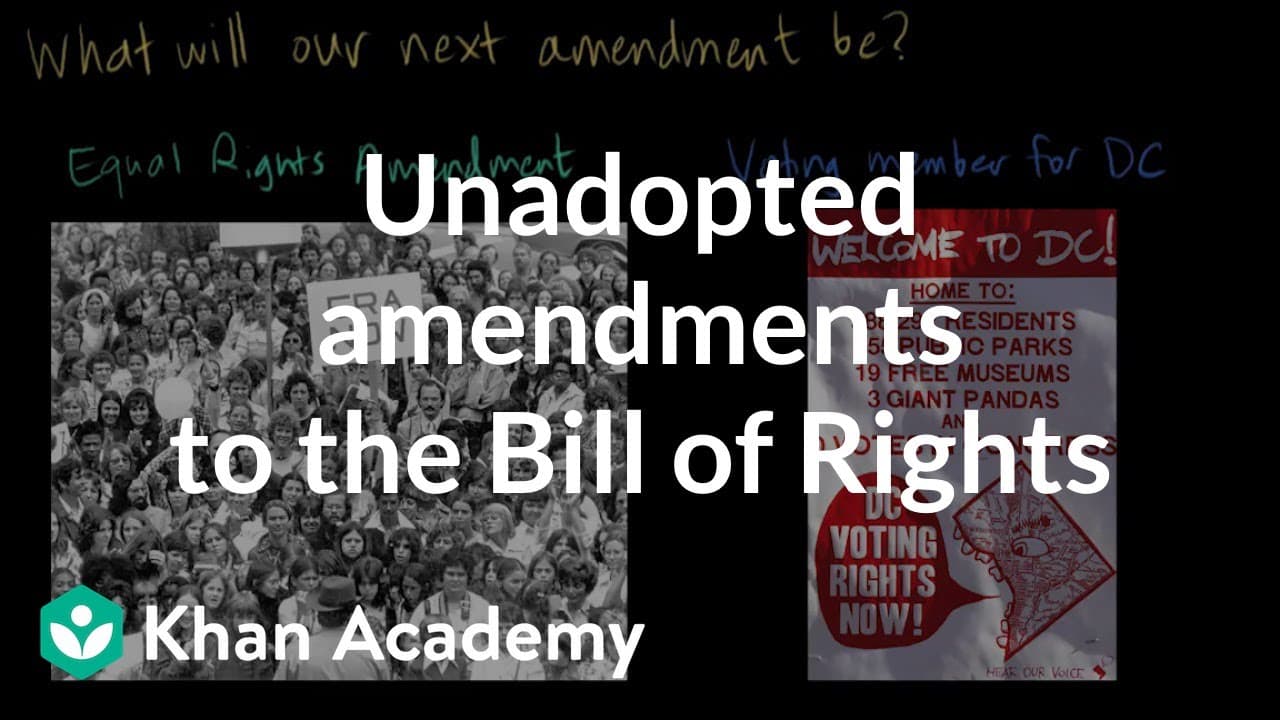
- ❓ Recent proposed amendments include the Equal Rights Amendment and representation for the District of Columbia.
- 💢 James Madison advocated for the application of the Bill of Rights to the states, which was eventually enforced through Reconstruction-era amendments.
- 🗯️ Without federal enforcement, equal rights under the law were disregarded in the 19th century.
Install to Summarize YouTube Videos and Get Transcripts
Explore YouTube Video Summarizer or Get YouTube Transcript Extractor
Questions & Answers
Q: Why were there originally 12 amendments proposed for the Bill of Rights instead of 10?
James Madison initially compressed the proposed amendments from over 200 to 12 before the First Congress. These 12 were approved, but the term "Bill of Rights" was not used for them.
Q: What were the two unadopted amendments?
One amendment addressed the apportionment of seats in Congress, and the other concerned the method of providing salaries for members of the Senate and the House of Representatives.
Q: Why did the two unadopted amendments fail to be ratified?
The apportionment amendment almost passed but fell short by one state's ratification. The salary amendment did not generate enough interest for ratification, as it was deemed uncontroversial and unnecessary for amending the Constitution.
Q: How did the amendment on Congressional salaries get ratified in 1992 despite being unnecessary?
The amendment, although unnecessary, gained attention after a student rediscovered it in the 1980s. Within a decade, all but four states ratified it, making it the 27th amendment to the Constitution.
Summary & Key Takeaways
-
The First Congress proposed over 200 amendments to the US Constitution, which were narrowed down to 12 in the original draft of the Bill of Rights.
-
These unadopted amendments focused on apportionment of seats in Congress and salaries for members.
-
The amendment regarding apportionment fell short by one state, while the other amendment lacked enough interest for ratification.
Read in Other Languages (beta)
Share This Summary 📚
Summarize YouTube Videos and Get Video Transcripts with 1-Click
Try YouTube Summary with ChatGPT & Claude or YouTube Transcript Generator
Explore More Summaries from Khan Academy 📚



Summarize YouTube Videos and Get Video Transcripts with 1-Click
Try YouTube Summary with ChatGPT & Claude or YouTube Transcript Generator