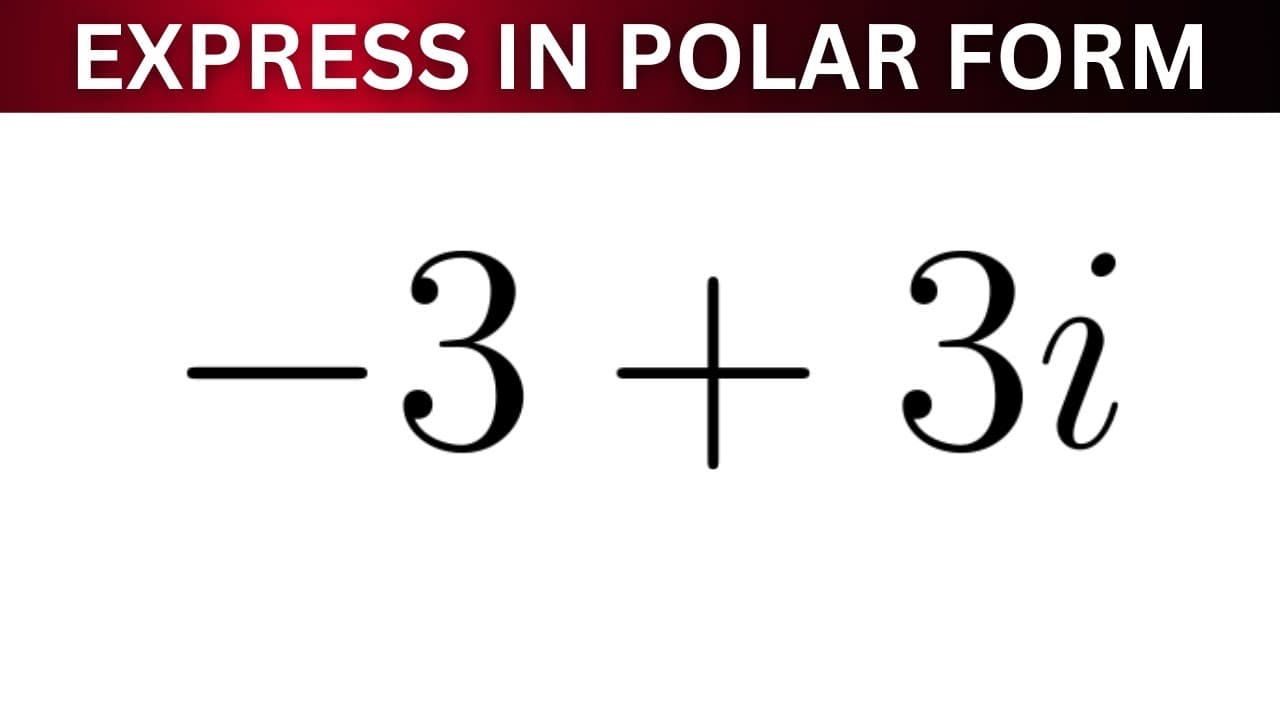
Express the Complex Number -3 + 3i in Polar Form
TL;DR
Convert complex number -3 + 3i to polar form using modulus and angle.
Transcript
hello in this video we're going to express negative 3 plus 3i in what's called Polar form let me show you how to do this solution so if you have a complex number in the form a plus bi to write it in polar form basically means you write it like this it's r arentheses cosine Theta plus I sine Theta so in this case r is the square root of a squared pl... Read More
Key Insights
- 💁 Polar form conversion involves finding the modulus and angle of a complex number.
- 💁 'r' in polar form signifies the distance of the complex number from the origin.
- 🥳 Equating real and imaginary parts helps determine the angle 'Theta' in polar form.
- 💁 Different notations like trigonometric form and exponential form can be used to express complex numbers in polar form.
- 💁 Understanding the unit circle is crucial in determining special angles for polar form conversion.
- 🔺 Less memorization is required by utilizing basic formulas for modulus and angle calculations.
- 🥳 Distributing the modulus helps in equating real and imaginary parts efficiently.
Install to Summarize YouTube Videos and Get Transcripts
Explore YouTube Video Summarizer or Get YouTube Transcript Extractor
Questions & Answers
Q: How do you convert a complex number to polar form?
To convert a complex number to polar form, calculate the modulus 'r' using the formula sqrt(a^2 + b^2) and find the angle 'Theta' by equating real and imaginary parts.
Q: What is the significance of 'r' in polar form?
'r' represents the modulus of the complex number, indicating its distance from the origin in the complex plane.
Q: How do you find the angle 'Theta' in polar form conversion?
The angle 'Theta' can be determined by setting the real and imaginary parts of the complex number equal to the corresponding parts in the polar form equation.
Q: What are the multiple ways to express a complex number in polar form?
A complex number in polar form can be written in trigonometric form, using CIS notation, or as an exponential form with Euler's formula.
Summary & Key Takeaways
-
Complex numbers can be converted to polar form using modulus and angle formulas.
-
The modulus 'r' is the distance of the complex number from the origin in the complex plane.
-
The angle 'Theta' can be determined by equating real and imaginary parts of the complex number.
Read in Other Languages (beta)
Share This Summary 📚
Summarize YouTube Videos and Get Video Transcripts with 1-Click
Try YouTube Summary with ChatGPT & Claude or YouTube Transcript Generator
Explore More Summaries from The Math Sorcerer 📚


Summarize YouTube Videos and Get Video Transcripts with 1-Click
Try YouTube Summary with ChatGPT & Claude or YouTube Transcript Generator