Unitary and Orthogonal Matrices
TL;DR
Explaining the concepts of unitary and orthogonal matrices with key mathematical operations and properties.
Transcript
click the Bell icon to get latest videos from akira hello friends in this particular chapter I gain values and eigenvectors we are going to focus on what are the unitary matrix and what are the orthogonal matrix so let us talk about the same so you need unitary matrix is nothing but if we take any matrix a and its complex conjugate that is a theta ... Read More
Key Insights
- ❓ Unitary matrices have specific properties where their products have unique relationships with the identity matrix.
- ❓ Finding the inverse of a unitary matrix is simplified by considering its conjugate transpose.
- 📁 Orthogonal matrices have properties related to the direct transpose of the matrix.
- ❓ Singular matrices do not meet the criteria for being orthogonal matrices.
- 🖐️ Determinants play a crucial role in distinguishing properties of unitary and orthogonal matrices.
- 🤩 Understanding the key operations and conditions for unitary and orthogonal matrices is essential in linear algebra.
- 🏑 The mathematical definitions and properties of unitary and orthogonal matrices have practical applications in various fields.
Install to Summarize YouTube Videos and Get Transcripts
Explore YouTube Video Summarizer or Get YouTube Transcript Extractor
Questions & Answers
Q: What are the defining properties of a unitary matrix?
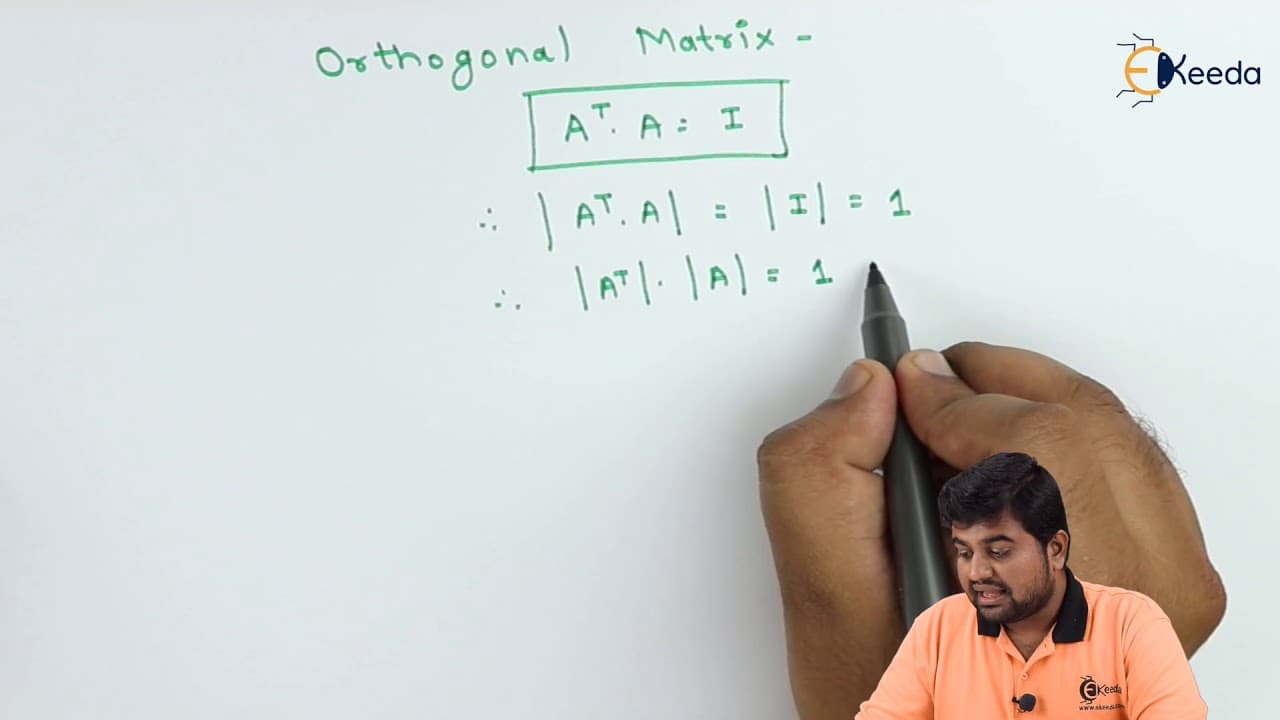
A unitary matrix satisfies the condition that its product with its conjugate transpose equals the identity matrix, with the determinant not being zero, indicating its special properties.
Q: How is the inverse of a unitary matrix calculated?
The inverse of a unitary matrix is simply its conjugate transpose, making it easy to find without complex operations, simplifying the process.
Q: What distinguishes an orthogonal matrix from other matrices?
An orthogonal matrix is one where the product of the matrix with its transpose equals the identity matrix, with the determinant not being zero, defining its unique properties.
Q: Why are singular matrices not considered orthogonal matrices?
Singular matrices have a determinant of zero, which violates the property required for an orthogonal matrix where the determinant should not be zero, distinguishing the two types.
Summary & Key Takeaways
-
Unitary matrices are those for which the product of the matrix and its conjugate transpose equals the identity matrix.
-
The determinant of a unitary matrix should not be zero, indicating its properties.
-
Orthogonal matrices have a similar concept but involve the direct transpose of the matrix with certain properties.
Read in Other Languages (beta)
Share This Summary 📚
Summarize YouTube Videos and Get Video Transcripts with 1-Click
Try YouTube Summary with ChatGPT & Claude or YouTube Transcript Generator
Explore More Summaries from Ekeeda 📚


Summarize YouTube Videos and Get Video Transcripts with 1-Click
Try YouTube Summary with ChatGPT & Claude or YouTube Transcript Generator