Unit vectors | Matrix transformations | Linear Algebra | Khan Academy
TL;DR
Unit vectors are vectors with a length of 1, and they are useful for transformations and projections in vector spaces.
Transcript
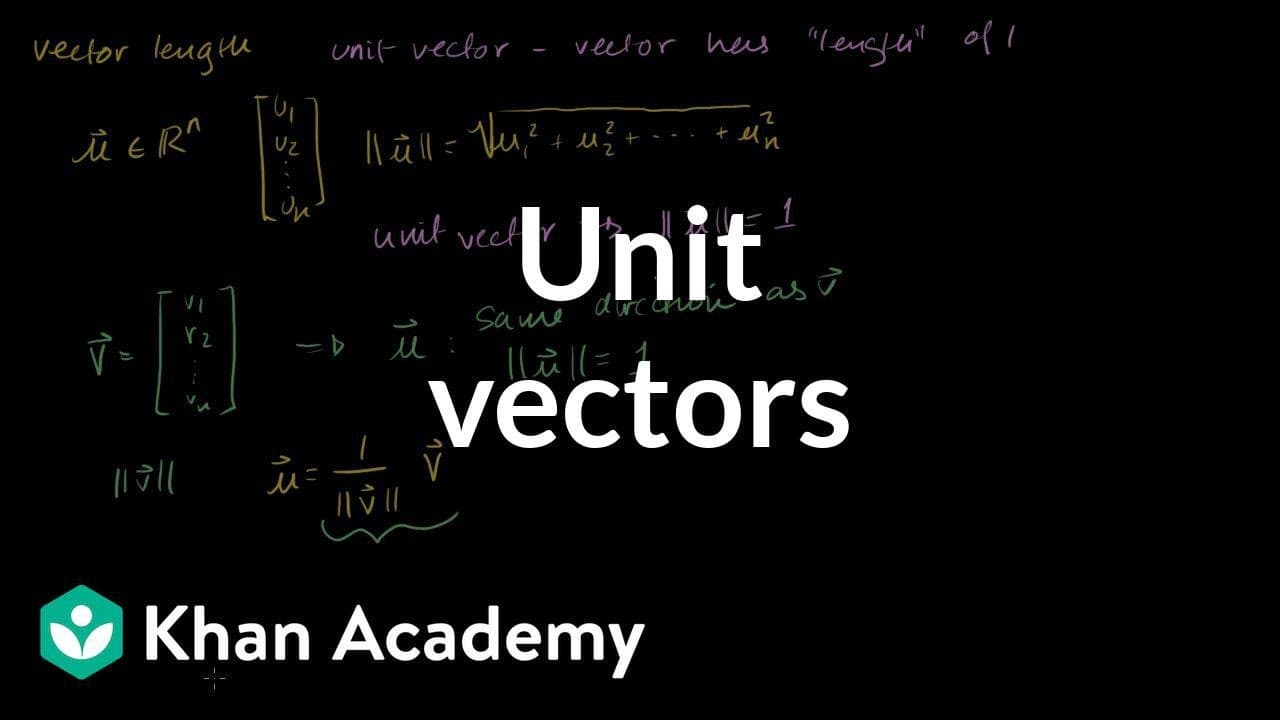
We covered the idea of vector length many, many videos ago. And I realize that I forgot to cover an important topic. This topic's going to be useful when we do some types of transformation -- actually, the projections that I'll do in the next video. The notion that I forgot to do is the notion of a unit vector. And all this is, is a vector that has... Read More
Key Insights
- 👾 A unit vector has a length of 1 and is used to represent direction in vector spaces.
- 🇦🇪 The length of a unit vector is determined using the Pythagorean theorem.
- 👷 To construct a unit vector, divide a given vector by its length.
- 🤠 Unit vectors are often represented with a hat symbol to indicate their normalized length.
- 👾 Unit vectors are commonly used in transformations and projections in vector spaces.
- 🎃 In R3, the vectors i, j, and k are unit vectors and serve as the basis vectors.
- 🇦🇪 The standard basis vectors in R3 are equivalent to the unit vectors e1, e2, and e3.
Install to Summarize YouTube Videos and Get Transcripts
Explore YouTube Video Summarizer or Get YouTube Transcript Extractor
Questions & Answers
Q: What is a unit vector?
A unit vector is a vector with a length of 1, and it is used to represent direction in vector spaces. It is calculated by dividing a given vector by its length.
Q: How is the length of a unit vector determined?
The length of a unit vector is always equal to 1, regardless of the dimension space it belongs to. The length is calculated using the Pythagorean theorem.
Q: How do you construct a unit vector?
To construct a unit vector that goes in the same direction as a given vector, divide the vector by its length. This will normalize the vector and make its length equal to 1.
Q: What is the significance of the hat symbol on a unit vector?
The hat symbol on a vector indicates that it is a unit vector. It distinguishes it from other vectors and indicates that its length is 1.
Summary & Key Takeaways
-
A unit vector is a vector with a length of 1 in any dimension space, and its length is calculated using the Pythagorean theorem.
-
To construct a unit vector that goes in the same direction as a given vector, divide the vector by its length.
-
The length of a unit vector is always equal to 1.
-
Unit vectors are often represented with a hat symbol on top of the vector.
Read in Other Languages (beta)
Share This Summary 📚
Summarize YouTube Videos and Get Video Transcripts with 1-Click
Try YouTube Summary with ChatGPT & Claude or YouTube Transcript Generator
Explore More Summaries from Khan Academy 📚



Summarize YouTube Videos and Get Video Transcripts with 1-Click
Try YouTube Summary with ChatGPT & Claude or YouTube Transcript Generator