How to Calculate Surface Area of Revolution in Calculus
TL;DR
To calculate the surface area of a solid formed by rotating a curve around an axis, use the formula S = 2π∫(a to b) r(x)√(1 + f'(x)^2)dx. For example, rotating y = x^3 from 0 to 2 around the x-axis yields a surface area of approximately 203.14.
Transcript
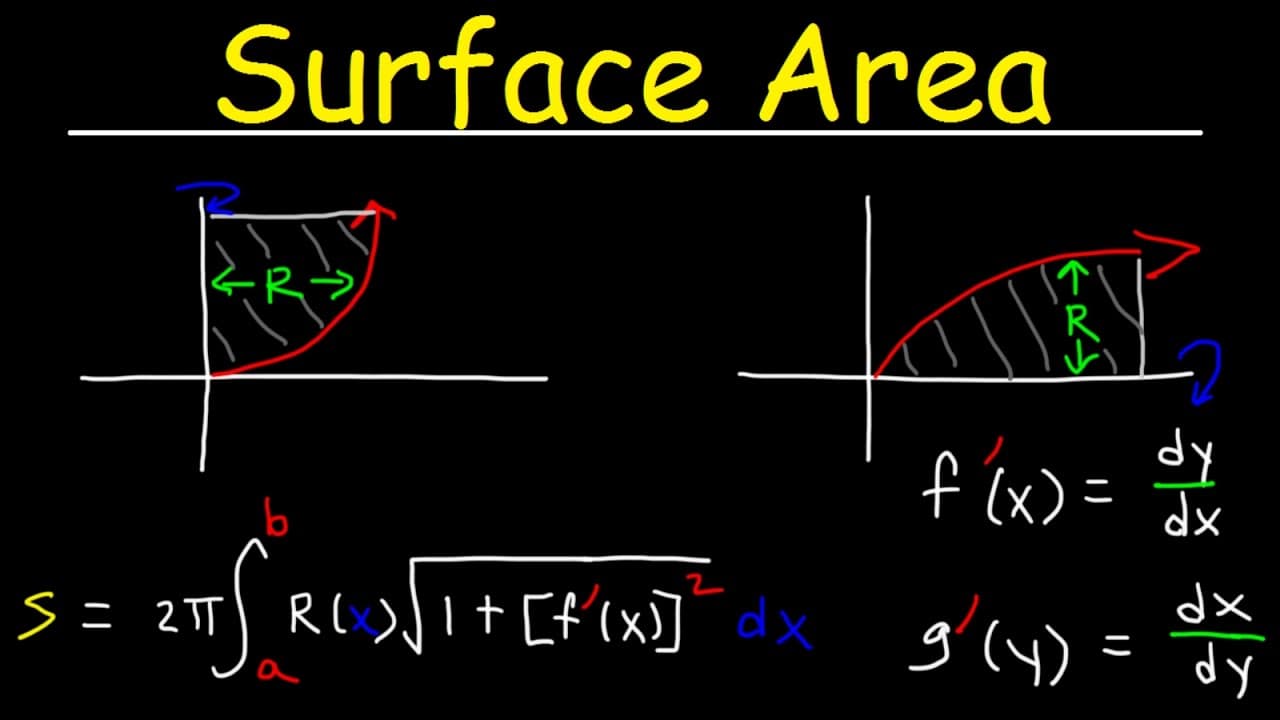
now in this video we're going to talk about how to calculate the surface area of a solid when rotating the curve about let's say the x-axis or even the y-axis so here's the formula the surface area is equal to 2 pi integration from a to b times the radius in terms of x multiplied by the square root of 1 plus f prime of x squared times dx so that's ... Read More
Key Insights
- ❎ The surface area of a solid can be calculated by integrating the product of the radius function and the square root of the sum of one and the square of the derivative of the curve.
- ☺️ When rotating a curve around an axis, the radius is equal to the distance between the curve and the axis of rotation, and it depends on whether the rotation is in terms of x or y.
- 😄 The integration process can be simplified using techniques such as u-substitution.
- 💱 It is important to correctly change the limits of integration when converting between x and y values.
Install to Summarize YouTube Videos and Get Transcripts
Explore YouTube Video Summarizer or Get YouTube Transcript Extractor
Questions & Answers
Q: What formula is used to calculate the surface area of a solid formed by rotating a curve around an axis?
The formula is S = 2π∫(a to b) r(x)√(1 + f'(x)^2)dx, where S is the surface area, r(x) is the radius of the curve, and f'(x) is the derivative of the curve.
Q: How can you determine the radius of the curve when rotating around the x-axis or y-axis?
The radius of the curve is equal to the distance between the curve and the axis of rotation. If the rotation is around the x-axis, the radius is parallel to the y-axis and equal to y. If the rotation is around the y-axis, the radius is parallel to the x-axis and equal to x.
Q: What technique can be used to integrate the expression for surface area?
The best technique for integration is u-substitution. By setting u equal to a suitable expression within the integral, it becomes possible to simplify the integration process.
Q: How do you change the limits of integration when converting from x to y values or vice versa?
To change the limits of integration, substitute the original x or y values into the respective conversion equation to find the new values. This ensures that the integration accounts for the correct range of the curve.
Key Insights:
- The surface area of a solid can be calculated by integrating the product of the radius function and the square root of the sum of one and the square of the derivative of the curve.
- When rotating a curve around an axis, the radius is equal to the distance between the curve and the axis of rotation, and it depends on whether the rotation is in terms of x or y.
- The integration process can be simplified using techniques such as u-substitution.
- It is important to correctly change the limits of integration when converting between x and y values.
- The final step is to evaluate the integral and obtain the surface area of the solid.
Summary & Key Takeaways
-
To calculate the surface area of a solid formed by rotating a curve around the x-axis or y-axis, use the formula S = 2π∫(a to b) r(x)√(1 + f'(x)^2)dx.
-
Example 1: Given y = x^3, rotate the curve around the x-axis from x = 0 to x = 2. The surface area is approximately 203.14.
-
Example 2: Given y = √(4-x^2), rotate the curve around the x-axis from x = -1 to x = 1. The surface area is approximately 25.13.
-
Example 3: Given x = (1/3)y^2 + 2^(3/2), rotate the curve around the x-axis from y = 1 to y = 2. The surface area is 21π/2.
Read in Other Languages (beta)
Share This Summary 📚
Summarize YouTube Videos and Get Video Transcripts with 1-Click
Try YouTube Summary with ChatGPT & Claude or YouTube Transcript Generator
Explore More Summaries from The Organic Chemistry Tutor 📚

Summarize YouTube Videos and Get Video Transcripts with 1-Click
Try YouTube Summary with ChatGPT & Claude or YouTube Transcript Generator