Products
Features
YouTube Video Summarizer
Summarize YouTube videos
Web & PDF Highlighter
Highlight web pages & PDFs
Chat with PDF
Ask any PDF questions with AI
Ask AI Clone
Chat with your highlights & memories
Audio Transcriber
Transcribe audio files to text
Glasp Reader
Read and highlight articles
Kindle Highlight Export
Export your Kindle highlights
Idea Hatch
Hatch ideas from your highlights
Integrations
Obsidian Plugin
Notion Integration
Pocket Integration
Instapaper Integration
Medium Integration
Readwise Integration
Snipd Integration
Hypothesis Integration
Apps & Extensions
Chrome Extension
Safari Extension
Edge Add-ons
Firefox Add-ons
iOS App
Android App
Discover
Discover
Ideas
Discover new ideas and insights
Articles
Curated articles and insights
Books
Book recommendations by great minds
Posts
Essays and notes from readers
Quotes
Inspiring quotes collection
Videos
Curated videos and summaries
Explore Glasp
Glasp Newsletter
Weekly insights and updates
Glasp Talk
Interview series with great minds
Glasp Blog
Latest news and articles
Glasp Use Cases
Learn how others use Glasp
Build & Support
Glasp API
Access Glasp's API for developers
MCP Connector
Connect Glasp to Claude & ChatGPT
Community
Glasp Reddit Community
Students
Student discount and benefits
FAQs
Frequently Asked Questions
AboutPricing
DashboardLog inSign up

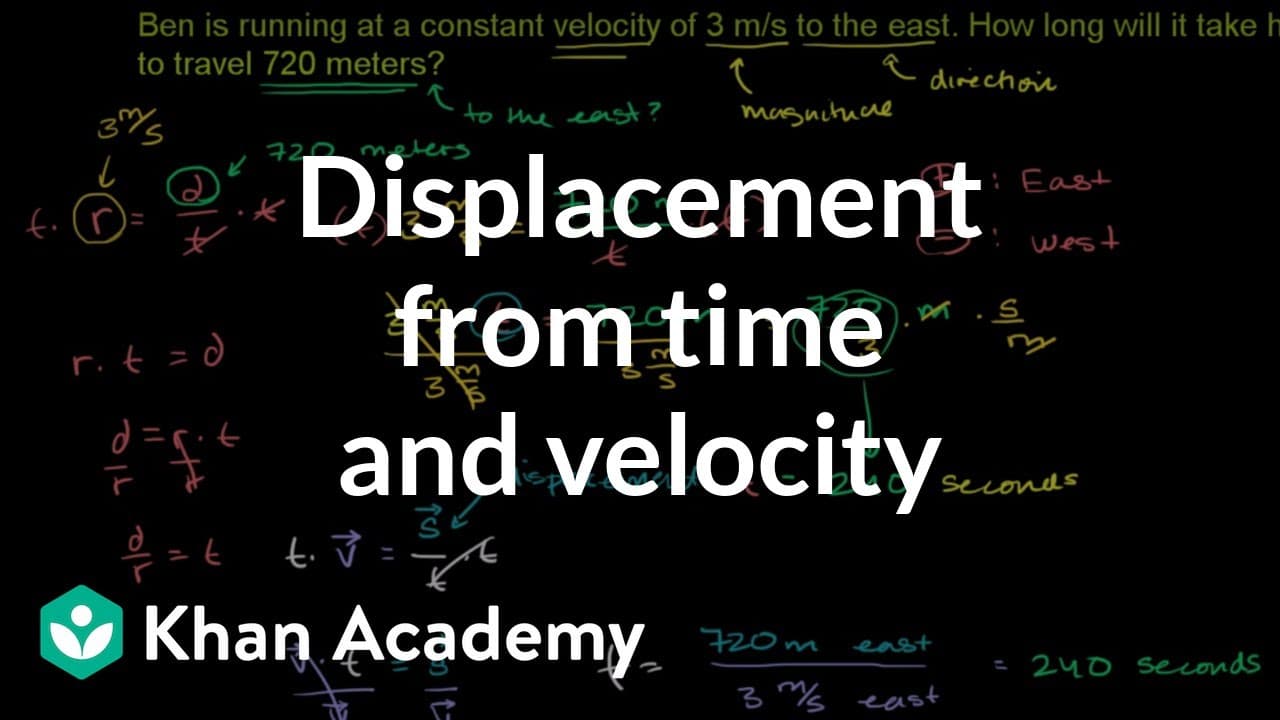
Displacement from time and velocity example | One-dimensional motion | Physics | Khan Academy
June 11, 2011
by
Khan Academy
YouTube video player
Displacement from time and velocity example | One-dimensional motion | Physics | Khan Academy

TL;DR

Marcia travels south for 1 minute at 5 meters per second. Her displacement is 300 meters south.

Transcript

Let's do one more example dealing with displacement, velocity, and time. So we have if Marcia travels for 1 minute at 5 meters per second to the south, how much will she be displaced? Let me do it this way. We know that velocity is equal to displacement divided by time. And it's really, once again, it is change in time. But we'll just say time. Tha... Read More

Key Insights

  • 🧘 Displacement is the change in position, taking into account both magnitude and direction.
  • ⌛ Velocity is calculated by dividing displacement by time.
  • ⌛ Time and velocity are inversely proportional in displacement calculations.
  • 🤪 Displacement values can be negative if the motion goes against the chosen positive direction.
  • 🧘 Displacement represents the change in position, whereas distance is the total length traveled.
  • ⌛ Units of velocity and time need to be consistent for accurate displacement calculations.
  • 😑 Displacement can be expressed as distance with a specific direction.

Install to Summarize YouTube Videos and Get Transcripts

Explore YouTube Video Summarizer or Get YouTube Transcript Extractor

Questions & Answers

Q: How is displacement calculated?

Displacement is calculated by multiplying velocity by time. It represents the change in position, taking into account both magnitude and direction.

Q: What units are used for velocity and time in displacement calculations?

Velocity is typically measured in meters per second, and time is measured in seconds. Both units need to be consistent for accurate displacement calculations.

Q: If a person travels north, will the displacement be negative?

Yes, displacement can be negative if the motion is in the opposite direction of the chosen positive direction. In this case, traveling north would result in a negative displacement value.

Q: How is displacement different from distance?

Displacement considers the change in position from the starting point to the endpoint, whereas distance is the total length traveled regardless of direction.

Summary & Key Takeaways

  • Marcia travels south for 1 minute at a velocity of 5 meters per second.

  • Displacement is calculated by multiplying velocity by time.

  • Marcia's displacement is 300 meters south.


Read in Other Languages (beta)

English

Share This Summary 📚

Summarize YouTube Videos and Get Video Transcripts with 1-Click

Download browser extensions on:

Try YouTube Summary with ChatGPT & Claude or YouTube Transcript Generator

Explore More Summaries from Khan Academy 📚

Classical Japan during the Heian Period | World History | Khan Academy thumbnail
Classical Japan during the Heian Period | World History | Khan Academy
Khan Academy
Breakthrough Junior Challenge Winner Reveal! Homeroom with Sal - Thursday, December 3 thumbnail
Breakthrough Junior Challenge Winner Reveal! Homeroom with Sal - Thursday, December 3
Khan Academy
Interview with Karina Murtagh thumbnail
Interview with Karina Murtagh
Khan Academy

Summarize YouTube Videos and Get Video Transcripts with 1-Click

Download browser extensions on:

Try YouTube Summary with ChatGPT & Claude or YouTube Transcript Generator

Apps & Extensions

  • Chrome Extension
  • Safari Extension
  • Edge Add-ons
  • Firefox Add-ons
  • iOS App
  • Android App

Key Features

  • YouTube Video Summarizer
  • Web & PDF Summarizer
  • Web & PDF Highlighter
  • Chat with PDF
  • Ask AI Clone
  • Audio Transcriber
  • Glasp Reader
  • Kindle Highlight Export
  • Idea Hatch

Integrations

  • Obsidian Plugin
  • Notion Integration
  • Pocket Integration
  • Instapaper Integration
  • Medium Integration
  • Readwise Integration
  • Snipd Integration
  • Hypothesis Integration

More Features

  • APIs
  • MCP Connector
  • Blog & Post
  • Embed Links
  • Image Highlight
  • Personality Test
  • Quote Shots

Company

  • About us
  • Blog
  • Community
  • FAQs
  • Job Board
  • Newsletter
  • Pricing
Terms

•

Privacy

•

Guidelines

© 2026 Glasp Inc. All rights reserved.

