Linear transformation examples: Rotations in R2 | Linear Algebra | Khan Academy
TL;DR
This video explains the concept of linear transformations and specifically focuses on rotations in a two-dimensional space.
Transcript
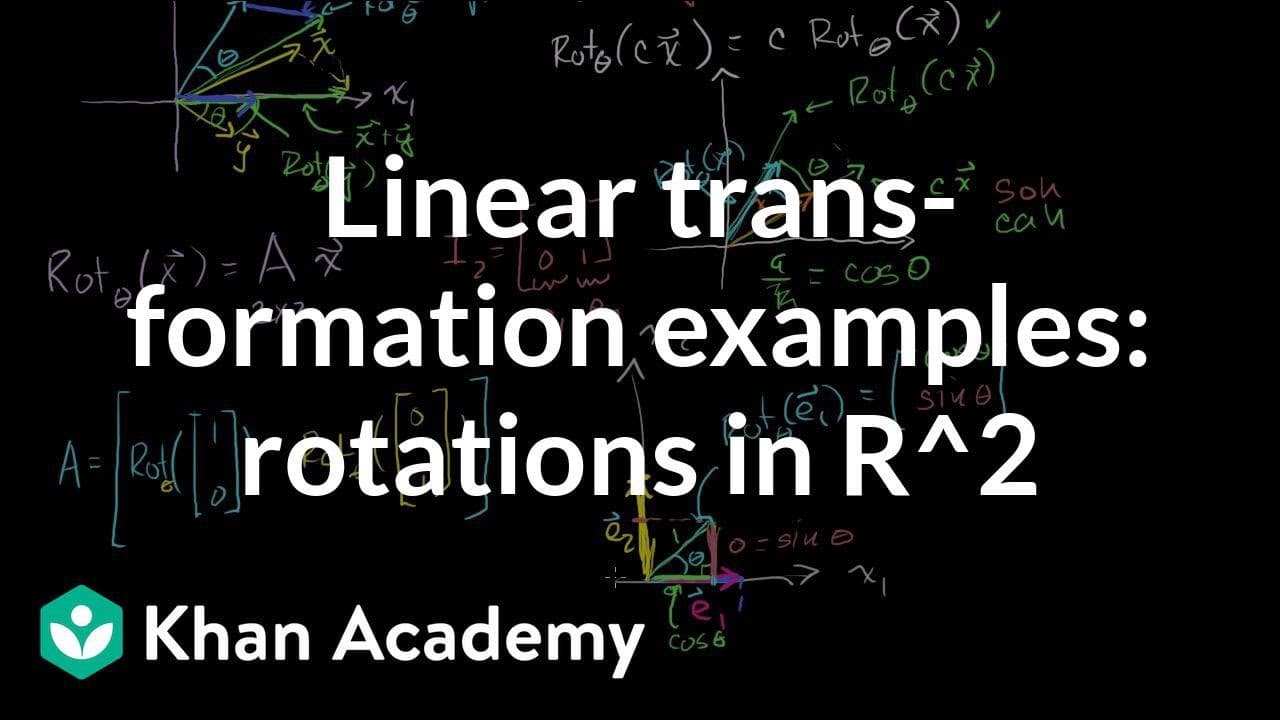
Let's see if we can create a linear transformation that is a rotation transformation through some angle theta. And what it does is, it takes any vector in R2 and it maps it to a rotated version of that vector. Or another way of saying it, is that the rotation of some vector x is going to be equal to a counterclockwise theta degree rotation of x. So... Read More
Key Insights
- 🛟 Linear transformations preserve vector addition and scalar multiplication.
- 👾 The rotation transformation in a two-dimensional space can be described by a 2x2 matrix.
- 👨💼 The rotation matrix is determined by evaluating the cosine and sine of the rotation angle.
- 👻 The matrix representation of the rotation transformation allows for easy application to position vectors and rotation of objects.
- 👾 Linear transformations have various applications, such as computer graphics and game development.
- ❓ Three-dimensional rotations can be approached using similar principles, with considerations for additional axes.
Install to Summarize YouTube Videos and Get Transcripts
Explore YouTube Video Summarizer or Get YouTube Transcript Extractor
Questions & Answers
Q: What is a linear transformation?
A linear transformation is a mapping that preserves vector addition and scalar multiplication, resulting in a rotated version of the original vector.
Q: What conditions need to be met for a transformation to be considered linear?
Two conditions must be satisfied: the transformation of the sum of two vectors should be equal to the sum of their individual transformations, and the transformation of a scaled-up vector should be equal to a corresponding scaled-up version of the transformed vector.
Q: How can the rotation transformation be represented by a matrix?
The rotation transformation in a two-dimensional space can be represented by a 2x2 matrix with elements equal to the cosine and sine of the rotation angle, along with their negations.
Q: How can the matrix representation of the rotation transformation be used to rotate vectors?
By multiplying a position vector by the rotation matrix, the vector can be transformed and rotated by the specified angle.
Summary & Key Takeaways
-
The video introduces the concept of a linear transformation that performs rotational mapping on vectors in a two-dimensional space.
-
It explains the conditions that need to be met for a transformation to be considered linear, including the preservation of vector addition and scalar multiplication.
-
The video demonstrates visually how the rotation transformation can be applied to vectors and explores the mathematical definition of the transformation using a 2x2 matrix.
Read in Other Languages (beta)
Share This Summary 📚
Summarize YouTube Videos and Get Video Transcripts with 1-Click
Try YouTube Summary with ChatGPT & Claude or YouTube Transcript Generator
Explore More Summaries from Khan Academy 📚



Summarize YouTube Videos and Get Video Transcripts with 1-Click
Try YouTube Summary with ChatGPT & Claude or YouTube Transcript Generator