Find the Velocity, Speed, and Acceleration Given the Vector Valued Position Function
TL;DR
Derive velocity, speed, and acceleration functions using position functions in a step-by-step manner.
Transcript
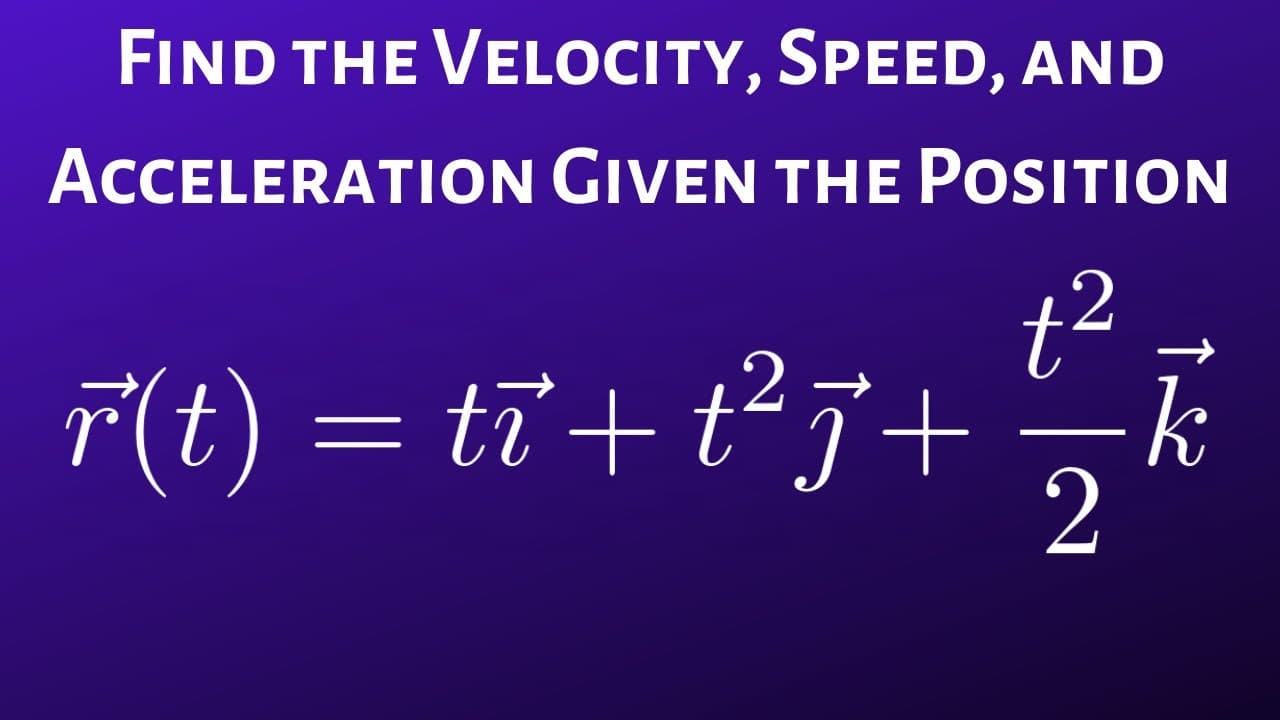
in this problem we're given the position function and we have to find the velocity function v the speed function and the acceleration function let's go ahead and work through it so solution so to find the velocity function all we have to do is take the derivative of position so the velocity v of t is equal to the derivative of r so taking the deriv... Read More
Key Insights
- 🧘 Velocity is obtained by differentiating the position function.
- 🐎 Speed is the magnitude of velocity, calculated using squared components.
- ☠️ Acceleration is the rate of change of velocity, derived from the velocity function.
- ❓ The differentiation process is crucial in finding velocity and acceleration.
- 🧘 Understanding the relationship between position, velocity, and acceleration is vital for kinematics.
- 🐎 Speed reflects how quickly an object is moving in a specific direction.
- ⌛ Acceleration indicates changes in velocity over time, whether in magnitude or direction.
Install to Summarize YouTube Videos and Get Transcripts
Explore YouTube Video Summarizer or Get YouTube Transcript Extractor
Questions & Answers
Q: How is velocity calculated from the position function?
Velocity is found by taking the derivative of the position function, yielding the vector-valued function for velocity.
Q: What is the formula for calculating speed?
Speed is obtained by taking the magnitude of the velocity vector, involving squaring and summing the components before taking the square root.
Q: How is acceleration related to velocity?
Acceleration is the derivative of velocity, representing the rate of change of velocity over time, with each component differentiated accordingly.
Q: Can you explain the step-by-step process of finding acceleration from the velocity function?
Acceleration is derived by differentiating each component of velocity, resulting in the acceleration vector-valued function representing the acceleration at any given time.
Summary & Key Takeaways
-
Derive velocity by taking the derivative of position.
-
Calculate speed as the magnitude of velocity.
-
Determine acceleration by differentiating velocity.
Read in Other Languages (beta)
Share This Summary 📚
Summarize YouTube Videos and Get Video Transcripts with 1-Click
Try YouTube Summary with ChatGPT & Claude or YouTube Transcript Generator
Explore More Summaries from The Math Sorcerer 📚

Summarize YouTube Videos and Get Video Transcripts with 1-Click
Try YouTube Summary with ChatGPT & Claude or YouTube Transcript Generator