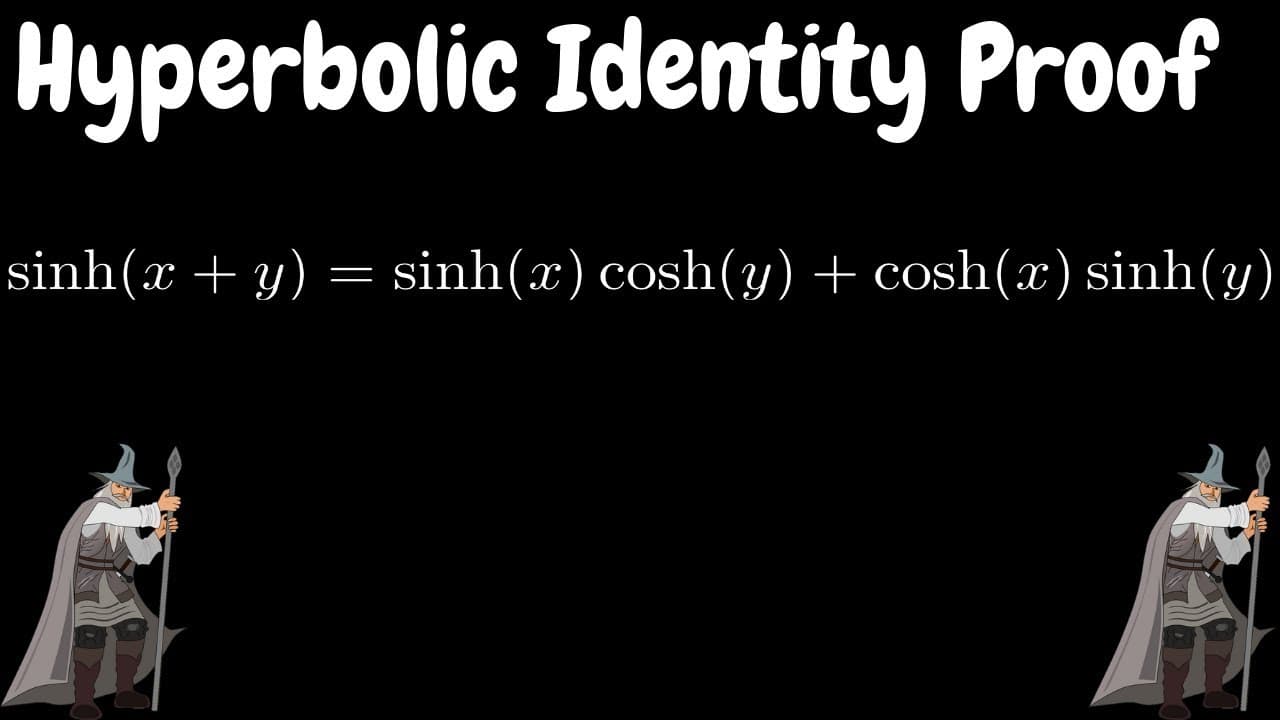
How to Prove the Identity for sinh(x + y)
TL;DR
To prove the identity sinh(x + y) = sinh(x)cosh(y) + cosh(x)sinh(y), start by rewriting the more complex right-hand side using definitions of hyperbolic functions. Through algebraic manipulations and cancellations, you will arrive at the left-hand side, confirming the identity.
Transcript
hi YouTube in this video we're going to prove this hyperbolic identity so proof so we have to pick a side to start with and then show it's equal to the other side so let's start with the right-hand side because it looks more complicated so I'll go ahead and rewrite the right-hand side so we have Cinch of X cosine y plus cosine X times the Cinch of ... Read More
Key Insights
- 👨💼 The proof starts by rewriting the more complicated side of the equation using the definitions of hyperbolic sine and cosine.
- 🍉 Distributing and multiplying the terms allows for simplification, combining like terms, and cancellations.
- 😑 The cancellation of terms leads to the desired expression for the hyperbolic sine function.
- ❓ This algebraic proof provides a clear demonstration of the identity's validity and strengthens understanding of hyperbolic functions.
- 🫵 The step-by-step approach in the video makes the proof accessible and understandable for viewers.
- 🖐️ Algebraic manipulation and properties play a crucial role in the proof, emphasizing their importance in mathematical analyses.
- 🎮 The video highlights the connection between exponential functions and hyperbolic functions.
Install to Summarize YouTube Videos and Get Transcripts
Explore YouTube Video Summarizer or Get YouTube Transcript Extractor
Questions & Answers
Q: What is the initial approach in proving the hyperbolic identity in this video?
The initial approach in the video is to start with the more complex right-hand side of the equation and rewrite it using the definitions of hyperbolic sine and cosine.
Q: How is the goal of the proof defined in this video?
The goal of the proof is to make the right-hand side of the equation equal to a specific expression, which is e^(X+Y) - e^(-X+Y) / 2.
Q: What are the steps involved in proving the hyperbolic identity?
The proof involves multiplying the terms in parentheses, distributing and simplifying the resulting expressions. Like terms are combined, and cancellations occur, leading to the final result.
Q: How is the final result of the proof related to the hyperbolic sine function?
The final result, which is e^(X+Y) - e^(-X+Y) / 2, matches the expression for the hyperbolic sine function, Cinh(X+Y). Therefore, the proof demonstrates the validity of the hyperbolic identity.
Summary & Key Takeaways
-
The video explains the process of proving a hyperbolic identity by starting with the more complicated side and rewriting it using the definitions of hyperbolic sine and cosine.
-
The goal of the proof is to make the right-hand side of the equation equal to a specific expression, which is achieved through algebraic manipulations and distribution of terms.
-
Cancelling out like terms and simplifying leads to the final result, which matches the desired expression, proving the hyperbolic identity.
Read in Other Languages (beta)
Share This Summary 📚
Summarize YouTube Videos and Get Video Transcripts with 1-Click
Try YouTube Summary with ChatGPT & Claude or YouTube Transcript Generator
Explore More Summaries from The Math Sorcerer 📚


Summarize YouTube Videos and Get Video Transcripts with 1-Click
Try YouTube Summary with ChatGPT & Claude or YouTube Transcript Generator