How to Evaluate Inverse Hyperbolic Functions Easily
TL;DR
To evaluate inverse hyperbolic functions like the inverse hyperbolic cosine of one, use the formula which yields zero. For the inverse hyperbolic sine of one, apply its formula resulting in approximately 0.88137. Each function has a specific formula and domain that should be understood for accurate calculation.
Transcript
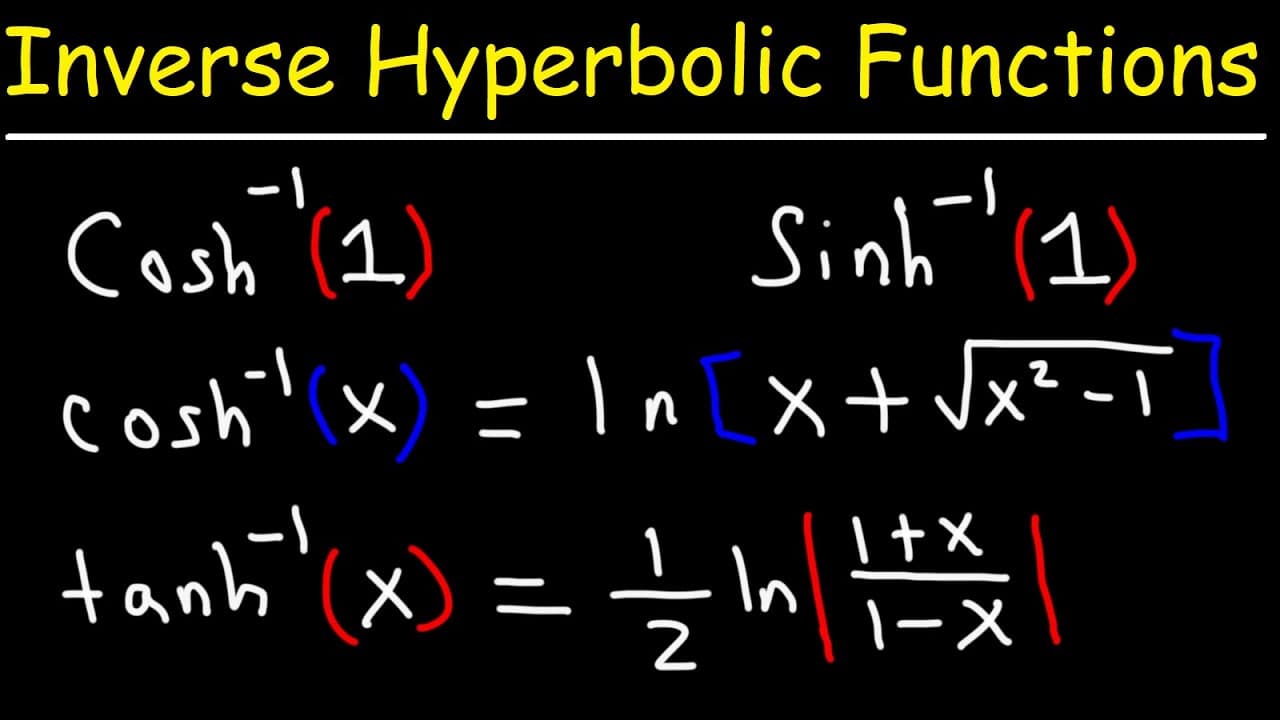
how would you evaluate this expression the inverse of the hyperbolic cosine of one what is that equal to now when dealing with inverse functions X and Y are switched so what we have is the Y value and what we're looking for is the x value in other words hyperbolic cosine of what number is one that's what we're looking for so how do we figure this o... Read More
Key Insights
- 0️⃣ The inverse hyperbolic cosine function of one is zero.
- ☺️ The formula for the inverse hyperbolic cosine function is the natural log of x plus the square root of x squared minus one.
- ➕ The inverse hyperbolic sine function has a similar formula to the cosine function but with a plus sign instead of a minus sign.
- ❓ The formulas for the inverse hyperbolic tangent, cotangent, secant, and cosecant functions are also provided.
- 🧡 Each inverse hyperbolic function has its own domain and range restrictions.
- 🗯️ Using the corresponding exponential function, you can confirm if you have the right answer for the inverse hyperbolic functions.
- 🧑🎓 The inverse hyperbolic functions have specific formulas and domains that students should be familiar with.
Install to Summarize YouTube Videos and Get Transcripts
Explore YouTube Video Summarizer or Get YouTube Transcript Extractor
Questions & Answers
Q: How do you evaluate the inverse hyperbolic cosine function of one?
To evaluate the inverse hyperbolic cosine function of one, you can either intuitively recognize that the answer is zero or use the formula: natural log of x plus the square root of x squared minus one. Plugging in one, the answer comes out as zero.
Q: What is the formula for the inverse hyperbolic sine function?
The formula for the inverse hyperbolic sine function is the natural log of x plus the square root of x squared plus one. Plug in the value of one and you get the exact answer as the natural log of one plus the square root of two.
Q: How can you confirm if you have the right answer for the inverse hyperbolic sine function?
You can confirm if you have the right answer for the inverse hyperbolic sine function by using the exponential function of hyperbolic sine: e^(x) - e^(-x) over 2. Plug in the calculated value and check if it gives a result close to one.
Q: What are the formulas for the inverse hyperbolic tangent, cotangent, secant, and cosecant functions?
The formula for the inverse hyperbolic tangent function is one-half natural log of 1 plus x over 1 minus x. The inverse hyperbolic cotangent function has a similar formula with the terms switched. The inverse hyperbolic secant function uses the formula natural log of 1 plus the square root of 1 minus x squared divided by x. Finally, the inverse hyperbolic cosecant function uses a fraction with x and the absolute value of x in the numerator and denominator.
Summary & Key Takeaways
-
The video discusses evaluating the inverse hyperbolic cosine function of one, explaining that the answer is zero.
-
It also explains the formula for the inverse hyperbolic cosine function and how to use it to confirm the answer.
-
The content then moves on to evaluating the inverse hyperbolic sine function of one, providing the formula and explaining how to calculate the answer.
Read in Other Languages (beta)
Share This Summary 📚
Summarize YouTube Videos and Get Video Transcripts with 1-Click
Try YouTube Summary with ChatGPT & Claude or YouTube Transcript Generator
Explore More Summaries from The Organic Chemistry Tutor 📚



Summarize YouTube Videos and Get Video Transcripts with 1-Click
Try YouTube Summary with ChatGPT & Claude or YouTube Transcript Generator