Everything you should know about TRAPPIST-1 exoplanets
TL;DR
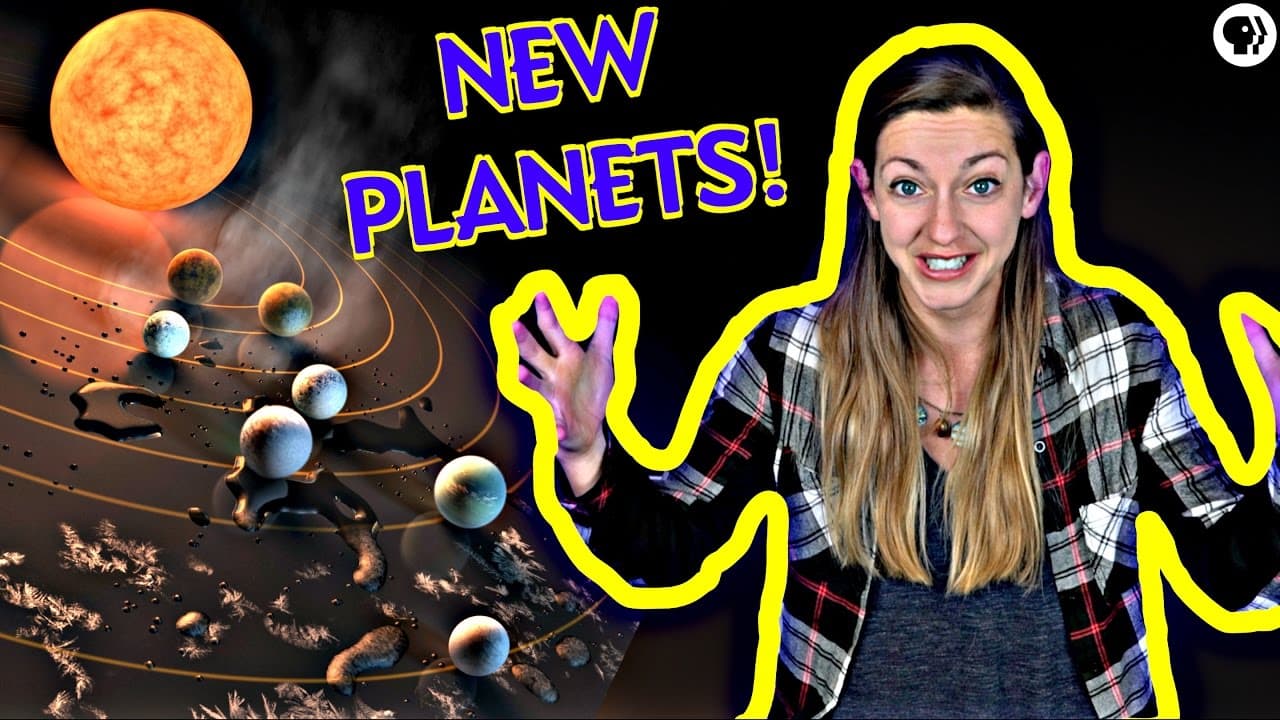
New planetary system called Trappist-1 discovered with seven earth-like planets, some possibly habitable.
Transcript
[MUSIC PLAYING] Hey there, I'm Diana. And you're watching "Physics Girl." Last week, NASA made this big announcement about a new planetary system we found with a star called Trappist-1, seven earth-like planets. [SINGS ANGELICALLY] It's 39 light years away. But that would still take some millions of years to get to, with current technology. So tou... Read More
Key Insights
- 👨🔬 The discovery of seven earth-sized planets in the Trappist-1 system is a significant finding in the search for habitable exoplanets.
- 💦 The proximity of the Trappist-1 system to Earth and the possibility of liquid water make it an exciting target for future exploration.
- 💁 The study of planetary systems, including Trappist-1, provides insights into the formation and evolution of planets and the potential for life beyond Earth.
- 💁 The next steps in studying the Trappist-1 system involve characterizing the atmospheres and composition of the planets, which can provide valuable information about their suitability for life.
- 🖐️ The development of new telescopes, such as the James Webb Space Telescope, will play a crucial role in advancing our understanding of exoplanets and their potential habitability.
- 🧑🏭 The study of exoplanets is complex due to factors like tidal locking and interactions between planets within the system.
- 👨🔬 Research efforts are ongoing to determine if the Trappist-1 system is unique or if similar systems with earth-sized planets are more common in the universe.
Install to Summarize YouTube Videos and Get Transcripts
Explore YouTube Video Summarizer or Get YouTube Transcript Extractor
Questions & Answers
Q: How did scientists discover the Trappist-1 system?
The discovery was made through the observation of transits, where planets pass in front of their star, causing a slight dip in light intensity.
Q: What makes the Trappist-1 system unique?
The system is unique because all seven planets are earth-sized, which is rare compared to the larger gas giants typically discovered. Additionally, the system is relatively close to Earth.
Q: How do scientists determine if a planet in the Trappist-1 system is habitable?
Scientists study the composition and atmospheres of the planets by analyzing the absorption of light as it passes through their atmospheres. This can give insights into the presence of molecules, including those necessary for life.
Q: Can life exist on these planets?
While it is still uncertain, the potential habitability of three planets in the Trappist-1 system, due to their distance from the star and the possibility of liquid water, makes them intriguing candidates for further study.
Summary & Key Takeaways
-
The Trappist-1 system, located 39 light years away, is home to seven earth-sized planets, three of which are potentially habitable.
-
The discovery was made through the observation of transits, where planets pass in front of their star, blocking a small amount of light.
-
Astronomers are now focused on studying the composition and atmospheres of these planets to determine their potential for supporting life.
Read in Other Languages (beta)
Share This Summary 📚
Summarize YouTube Videos and Get Video Transcripts with 1-Click
Try YouTube Summary with ChatGPT & Claude or YouTube Transcript Generator
Explore More Summaries from Physics Girl 📚






Summarize YouTube Videos and Get Video Transcripts with 1-Click
Try YouTube Summary with ChatGPT & Claude or YouTube Transcript Generator