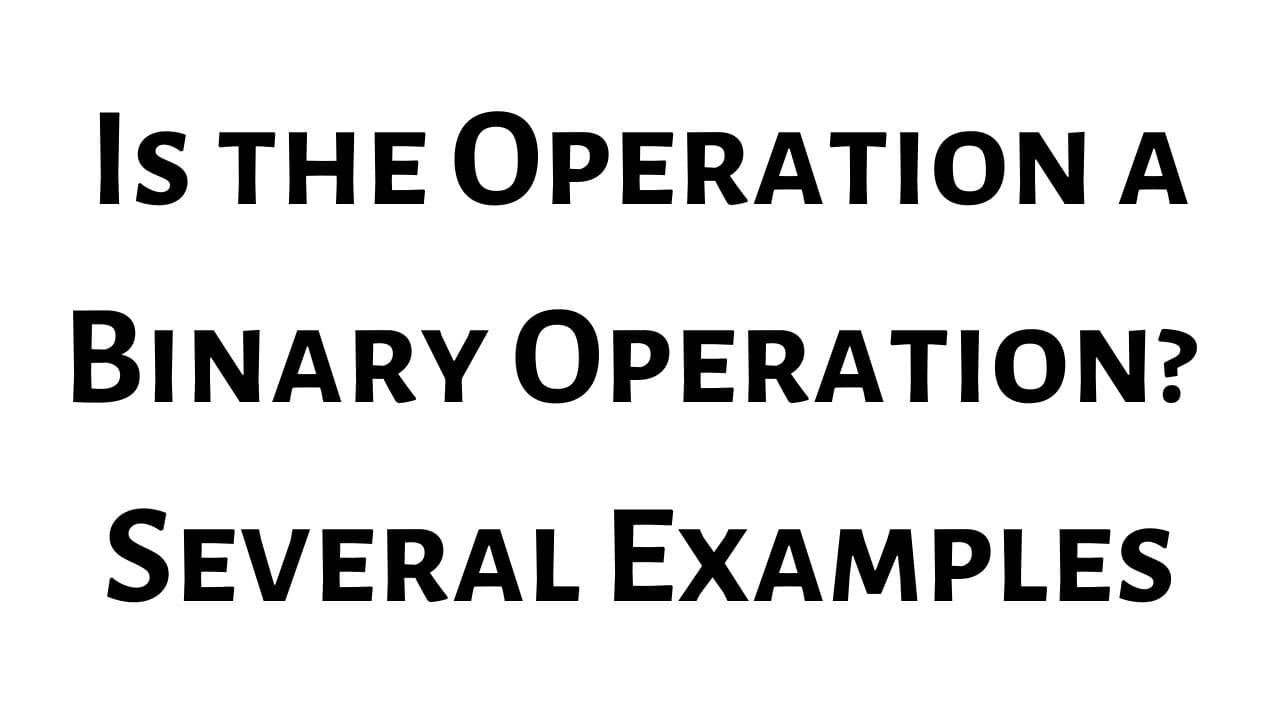
What Is a Binary Operation and How to Identify One?
TL;DR
A binary operation is defined as an operation on a set where applying it to any two elements yields another element within that set. To determine if an operation is binary, check for any failing example; if even one pair does not produce an element in the set, it is not a binary operation.
Transcript
hi everyone in this video we're going to talk about binary operations so we have several examples that we're going to do so a binary operation is an operation on a set such that given two elements in the set when you apply the operation you get an element in the set so in each example here the operation has the name star so for example let's do the... Read More
Key Insights
- 😫 Binary operations involve applying an operation on two elements in a set to get another element in the set.
- ✖️ Multiplication and addition on real numbers are binary operations.
- ❓ Subtraction on positive integers is not a binary operation.
- ➗ Division on positive integers is not a binary operation.
- ✖️ Multiplication on integers is a binary operation.
- ❓ Understanding binary operations is crucial in various mathematical concepts.
- 👍 Finding examples where binary operations fail is essential to prove its nature.
Install to Summarize YouTube Videos and Get Transcripts
Explore YouTube Video Summarizer or Get YouTube Transcript Extractor
Questions & Answers
Q: What is a binary operation?
A binary operation on a set is an operation where applying it to any two elements in the set results in another element in the set. It is denoted as a * b = c.
Q: How do you determine if an operation is binary?
To determine if an operation is binary, you need to show that it holds true for all elements in the set. If you find one example where it fails, then it is not a binary operation.
Q: Can a binary operation give a result outside of the set?
No, a binary operation should always produce an element within the set. If it generates an element outside of the set, then it is not a binary operation.
Q: What are some common examples of binary operations?
Common examples of binary operations include addition, subtraction, multiplication, and division on various sets such as real numbers, integers, positive integers, and complex numbers.
Summary & Key Takeaways
-
Binary operations are operations on a set where applying the operation to two elements in the set results in another element in the set.
-
Examples given include multiplication, division, addition, and subtraction on sets of real numbers, positive integers, and integers.
-
To determine if an operation is binary, find one example where it fails for it to be a "no."
Read in Other Languages (beta)
Share This Summary 📚
Summarize YouTube Videos and Get Video Transcripts with 1-Click
Try YouTube Summary with ChatGPT & Claude or YouTube Transcript Generator
Explore More Summaries from The Math Sorcerer 📚



Summarize YouTube Videos and Get Video Transcripts with 1-Click
Try YouTube Summary with ChatGPT & Claude or YouTube Transcript Generator