Alternate basis transformation matrix example | Linear Algebra | Khan Academy
TL;DR
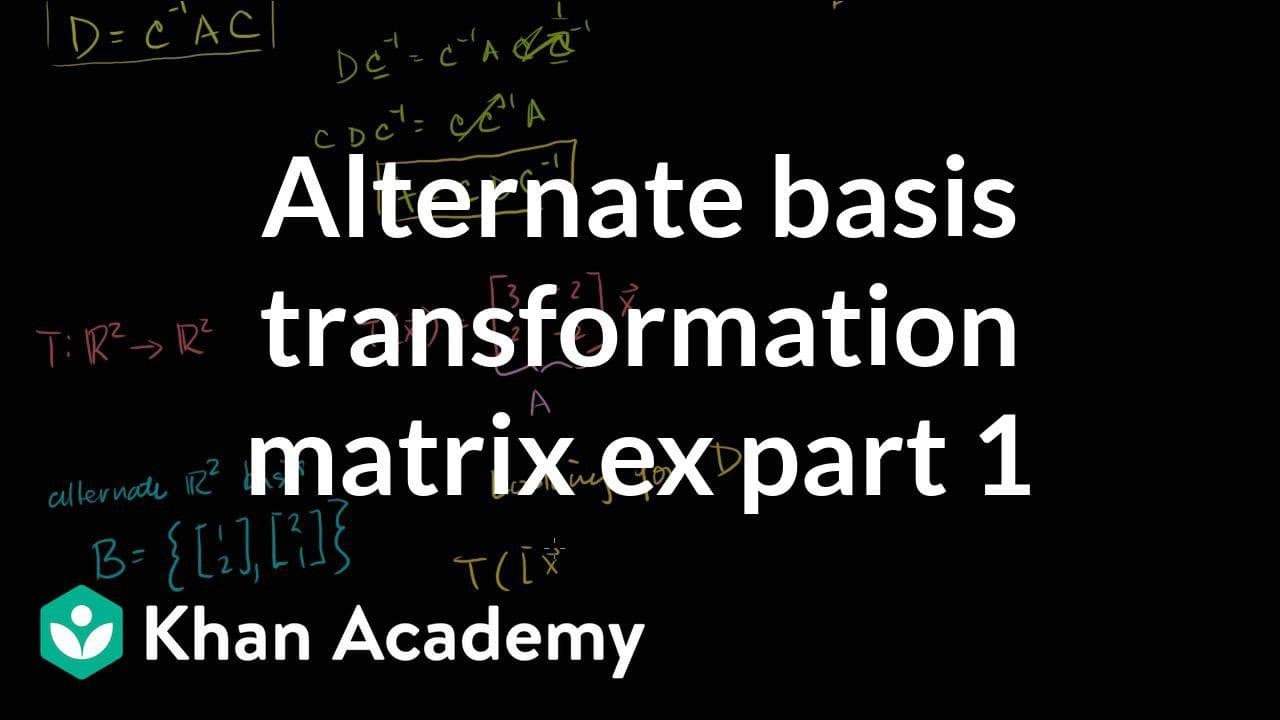
This video explains how to represent a linear transformation in nonstandard coordinates by using a change of basis matrix.
Transcript
Let's review a bit of what we learned in the last video. If I have some linear transformation that's a mapping from rn to rn, and if we're dealing with standard coordinates, that transformation -- applied to some vector x in standard cooridenties -- will be equal to the matrix a times x. So let me write this down. If we are dealing with standard co... Read More
Key Insights
- ✖️ Linear transformations in standard coordinates can be represented by multiplying the transformation matrix by the vector.
- 💱 Change of basis matrices can be used to convert vectors between standard and nonstandard coordinates.
- 💱 The transformation matrix in nonstandard coordinates can be obtained by multiplying the inverse of the change of basis matrix, the standard transformation matrix, and the change of basis matrix.
- 💨 Different coordinate systems are just different ways of representing the same vector.
- ❓ The transformation matrix in nonstandard coordinates applies the same transformation as the transformation matrix in standard coordinates but in a different coordinate system.
- 💱 The equation A = CDC^(-1) relates the transformation matrix in standard coordinates (A), the change of basis matrix (C), and the transformation matrix in nonstandard coordinates (D).
Install to Summarize YouTube Videos and Get Transcripts
Explore YouTube Video Summarizer or Get YouTube Transcript Extractor
Questions & Answers
Q: What is the relationship between a linear transformation and a matrix?
A linear transformation can be represented by a matrix when using standard coordinates. Applying the linear transformation to a vector in standard coordinates is equivalent to multiplying the vector by the matrix.
Q: How can we represent a linear transformation in nonstandard coordinates?
To represent a linear transformation in nonstandard coordinates, we can use a change of basis matrix to convert the vector from nonstandard coordinates to standard coordinates. Then, we can multiply the vector by the transformation matrix in standard coordinates to obtain the transformation in nonstandard coordinates.
Q: What is a change of basis matrix?
A change of basis matrix is a matrix that contains the basis vectors of the nonstandard coordinate system as its columns. It can be used to convert vectors between standard and nonstandard coordinates.
Q: How can we find the transformation matrix in nonstandard coordinates?
To find the transformation matrix in nonstandard coordinates, we need to multiply the inverse of the change of basis matrix, the standard transformation matrix, and the change of basis matrix. This will give us the matrix that directly applies the transformation to a vector in nonstandard coordinates.
Summary & Key Takeaways
-
Linear transformations can be represented by matrices in standard coordinates.
-
For nonstandard coordinates, a change of basis matrix can be used to convert between standard and nonstandard coordinates.
-
There is a matrix, called the transformation matrix in nonstandard coordinates, that can directly apply the transformation to vectors in nonstandard coordinates.
-
The transformation matrix in nonstandard coordinates can be found by multiplying the inverse of the change of basis matrix, the standard transformation matrix, and the change of basis matrix.
Read in Other Languages (beta)
Share This Summary 📚
Summarize YouTube Videos and Get Video Transcripts with 1-Click
Try YouTube Summary with ChatGPT & Claude or YouTube Transcript Generator
Explore More Summaries from Khan Academy 📚



Summarize YouTube Videos and Get Video Transcripts with 1-Click
Try YouTube Summary with ChatGPT & Claude or YouTube Transcript Generator