Recursive formulas for arithmetic sequences | Mathematics I | High School Math | Khan Academy
TL;DR
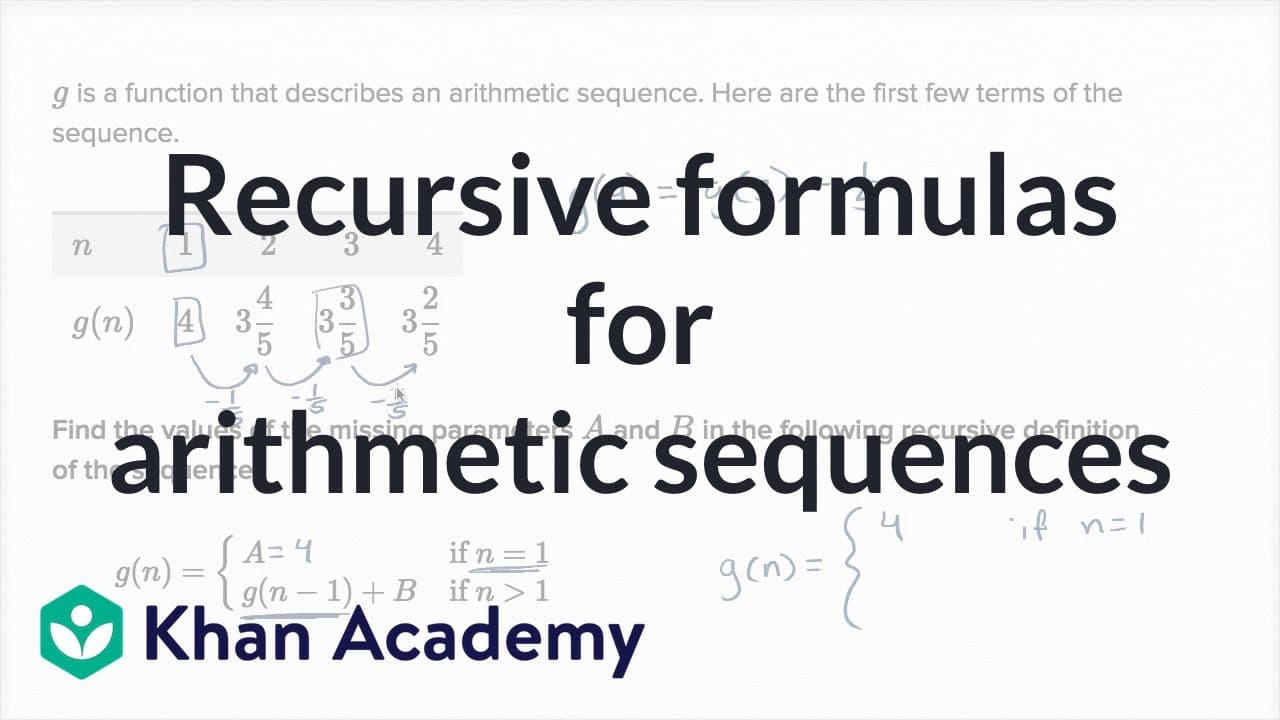
The video explains how to find the missing parameters in a recursive definition of an arithmetic sequence.
Transcript
- [Voiceover] g is a function that describes an arithmetic sequence. Here are the first few terms of the sequence. So let's say the first term is four, second term is 3 4/5, third term is 3 3/5, fourth term is 3 2/5. Find the values of the missing parameters A and B in the following recursive definition of the sequence. So they say the nth term is ... Read More
Key Insights
- 🍉 The value of A in a recursive definition of an arithmetic sequence is determined by the first term.
- 😃 The value of B in a recursive definition of an arithmetic sequence can be found by identifying the common difference between consecutive terms.
- 💼 The first case of the recursive definition is only applicable when n equals one.
Install to Summarize YouTube Videos and Get Transcripts
Explore YouTube Video Summarizer or Get YouTube Transcript Extractor
Questions & Answers
Q: How do you find the value of A in a recursive definition of an arithmetic sequence?
A in a recursive definition of an arithmetic sequence is determined by the first term. In this case, the first term is four, so A is equal to four.
Q: How do you find the value of B in a recursive definition of an arithmetic sequence?
B in a recursive definition of an arithmetic sequence is found by identifying the common difference between consecutive terms. In this case, the common difference is -1/5, so B is equal to -1/5.
Q: Can I use the first case of the recursive definition for any value of n?
No, the first case of the recursive definition is only applicable when n equals one. For any other value of n, the second case should be used.
Q: How can I find the nth term using the recursive definition and the determined values of A and B?
To find the nth term, substitute the n-1th term into the recursive definition and subtract B (-1/5) from it. For example, if n is four, the nth term would be g of three minus 1/5.
Summary & Key Takeaways
-
The video discusses finding the missing parameters A and B in a recursive definition of an arithmetic sequence.
-
A is determined by the first term of the sequence, which is four.
-
B is determined by finding the common difference between consecutive terms in the sequence, which is subtracting 1/5.
Read in Other Languages (beta)
Share This Summary 📚
Summarize YouTube Videos and Get Video Transcripts with 1-Click
Try YouTube Summary with ChatGPT & Claude or YouTube Transcript Generator
Explore More Summaries from Khan Academy 📚



Summarize YouTube Videos and Get Video Transcripts with 1-Click
Try YouTube Summary with ChatGPT & Claude or YouTube Transcript Generator