Products
Features
YouTube Video Summarizer
Summarize YouTube videos
Web & PDF Highlighter
Highlight web pages & PDFs
Chat with PDF
Ask any PDF questions with AI
Ask AI Clone
Chat with your highlights & memories
Audio Transcriber
Transcribe audio files to text
Glasp Reader
Read and highlight articles
Kindle Highlight Export
Export your Kindle highlights
Idea Hatch
Hatch ideas from your highlights
Integrations
Obsidian Plugin
Notion Integration
Pocket Integration
Instapaper Integration
Medium Integration
Readwise Integration
Snipd Integration
Hypothesis Integration
Apps & Extensions
Chrome Extension
Safari Extension
Edge Add-ons
Firefox Add-ons
iOS App
Android App
Discover
Discover
Ideas
Discover new ideas and insights
Articles
Curated articles and insights
Books
Book recommendations by great minds
Posts
Essays and notes from readers
Quotes
Inspiring quotes collection
Videos
Curated videos and summaries
Explore Glasp
Glasp Newsletter
Weekly insights and updates
Glasp Talk
Interview series with great minds
Glasp Blog
Latest news and articles
Glasp Use Cases
Learn how others use Glasp
Build & Support
Glasp API
Access Glasp's API for developers
MCP Connector
Connect Glasp to Claude & ChatGPT
Community
Glasp Reddit Community
Students
Student discount and benefits
FAQs
Frequently Asked Questions
AboutPricing
DashboardLog inSign up

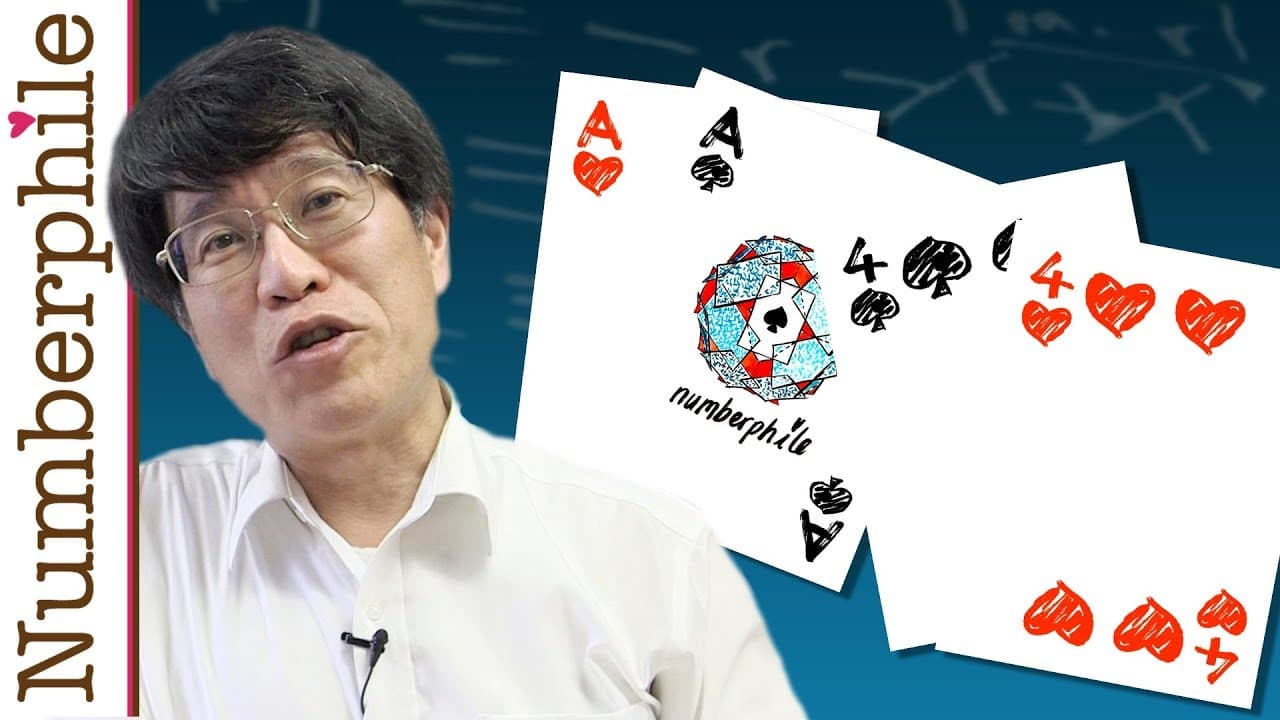
What Is the Chinese Remainder Theorem and How Is It Used in Card Tricks?
325.2K views
•
August 8, 2018
by
Numberphile
YouTube video player
What Is the Chinese Remainder Theorem and How Is It Used in Card Tricks?

TL;DR

The Chinese Remainder Theorem helps solve systems of congruences, allowing the Last Cards Match trick to work reliably with different numbers of cards. By using modular arithmetic and a specific magic phrase, you can predict the outcome of card shuffles and create surprising matches. This card trick demonstrates the fascinating interplay between mathematics and magic.

Transcript

Two sets of cards, 1 2 3 4, ace is one, 4 3 2 1, again ace is one, spades and hearts, black and red. They're in opposite orders. I now turn them over and we're going to shuffle them and you decide which one to shuffle but the shuffling means always to take the top card and put it at the bottom. That's shuffling. Okay, that's one shuffle. And, each ... Read More

Key Insights

  • 🪄 The Last Cards Match trick involves shuffling cards in a specific order determined by the magic phrase.
  • ❓ Modular arithmetic is essential in understanding the mechanism behind the trick.
  • #️⃣ The key number chosen for the trick determines the outcome based on congruences.
  • ❓ Chinese remainder theorem can be used to solve the system of congruences in the trick.
  • #️⃣ The trick can be adapted for different numbers of cards by adjusting the number of shuffles and the magic phrase.
  • 🪄 The trick relies on a unique combination of mathematics and magic to achieve its surprising outcome.
  • ❓ Understanding modular arithmetic and congruences is crucial in mastering the Last Cards Match trick.

Install to Summarize YouTube Videos and Get Transcripts

Explore YouTube Video Summarizer or Get YouTube Transcript Extractor

Questions & Answers

Q: How is the Last Cards Match magic trick performed?

The trick involves shuffling two sets of cards using a specific shuffling method based on the magic phrase "numberphile."

Q: What role does modular arithmetic play in the trick?

Modular arithmetic is used to determine the outcome of the trick based on the number of shuffles and the order of the cards.

Q: Why is the magic phrase "numberphile" significant in the trick?

The phrase "numberphile" dictates the shuffling pattern and impacts which cards will match at the end of the trick.

Q: How can the trick be adapted for different numbers of cards?

The trick can be modified by adjusting the number of cards and solving simultaneous systems of congruences using modular arithmetic.

Summary & Key Takeaways

  • A card trick called The Last Cards Match involves shuffling two sets of cards in a specific way.

  • The trick is based on modular arithmetic and the magic phrase "numberphile."

  • The number of shuffles determines which cards will match at the end of the trick.


Read in Other Languages (beta)

English

Share This Summary 📚

Summarize YouTube Videos and Get Video Transcripts with 1-Click

Download browser extensions on:

Try YouTube Summary with ChatGPT & Claude or YouTube Transcript Generator

Explore More Summaries from Numberphile 📚

The Light Switch Problem - Numberphile thumbnail
The Light Switch Problem - Numberphile
Numberphile
Professors React to 2048 - Numberphile thumbnail
Professors React to 2048 - Numberphile
Numberphile
Statistics, Storks, and Babies - Numberphile thumbnail
Statistics, Storks, and Babies - Numberphile
Numberphile
The Girl with the Hyperbolic Helicoid Tattoo - Numberphile thumbnail
The Girl with the Hyperbolic Helicoid Tattoo - Numberphile
Numberphile
What Is the 10,958 Problem in Mathematics? thumbnail
What Is the 10,958 Problem in Mathematics?
Numberphile
The Most Favourite Number - Numberphile thumbnail
The Most Favourite Number - Numberphile
Numberphile

Summarize YouTube Videos and Get Video Transcripts with 1-Click

Download browser extensions on:

Try YouTube Summary with ChatGPT & Claude or YouTube Transcript Generator

Apps & Extensions

  • Chrome Extension
  • Safari Extension
  • Edge Add-ons
  • Firefox Add-ons
  • iOS App
  • Android App

Key Features

  • YouTube Video Summarizer
  • Web & PDF Summarizer
  • Web & PDF Highlighter
  • Chat with PDF
  • Ask AI Clone
  • Audio Transcriber
  • Glasp Reader
  • Kindle Highlight Export
  • Idea Hatch

Integrations

  • Obsidian Plugin
  • Notion Integration
  • Pocket Integration
  • Instapaper Integration
  • Medium Integration
  • Readwise Integration
  • Snipd Integration
  • Hypothesis Integration

More Features

  • APIs
  • MCP Connector
  • Blog & Post
  • Embed Links
  • Image Highlight
  • Personality Test
  • Quote Shots

Company

  • About us
  • Blog
  • Community
  • FAQs
  • Job Board
  • Newsletter
  • Pricing
Terms

•

Privacy

•

Guidelines

© 2026 Glasp Inc. All rights reserved.