How to Calculate Equilibrium Concentrations
TL;DR
To calculate equilibrium concentrations, use an ICE table to track initial, change, and equilibrium values for reactants and products. Based on the balanced equation and equilibrium constant, you can derive the concentrations of all species at equilibrium.
Transcript
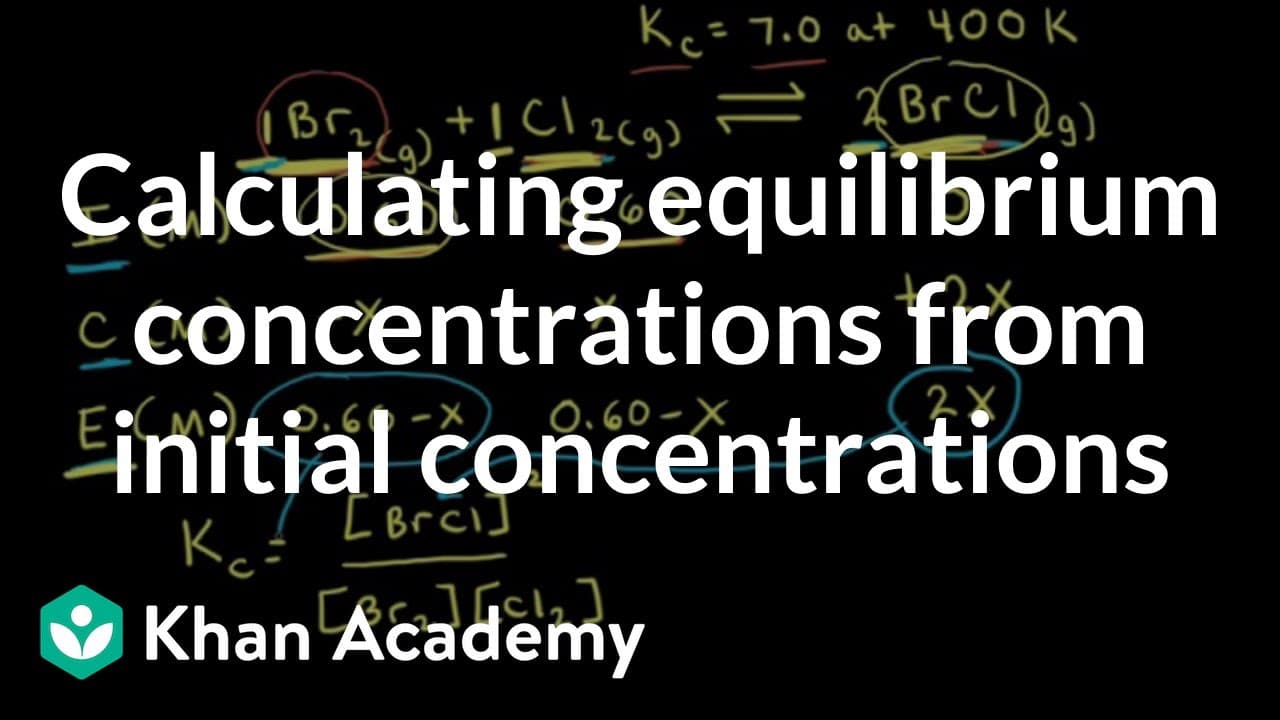
- [Instructor] For the reaction bromine gas plus chlorine gas goes to BrCl, Kc is equal to 7.0 at 400 Kelvin. If the initial concentration of bromine is 0.60 molar and the initial concentration of chlorine is also 0.60 molar, our goal is to calculate the equilibrium concentrations of Br2, Cl2 and BrCl. To help us find the equilibrium concentrations... Read More
Key Insights
- 🥶 An ICE table is a useful tool for organizing information and calculating equilibrium concentrations in chemical reactions.
- 🥳 The changes in concentration are determined based on stoichiometry and mole ratios in the balanced chemical equation.
- 😑 The equilibrium constant expression relates equilibrium concentrations of reactants and products and is used to calculate the equilibrium constant (Kc).
- 😑 Solving for equilibrium concentrations involves setting up an equation using the equilibrium constant expression and plugging in known values.
Install to Summarize YouTube Videos and Get Transcripts
Explore YouTube Video Summarizer or Get YouTube Transcript Extractor
Questions & Answers
Q: What is the purpose of an ICE table in calculating equilibrium concentrations?
The ICE table helps organize the initial concentrations, changes in concentration, and equilibrium concentrations of reactants and products in order to calculate the equilibrium concentrations of the substances involved.
Q: How are the changes in concentration determined in an ICE table?
The changes in concentration are determined based on the stoichiometry of the balanced chemical equation. The coefficients in the equation indicate the mole ratios between reactants and products, allowing us to determine the changes in concentration for each substance.
Q: What is an equilibrium constant expression?
An equilibrium constant expression is an equation that relates the concentrations of reactants and products at equilibrium for a particular chemical reaction. It is derived from the balanced chemical equation and allows us to calculate the equilibrium constant (Kc).
Q: How is the equilibrium constant used to calculate equilibrium concentrations?
The equilibrium constant expression is used to set up an equation involving the equilibrium concentrations of reactants and products. By plugging in the equilibrium concentrations into the expression and known equilibrium constant value (Kc), we can solve for the unknown equilibrium concentrations.
Summary & Key Takeaways
-
The content discusses the use of an ICE table to calculate equilibrium concentrations for a chemical reaction.
-
It explains how to determine the initial concentrations and changes in concentration for reactants and products.
-
The content also demonstrates how to write an equilibrium constant expression and use it to solve for equilibrium concentrations.
Read in Other Languages (beta)
Share This Summary 📚
Summarize YouTube Videos and Get Video Transcripts with 1-Click
Try YouTube Summary with ChatGPT & Claude or YouTube Transcript Generator
Explore More Summaries from Khan Academy 📚



Summarize YouTube Videos and Get Video Transcripts with 1-Click
Try YouTube Summary with ChatGPT & Claude or YouTube Transcript Generator