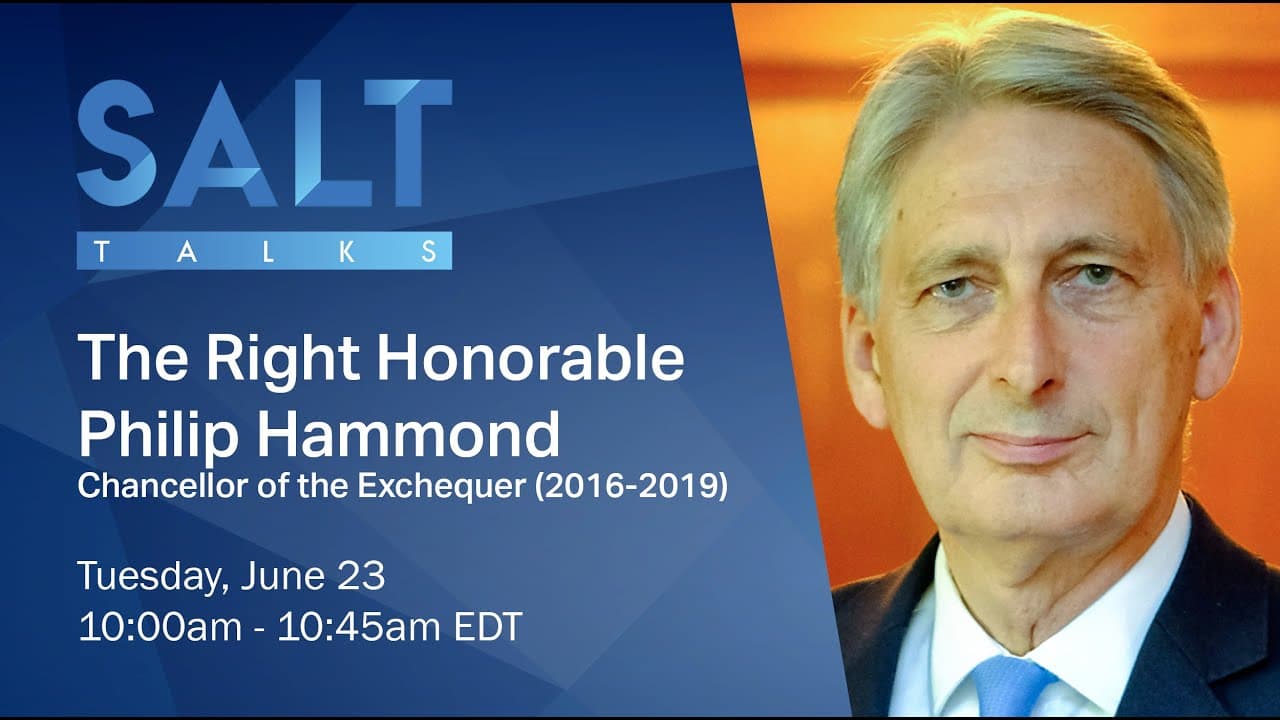
The Right Honorable Philip Hammond: Brexit, Boris Johnson & Financial Regulation | SALT Talks #13
TL;DR
The former Chancellor of the Exchequer, Philip Hammond, discusses his background, Brexit, the government's response to the pandemic, the state of the economy, and the UK's relationship with China.
Transcript
hello everyone and welcome back to salt talks my name is John Darcy I'm the managing director of salt which is a global thought leadership forum at the intersection of Finance technology and politics as we've been doing during this entire work-from-home period we've been bringing you these salt talks which are digital conversations with leading inv... Read More
Key Insights
- 🌸 The Brexit referendum was a result of political decisions to prevent potential losses in the general election and to address concerns about encroachment by Brussels.
- 🥺 The UK's response to the pandemic faced criticism for a delayed lockdown and overcentralization, leading to economic challenges and the need for restructuring.
- 🥇 The tension between the US and China places the UK in a complex situation, balancing trade relationships with both countries while maintaining a strategic partnership with the US.
- 🚕 There is a need for a global digital services tax to address the challenges of taxing digital businesses that lack a physical presence in market countries.
Install to Summarize YouTube Videos and Get Transcripts
Explore YouTube Video Summarizer or Get YouTube Transcript Extractor
Questions & Answers
Q: Why did former Prime Minister David Cameron decide to have a referendum for Brexit?
David Cameron called for a Brexit referendum to prevent a potential loss in the general election due to the rising popularity of the UK Independence Party. He believed the British people would vote to remain in the EU.
Q: What would have happened if the Brexit referendum did not take place?
If the referendum did not happen, the Labour Party would have likely won the general election, resulting in a different Prime Minister and a focus on remaining in the EU.
Q: What are Philip Hammond's thoughts on the UK's response to the pandemic?
Hammond believes that the government's lockdown was delayed, and there was an overcentralization of decision-making. He emphasizes the need for a sectoral approach, the gradual withdrawal of support measures, and the acceptance of the real consequences of the crisis.
Q: What is the UK government's stance on a post-Brexit deal with the EU?
The UK government aims to reach a deal by the end of 2020, but if no deal is achieved, the UK will leave without an agreement. The outcome will affect the value of the British Pound, with a deal potentially leading to a positive impact and no deal leading to a negative impact.
Summary & Key Takeaways
-
Philip Hammond was the former Chancellor of the Exchequer in the UK and served from 2016 to 2019. He discusses his background and his role in politics.
-
The Brexit referendum in 2016 was a political decision made by former Prime Minister David Cameron to head off the UK Independence Party and avoid a potential loss in the general election. However, the unexpected outcome led to the UK leaving the European Union.
-
The UK's response to the pandemic has been criticized for a delayed lockdown and overcentralization in decision-making. Hammond emphasizes the need for a sectoral approach and the importance of preparing for the future challenges of restructuring and unemployment.
Read in Other Languages (beta)
Share This Summary 📚
Summarize YouTube Videos and Get Video Transcripts with 1-Click
Try YouTube Summary with ChatGPT & Claude or YouTube Transcript Generator
Explore More Summaries from SALT 📚




Summarize YouTube Videos and Get Video Transcripts with 1-Click
Try YouTube Summary with ChatGPT & Claude or YouTube Transcript Generator