Design Thinking: Prioritizing Process Skills
TL;DR
Teachers implement design thinking to improve student collaboration, critical thinking, and problem-solving skills.
Transcript
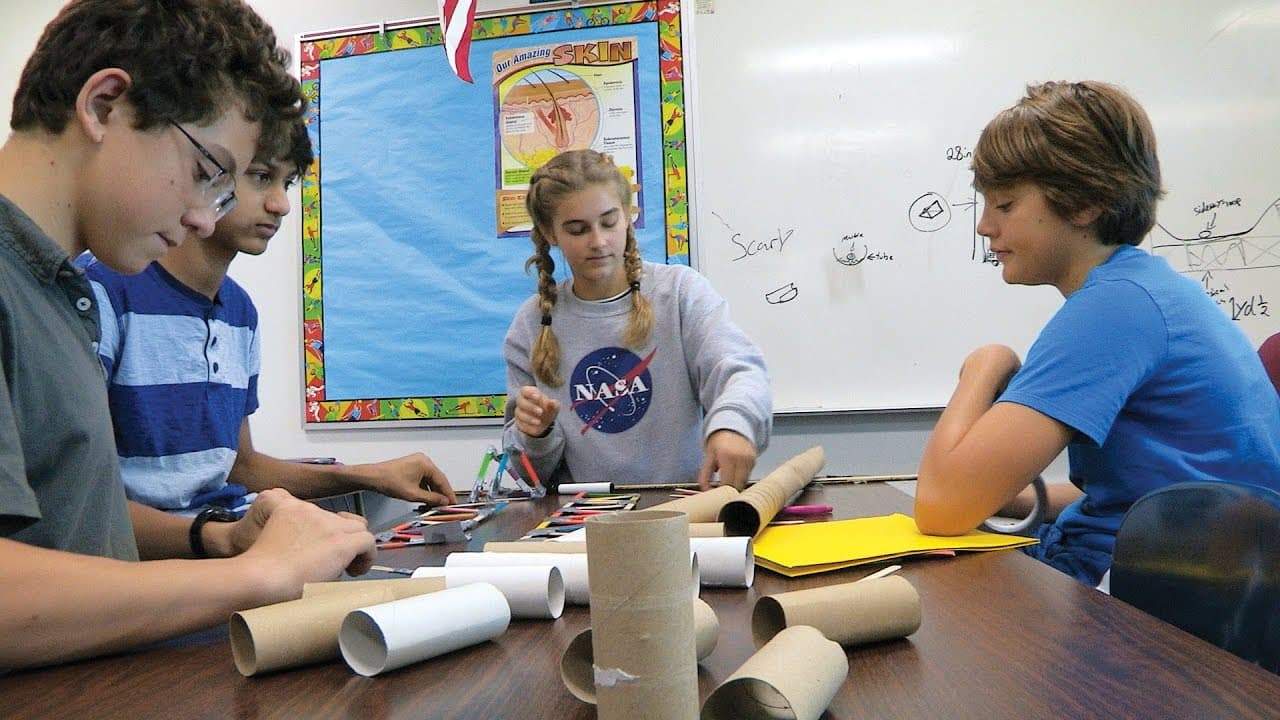
Roy: So guys, let's answer this question together. >>Maybe put some, like, more-- >>Put a piece of tape-- >>So you're going to put something else to brace the back? >>Student: Yeah. >>Roy: All right, but what about bracing this piece? >>Mark: Because we explicitly teach process skills through design thinking, our students are better collaborators... Read More
Key Insights
- 🤔 Design thinking boosts collaboration, resourcefulness, and critical thinking skills in students.
- ❓ The process involves inquiry, ideation, prototyping, and testing to create innovative solutions.
- 👨🏫 Teachers integrate design thinking to enhance traditional curriculum goals in public schools.
- 💦 Students work on projects to develop teamwork, problem-solving, and empathy skills.
- 🤔 Assessment in design thinking focuses on process skills like teamwork and project management.
- 😷 The process helps students learn to ask good questions and dig deeper into problems.
- 🤔 Implementing design thinking encourages students to consider end-users' perspectives and needs.
Install to Summarize YouTube Videos and Get Transcripts
Explore YouTube Video Summarizer or Get YouTube Transcript Extractor
Questions & Answers
Q: How does design thinking improve student skills beyond traditional curriculum?
Design thinking helps students develop collaboration, critical thinking, and problem-solving abilities essential for future employability.
Q: What are the key components of the design thinking process in education?
The design thinking process includes inquiry, ideation, prototyping, and testing, encouraging students to explore solutions creatively.
Q: How does implementing design thinking help students develop empathy and perspective-taking?
By focusing on end-users' needs and perspectives, students learn to understand and empathize with different viewpoints, enhancing their problem-solving approach.
Q: How can design thinking principles be applied to real-world challenges beyond the classroom?
Design thinking skills can be utilized in various contexts to address complex problems, fostering innovation and adaptability in students.
Summary & Key Takeaways
-
Design thinking is integrated into teaching to enhance students' collaboration, resourcefulness, and critical thinking skills.
-
Students engage in projects focusing on teamwork, problem-solving, and inquiry through the design thinking process.
-
The approach involves ideation, prototyping, testing, and refining ideas to create innovative solutions.
Read in Other Languages (beta)
Share This Summary 📚
Summarize YouTube Videos and Get Video Transcripts with 1-Click
Try YouTube Summary with ChatGPT & Claude or YouTube Transcript Generator
Explore More Summaries from Edutopia 📚





Summarize YouTube Videos and Get Video Transcripts with 1-Click
Try YouTube Summary with ChatGPT & Claude or YouTube Transcript Generator