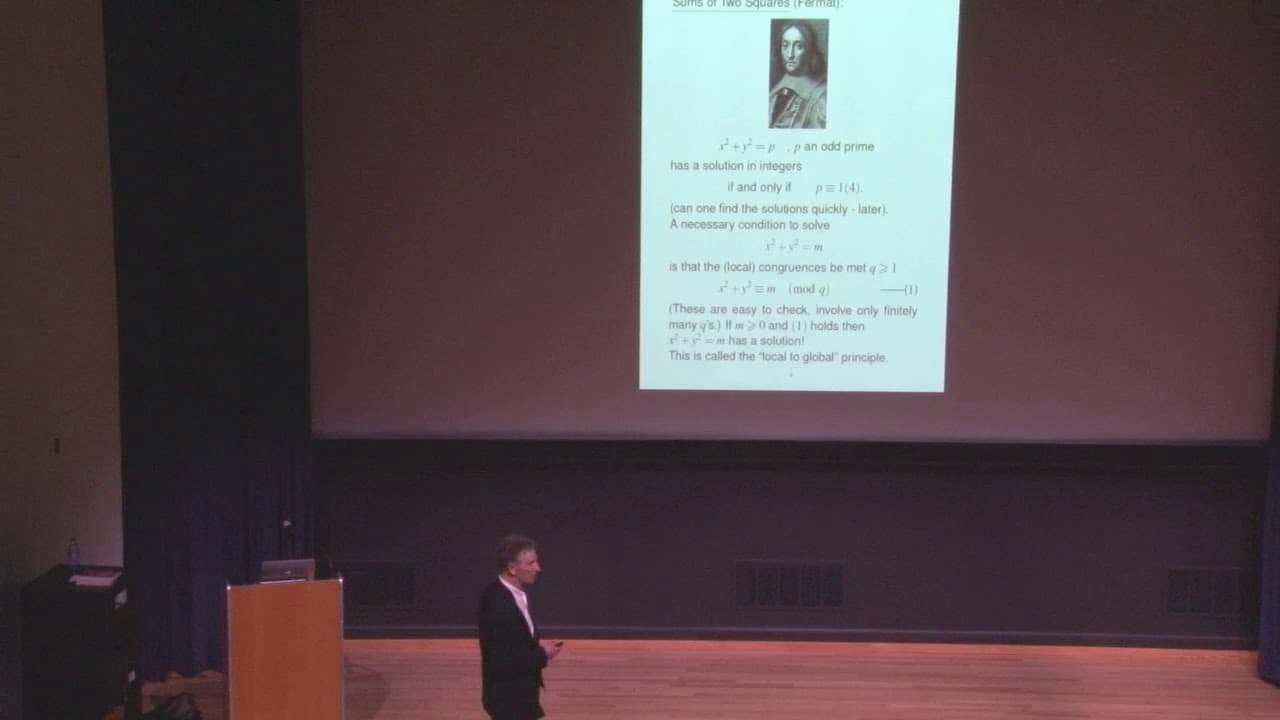
Sums of Squares and Golden Gates - Peter Sarnak (Princeton)
TL;DR
Sums of squares play a crucial role in quantum computing, enabling the construction of optimal quantum gates and providing a powerful tool for approximating unitary matrices.
Transcript
hello I'd like to welcome you all to this evenings lecture my name is Brian white and I'm chair of the Stanford mathematics department this lecture is one in a series of public lectures organized by Stanford's mathematics Research Center and by the Friends of Stanford mathematics if you would like to be notified of future events and are not on our ... Read More
Key Insights
- 💁 Sums of squares have historical significance in number theory, particularly in the study of quadratic forms.
- 🔬 Quantum gates are represented by unitary matrices, and the H and T gates are fundamental building blocks in quantum computing.
- 🔬 Recent research has shown a connection between sums of squares and quantum gates, enabling the construction of optimal quantum gates for efficient quantum computation.
Install to Summarize YouTube Videos and Get Transcripts
Explore YouTube Video Summarizer or Get YouTube Transcript Extractor
Questions & Answers
Q: What is the significance of the H and T gates in quantum computing?
The H and T gates are fundamental building blocks in quantum computing, enabling the construction of more complex quantum circuits. By combining these gates in various ways, we can approximate any unitary matrix and perform quantum computations.
Q: Can you explain more about the algorithm that finds short circuits of H and T gates?
The algorithm uses a heuristic approach to find an optimal sequence of H and T gates that approximates an arbitrary unitary matrix. It begins by choosing an initial approximation and then iteratively adjusts the parameters to minimize the discrepancy. The algorithm terminates once a satisfactory approximation is found.
Q: How does the concept of sums of squares tie into quantum computing?
The concept of sums of squares is used to represent numbers as combinations of squares, which is analogous to how quantum gates are represented as unitary matrices. By understanding the properties of sums of squares, we can uncover mathematical relationships that help optimize the design and implementation of quantum gates.
Q: Can you explain the connection between quadratic forms and quantum gates?
Quadratic forms, which involve sums of squares, are used to represent certain mathematical properties in number theory. In quantum computing, the state of a quantum system is represented by complex vectors, and unitary matrices are used to perform quantum operations. The connection lies in the mathematical properties shared by both quadratic forms and unitary matrices, enabling the use of concepts from number theory in the design of quantum gates.
Summary & Key Takeaways
-
The lecture discusses the historical background of sums of squares in mathematics, particularly in the field of number theory, where they have been extensively studied.
-
The focus then shifts to quantum computing, explaining the concept of quantum gates and the importance of unitary matrices in representing quantum operations.
-
The lecture highlights the connection between sums of squares and quantum gates, showing that certain combinations of gates, particularly the H and T gates, can be used to approximate any unitary matrix.
-
A recent algorithm is presented, which efficiently finds short circuits of H and T gates to approximate an arbitrary unitary matrix with high accuracy.
Read in Other Languages (beta)
Share This Summary 📚
Summarize YouTube Videos and Get Video Transcripts with 1-Click
Try YouTube Summary with ChatGPT & Claude or YouTube Transcript Generator
Explore More Summaries from Stanford 📚

Summarize YouTube Videos and Get Video Transcripts with 1-Click
Try YouTube Summary with ChatGPT & Claude or YouTube Transcript Generator