Stanford engineer creates circuit board that mimics the human brain
Transcript
Read and summarize the transcript of this video on Glasp Reader (beta).
Install to Summarize YouTube Videos and Get Transcripts
Explore YouTube Video Summarizer or Get YouTube Transcript Extractor
Summary
Neurogrid is a system developed by Stanford University that can simulate a million neurons in real time using analog circuits, requiring significantly less power compared to traditional digital logic-based systems. This breakthrough allows for the development of autonomous robots that are not tethered to large power supplies. The technology also has potential clinical applications, such as aiding quadriplegics or individuals who have lost control over a limb by bypassing the damaged area and controlling a robotic limb through signals taken directly from the cortex.
Questions & Answers
Q: How does computing like the brain allow for the development of more autonomous robots?
By using analog circuits instead of digital logic, which mirrors the functioning of the brain, the technology can significantly reduce power requirements for computation. This means that robots can operate on much less power and won't need to be constantly connected to a large power supply, leading to greater autonomy.
Q: What is Neurogrid capable of simulating in real time?
Neurogrid is capable of simulating a million neurons in real time, providing teraflops of computing power. This level of power is typically only available in supercomputers, which consume about a million watts of energy. However, Neurogrid achieves similar simulations using much less power.
Q: How does Neurogrid achieve energy efficiency in its simulations?
Instead of using transistors as digital logic elements, Neurogrid utilizes them as analog circuits. The circuit design ensures that the voltage and current levels correspond to those inside a real cell and its synaptic input, respectively. This approach greatly reduces power consumption while maintaining the ability to simulate complex neural networks.
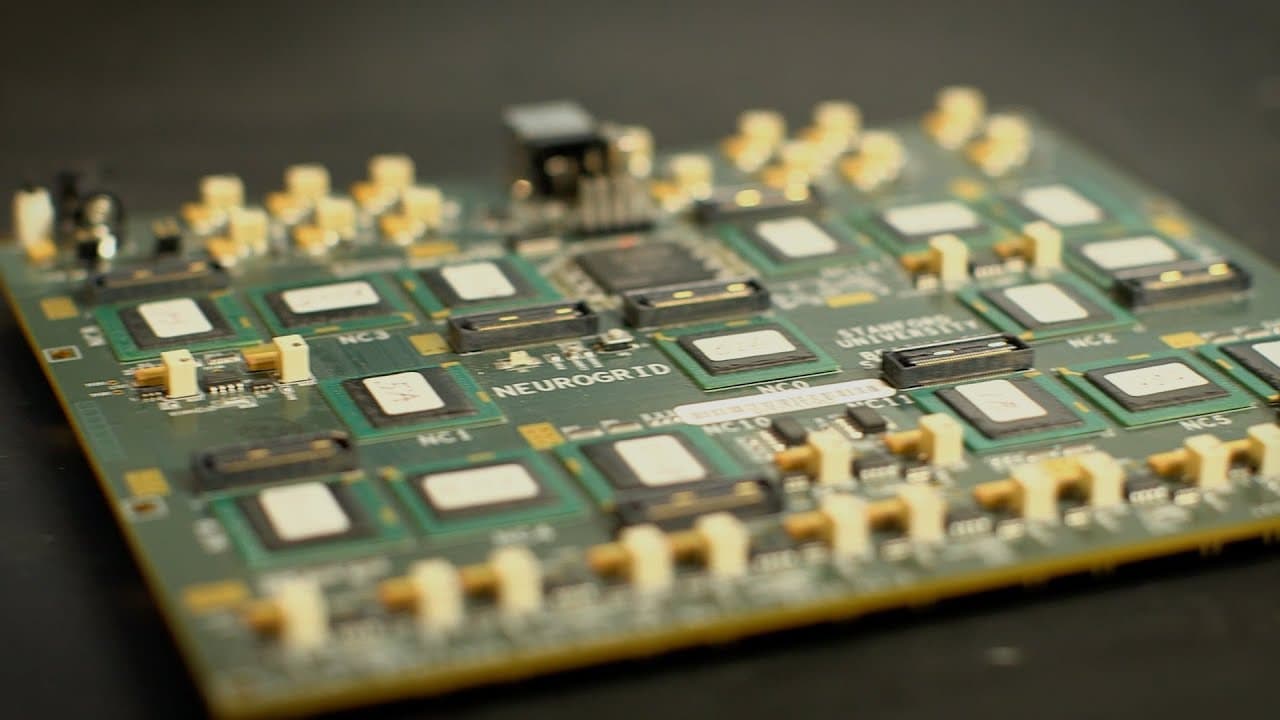
Q: What does a Neurogrid board consist of?
A Neurogrid board consists of sixteen chips arranged in a tree network, which collectively enable the simulation of one million neurons. This board can be configured for various purposes and is not limited to being used solely as a simulation tool. It caters to a wide audience, including neuroscientists interested in understanding the brain and engineers interested in utilizing spiking neurons for innovative applications.
Q: What are the potential clinical applications of Neurogrid?
One of the clinical applications of Neurogrid is for quadriplegics or individuals who have lost control over a limb. By bypassing the damaged area, signals can be directly taken from the cortex to control a robotic limb, providing a potential solution for regaining motor functions. The low power aspect of Neurogrid is essential for clinical viability, as it allows for the development of implantable devices.
Q: How does Neurogrid enable clinical viability?
Neurogrid, along with the new morphic technology, enables clinical viability by significantly reducing power consumption. The low power requirements are crucial for implantable devices, as they need to operate at levels that are safe and effective for long-term use. This technology opens up possibilities for advanced prosthetics and neural interfaces with reduced power needs.
Q: What is the overall promise of this technology?
The overall promise of Neurogrid and similar technologies is the ability to harness the power and efficiency of the brain's computational capabilities. By emulating the brain's analog circuitry, researchers can develop systems that require less power while delivering high-performance computation. This kind of inspiration from the brain can lead to groundbreaking advancements in various fields, including robotics, neuroscience, and medicine.
Q: Who is the target audience for Neurogrid and its software?
Neurogrid and its software cater to a wide spectrum of audiences. It is of interest to neuroscientists who want to simulate and gain insights into the brain's functioning. Engineers are also attracted to Neurogrid because of its ability to simulate spiking neurons, opening up possibilities for innovative applications beyond neuroscience.
Takeaways
Neurogrid, developed by Stanford University, offers a groundbreaking approach to simulating neural networks using analog circuits. By emulating the power-efficient functioning of the brain, Neurogrid achieves real-time simulations of a million neurons with significantly lower power requirements compared to traditional methods. This technology not only allows for the development of more autonomous robots but also holds great potential for clinical applications, such as aiding individuals with paralysis or limb loss. The low power aspect of Neurogrid makes it suitable for implantable devices, paving the way for advancements in prosthetics and neural interfaces. This kind of inspiration from the brain has the potential to revolutionize various fields and lead to exciting new possibilities.
Read in Other Languages (beta)
Share This Summary 📚
Summarize YouTube Videos and Get Video Transcripts with 1-Click
Try YouTube Summary with ChatGPT & Claude or YouTube Transcript Generator
Explore More Summaries from Stanford 📚






Summarize YouTube Videos and Get Video Transcripts with 1-Click
Try YouTube Summary with ChatGPT & Claude or YouTube Transcript Generator