Problem No 3 on Basic System Properties | Continuous and Discrete Time Systems | Signals and Systems
TL;DR
Exploring a continuous time system's memoryless, causal, linear, and time-invariant properties.
Transcript
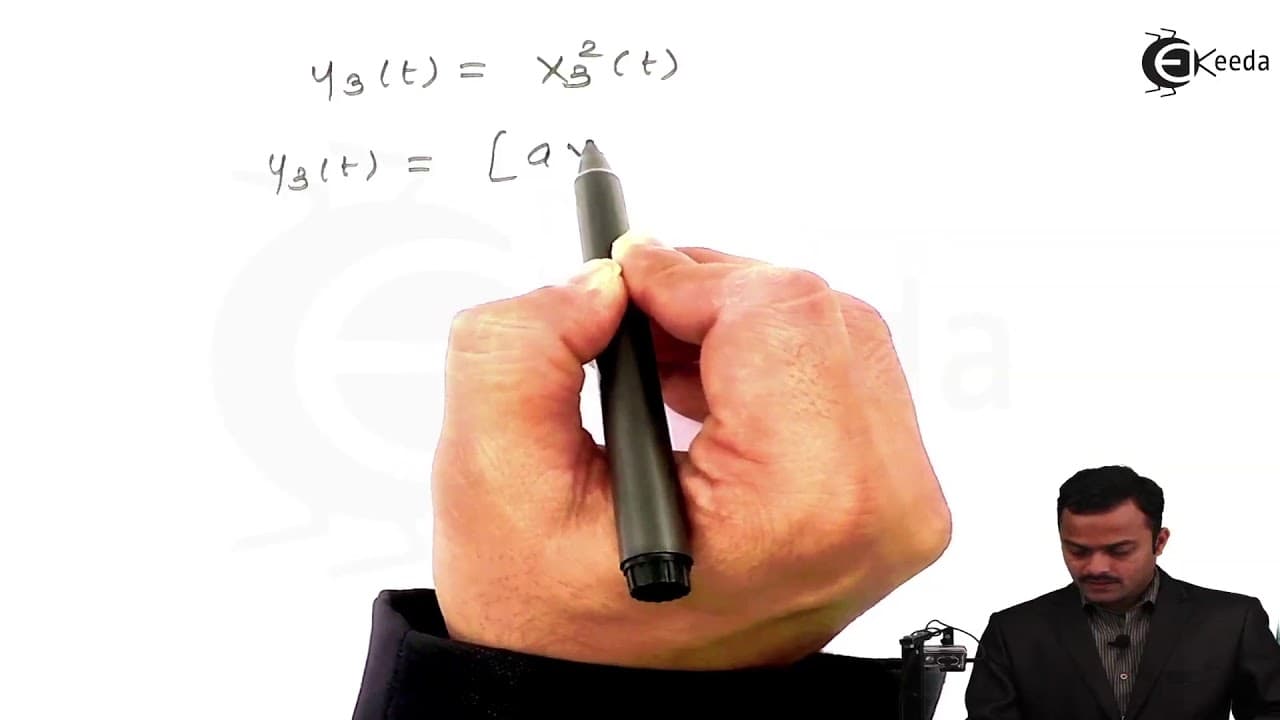
hi friends in this video we are going to take one continuous time system and we will check its properties so system is given like this so for this system we have to check whether it is memoryless causal linear and time invariant so let's see one by one first so here it is quite obvious that y of t is x squared is nothing but for any value of t y of... Read More
Key Insights
- 🔠 Memoryless systems have outputs dependent solely on present inputs, devoid of past input considerations.
- 🎁 Causality in systems relates to output dependency on past and present inputs guiding present output.
- ❓ Non-linearity in systems arises if the output doesn't conform to homogeneity and superposition.
- ⌛ Time invariance dictates system behaviors remain consistent despite input time shifts.
- 🤑 Linear systems satisfy the properties of homogeneity and superposition, unlike non-linear ones.
- 🦮 System properties like memoryless, causal, linearity, and time invariance guide system classifications.
- 🦻 Understanding system properties aids in predicting behaviors and responses accurately.
Install to Summarize YouTube Videos and Get Transcripts
Explore YouTube Video Summarizer or Get YouTube Transcript Extractor
Questions & Answers
Q: What defines a memoryless system in the context of the continuous time system?
A memoryless system has its current output solely dependent on the current input without any consideration of past inputs or memory elements, making it static.
Q: How does causality relate to continuous time systems?
Causality implies that a system's output is influenced by past and present inputs, and since the system output here depends only on the present input, it is causal.
Q: Why is the continuous time system considered non-linear?
The non-linearity of the system stems from it not satisfying the properties of homogeneity and superposition when subject to a linear combination of inputs.
Q: How is time invariance exhibited in the continuous time system?
Time invariance is demonstrated as shifting the input by a time delay, resulting in a corresponding shift in the output, showcasing consistency in the system's behavior.
Summary & Key Takeaways
-
The system is memoryless as the present output only depends on the present input, making it a static system.
-
It is causal because the output depends on present and past inputs according to the system's equation.
-
The system is non-linear as it does not follow the properties of homogeneity and superposition, but it is time-invariant.
Read in Other Languages (beta)
Share This Summary 📚
Summarize YouTube Videos and Get Video Transcripts with 1-Click
Try YouTube Summary with ChatGPT & Claude or YouTube Transcript Generator
Explore More Summaries from Ekeeda 📚






Summarize YouTube Videos and Get Video Transcripts with 1-Click
Try YouTube Summary with ChatGPT & Claude or YouTube Transcript Generator