Green's theorem proof part 1 | Multivariable Calculus | Khan Academy
TL;DR
Green's Theorem connects line integrals of vector fields in the xy plane to double integrals over a region.
Transcript
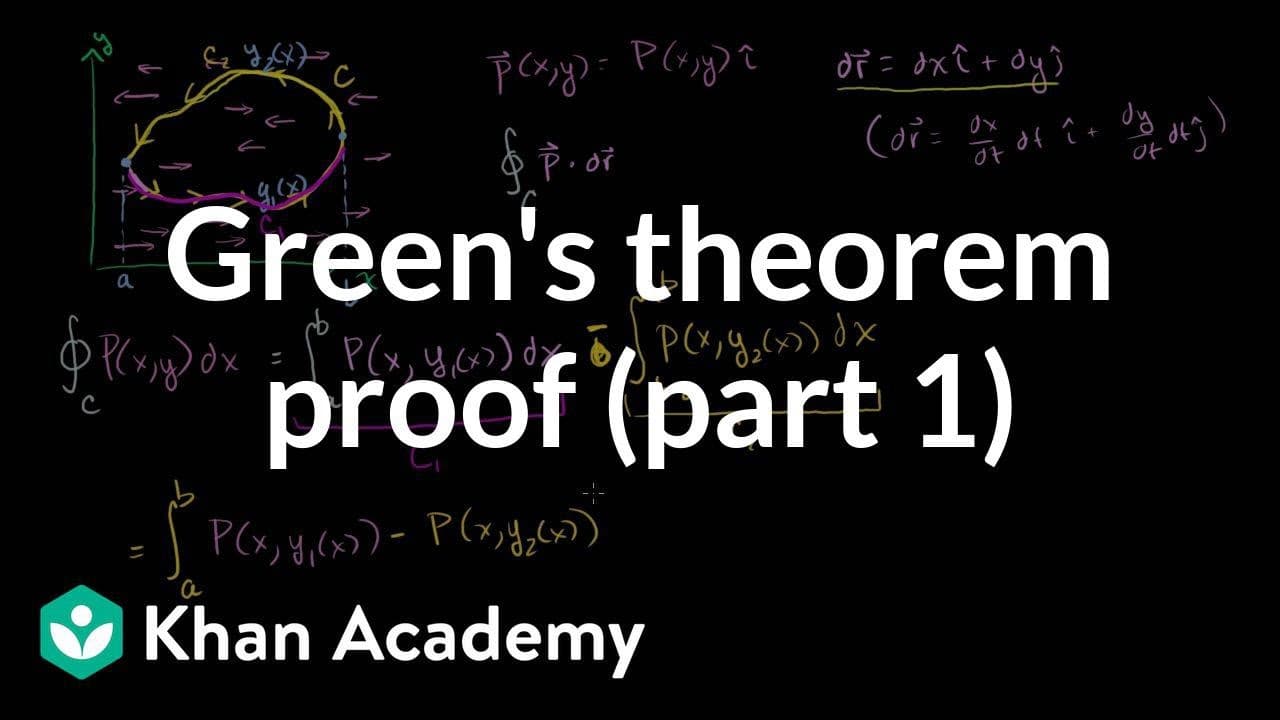
Let's say we have a path in the xy plane. That's my y-axis, that is my x-axis, in my path will look like this. Let's say it looks like that; trying to draw a bit of an arbitrary path, and let's say we go in a counter clockwise direction like that along our path. And we could call this path-- so we're going in a counter clockwise direction --we coul... Read More
Key Insights
- 🫥 Green's Theorem connects line integrals in vector fields to double integrals over a region.
- 🫥 Line integrals can be simplified using Green's Theorem by converting them into double integrals.
- 👻 Vector fields with specific components allow for further simplifications and connections to the double integral.
Install to Summarize YouTube Videos and Get Transcripts
Explore YouTube Video Summarizer or Get YouTube Transcript Extractor
Questions & Answers
Q: What is Green's Theorem?
Green's Theorem is a mathematical concept that relates a line integral around a closed curve to a double integral over the region enclosed by the curve. It provides a way to calculate volume under a surface defined by a vector field.
Q: How can line integrals be simplified using Green's Theorem?
Green's Theorem allows for the simplification of a line integral over a closed path by converting it into a double integral over a region. By using the partial derivative of the vector field with respect to the appropriate variable, the line integral can be expressed as a double integral, making the calculation easier.
Q: What is the significance of the vector field having only an x-component?
The vector field with only an x-component simplifies the line integral and allows for the connection to the double integral. By breaking the curve into two functions of x and utilizing the partial derivative of P with respect to y, the line integral can be expressed as a double integral over a region defined by y1 and y2.
Q: How does Green's Theorem relate to the calculation of volume under a surface?
Green's Theorem provides a method to calculate the volume under a surface defined by a vector field. By converting the line integral into a double integral, the region enclosed by the curve becomes the base of the volume, while the function defined by the partial derivative of P with respect to y represents the height. The double integral then calculates the volume under the surface.
Summary & Key Takeaways
-
The video explains the concept of line integrals in vector fields and introduces a specific vector field with only an x-component.
-
The line integral over a closed path is simplified using Green's Theorem and is shown to be equivalent to a double integral over a region.
-
The video demonstrates how to break the curve into two functions of x and solve the integral using the partial derivative of P with respect to y.
-
The final outcome is the connection between the line integral and the double integral, which allows for the calculation of volume under the surface defined by the vector field.
Read in Other Languages (beta)
Share This Summary 📚
Summarize YouTube Videos and Get Video Transcripts with 1-Click
Try YouTube Summary with ChatGPT & Claude or YouTube Transcript Generator
Explore More Summaries from Khan Academy 📚



Summarize YouTube Videos and Get Video Transcripts with 1-Click
Try YouTube Summary with ChatGPT & Claude or YouTube Transcript Generator