Two Candles, One Cake (Part 2) - Numberphile
TL;DR
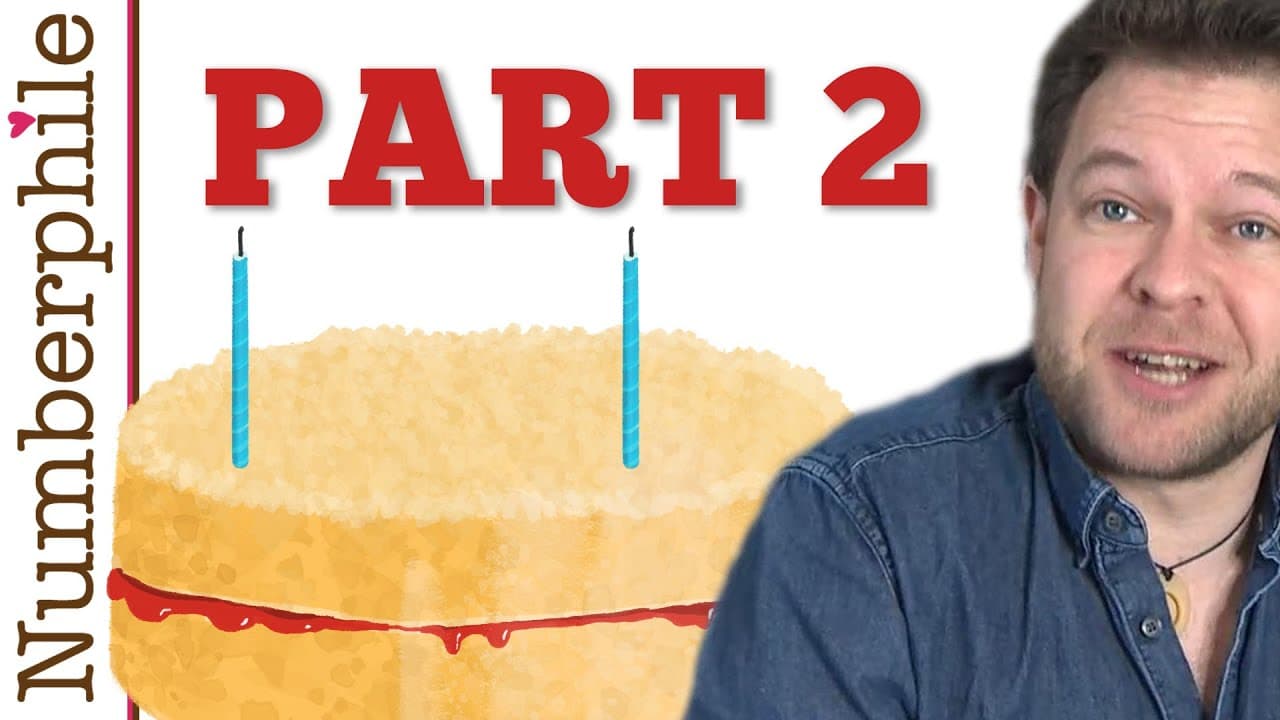
Mathematician delves into the complexities of randomly cutting cakes, highlighting the challenges of defining true randomness.
Transcript
This is part two of a video about two candles in a cake, I imagine it will make more sense if you've seen part one, so check out those links. Real cakes are not linear, unless they're Battenberg cakes and then they've got a Battenberg- the linear thing and there's a tradition of mathematical puzzles with Battenberg cakes; but anyway real ... Read More
Key Insights
- 💇 Random cuts in cakes present a fascinating yet challenging mathematical problem that showcases the intricate nature of randomness.
- 💇 Different methods of choosing random cuts can result in varying probabilities, demonstrating the subjective aspects of defining true randomness.
- 💇 The exploration of random cuts in cakes underscores the importance of precision and careful modeling in probabilistic scenarios.
Install to Summarize YouTube Videos and Get Transcripts
Explore YouTube Video Summarizer or Get YouTube Transcript Extractor
Questions & Answers
Q: What inspired the mathematician to explore the concept of random cuts in cakes?
The mathematician's exploration was inspired by the desire to delve into the complexities of randomness and probability in a tangible and relatable context.
Q: How did the simulations conducted by the mathematician shed light on the distribution of random cuts on cakes?
The simulations revealed that different methods of choosing random cuts produce varying probabilities, highlighting the nuances and challenges of defining true randomness in the real world.
Q: Why did the mathematician struggle to determine a definitive approach to defining truly random cuts in cakes?
The mathematician faced difficulty due to the subjective nature of randomness, prompting a deeper exploration of how different methods of random selection can lead to distinct outcomes.
Q: What key lesson did the mathematician draw from this exploration of random cuts in cakes?
The mathematician learned that even seemingly simple problems like cutting a cake can lead to profound insights into the complexities of randomness and probability distribution.
Summary & Key Takeaways
-
The video explores the intricacies of randomly cutting cakes and the complexities of defining true randomness in the process.
-
The mathematician uses simulations to analyze different methods of random cuts on cakes, revealing unexpected probabilities.
-
The discussion emphasizes the philosophical and practical challenges mathematicians face when dealing with probability and randomness.
Read in Other Languages (beta)
Share This Summary 📚
Summarize YouTube Videos and Get Video Transcripts with 1-Click
Try YouTube Summary with ChatGPT & Claude or YouTube Transcript Generator
Explore More Summaries from Numberphile 📚

Summarize YouTube Videos and Get Video Transcripts with 1-Click
Try YouTube Summary with ChatGPT & Claude or YouTube Transcript Generator