Two-way frequency tables and Venn diagrams | Data and modeling | 8th grade | Khan Academy
TL;DR
This video explains how to represent data using Venn diagrams and two-way tables in multiple ways.
Transcript
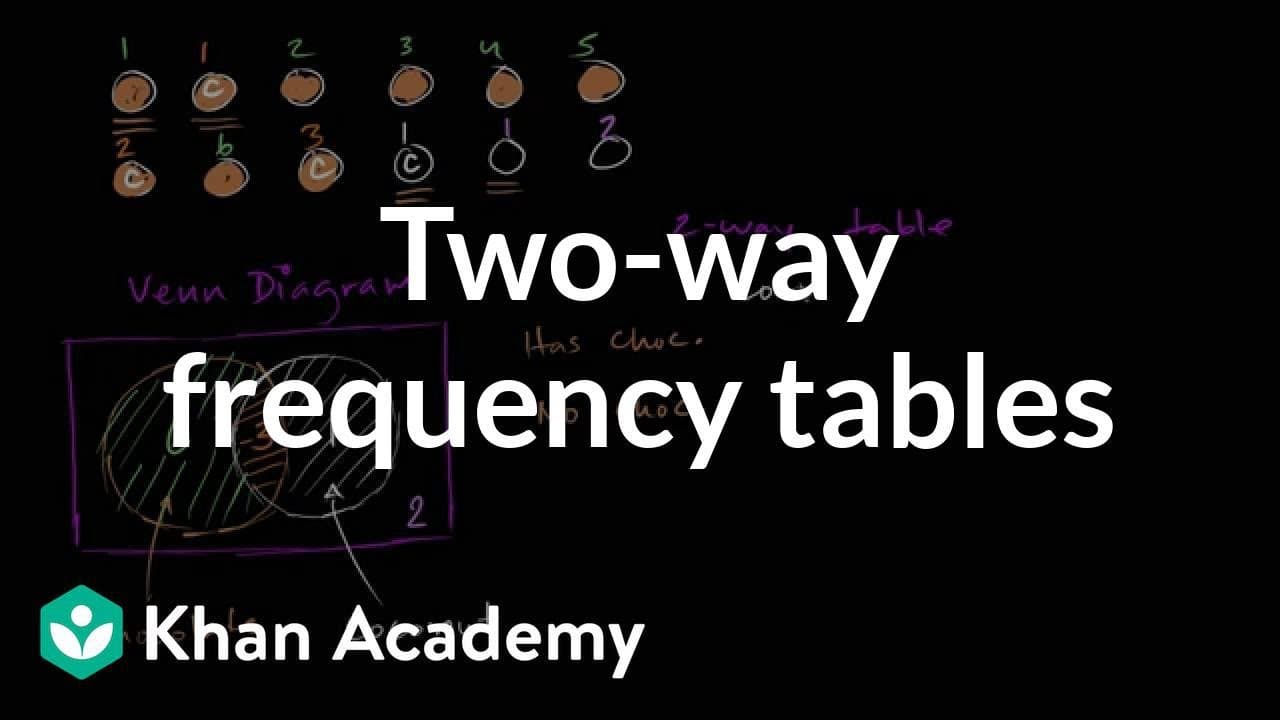
- So what I have here are 12 pieces of candy. The ones that are colored in brown have chocolate on the outside and the ones that have a C on them means that they have coconut on the inside. So for example, this one over here in the top left, it's made out of chocolate on the outside, but it doesn't have coconut on the inside. While this one right o... Read More
Key Insights
- 💨 Venn diagrams and two-way tables are effective tools for representing data and visually demonstrating relationships.
- 😫 Venn diagrams use circles to represent sets and overlapping areas to show shared attributes between sets.
- 🤨 Two-way tables organize data into columns and rows, allowing for comparisons and analysis.
- 💨 Venn diagrams provide a visual way to understand data relationships.
- 😫 Two-way tables are helpful for displaying complex data sets in a structured format.
- ❓ Using different representation methods can enhance data analysis and interpretation.
- 💨 Venn diagrams and two-way tables can be used in various fields, such as statistics, mathematics, and data science.
Install to Summarize YouTube Videos and Get Transcripts
Explore YouTube Video Summarizer or Get YouTube Transcript Extractor
Questions & Answers
Q: How does a Venn diagram represent data?
A Venn diagram uses circles to represent sets of data, with overlapping sections showing shared attributes. It allows for a visual representation of relationships between different categories.
Q: Can you explain how to interpret a two-way table?
In a two-way table, data is organized into columns and rows. Each cell represents a specific combination or category. By comparing data across rows and columns, we can analyze relationships and draw conclusions.
Q: What are the advantages of using a Venn diagram?
Venn diagrams are useful because they provide a visual representation of data relationships. They allow for easy comparison and identification of shared attributes, making it simpler to understand complex data sets.
Q: When should I use a two-way table to represent data?
Two-way tables are particularly useful when comparing data across two dimensions or categories. They are suitable for displaying large amounts of information in a structured and easy-to-understand format.
Summary & Key Takeaways
-
The video demonstrates how to represent information using a Venn diagram, where circles represent sets (like chocolate and coconut) and overlapping sections show shared attributes.
-
An alternative representation method explained is using a two-way table, where columns and rows display different categories of data, allowing for a clear comparison.
Read in Other Languages (beta)
Share This Summary 📚
Summarize YouTube Videos and Get Video Transcripts with 1-Click
Try YouTube Summary with ChatGPT & Claude or YouTube Transcript Generator
Explore More Summaries from Khan Academy 📚



Summarize YouTube Videos and Get Video Transcripts with 1-Click
Try YouTube Summary with ChatGPT & Claude or YouTube Transcript Generator