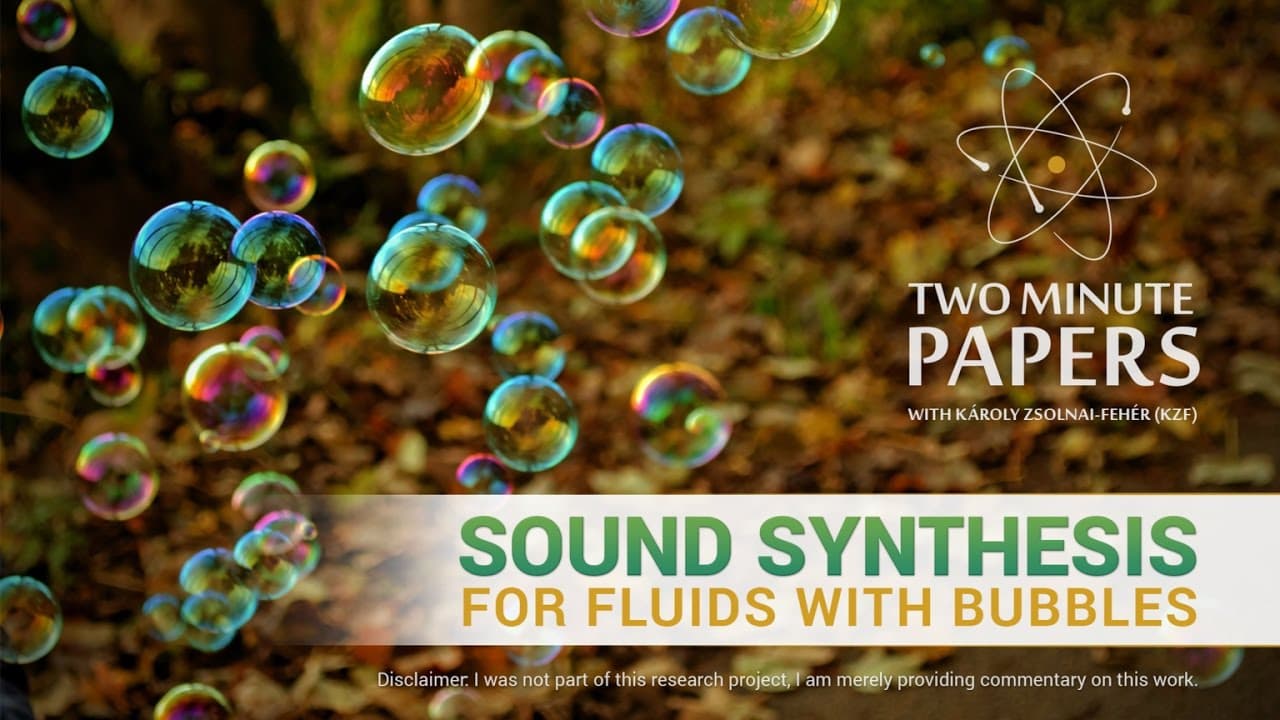
Sound Synthesis for Fluids With Bubbles | Two Minute Papers #97
TL;DR
Physics-driven simulation of bubbles in fluid with realistic sound effects.
Transcript
Dear Fellow Scholars, this is Two Minute Papers with Károly Zsolnai-Fehér. We have had quite a few episodes on simulating the motion of fluids and creating beautiful footages from the results. In this work, the authors created a simulator, that shows us not only the motion of a piece of fluid, but the physics of bubbles within as well. This sounds ... Read More
Key Insights
- 👁️🗨️ Accurate simulation of bubble physics involves modeling effects like entrainment, splitting, merging, advection, and collapsing.
- ⚾ Sound effects in the simulation are based on bubble movement, position, and shape, with different frequencies based on these factors.
- 💠 Bubble shape greatly influences the emitted sound frequency, with differences of up to 30% based on the shape.
- 👁️🗨️ New techniques in the simulation include chirp-like sounds and bubble surface popping effects.
Install to Summarize YouTube Videos and Get Transcripts
Explore YouTube Video Summarizer or Get YouTube Transcript Extractor
Questions & Answers
Q: What are some challenges in simulating realistic bubble physics in fluid simulations?
Challenges include simulating a large number of bubbles with deformations and topology changes accurately, as well as accounting for bubble-related effects like entrainment, splitting, merging, advection, and collapsing.
Q: How is the sound of bubbles in the simulation generated?
The sound of bubbles is simulated by borrowing equations from physics that govern the movement of springs. Factors like bubble position, shape, and their interactions with surfaces determine the pitch and frequency of the sound.
Q: What improvements have been made in the simulation compared to previous techniques?
The simulation now includes effects like chirp-like sounds and bubble popping at the surface, which were missing in previous techniques. A novel frequency extension model enhances the realism of the sound simulation.
Q: How is the realism of the simulation validated?
The authors stress the importance of validating the simulation by comparing the results to real-world footage. They emphasize the need for reality to be the judge of the accuracy of the simulation.
Summary & Key Takeaways
-
The video showcases a fluid simulation that includes not only the fluid motion but also the physics of bubbles within.
-
Various bubble-related effects such as entrainment, splitting, merging, advection, and collapsing are faithfully simulated.
-
The simulation also includes realistic sound effects based on the movement and shape of the bubbles.
Read in Other Languages (beta)
Share This Summary 📚
Summarize YouTube Videos and Get Video Transcripts with 1-Click
Try YouTube Summary with ChatGPT & Claude or YouTube Transcript Generator
Explore More Summaries from Two Minute Papers 📚



Summarize YouTube Videos and Get Video Transcripts with 1-Click
Try YouTube Summary with ChatGPT & Claude or YouTube Transcript Generator