Horizontal Asymptotes and Slant Asymptotes of Rational Functions
TL;DR
Learn how to identify horizontal and slant asymptotes by comparing the degrees of the numerator and denominator of a function.
Transcript
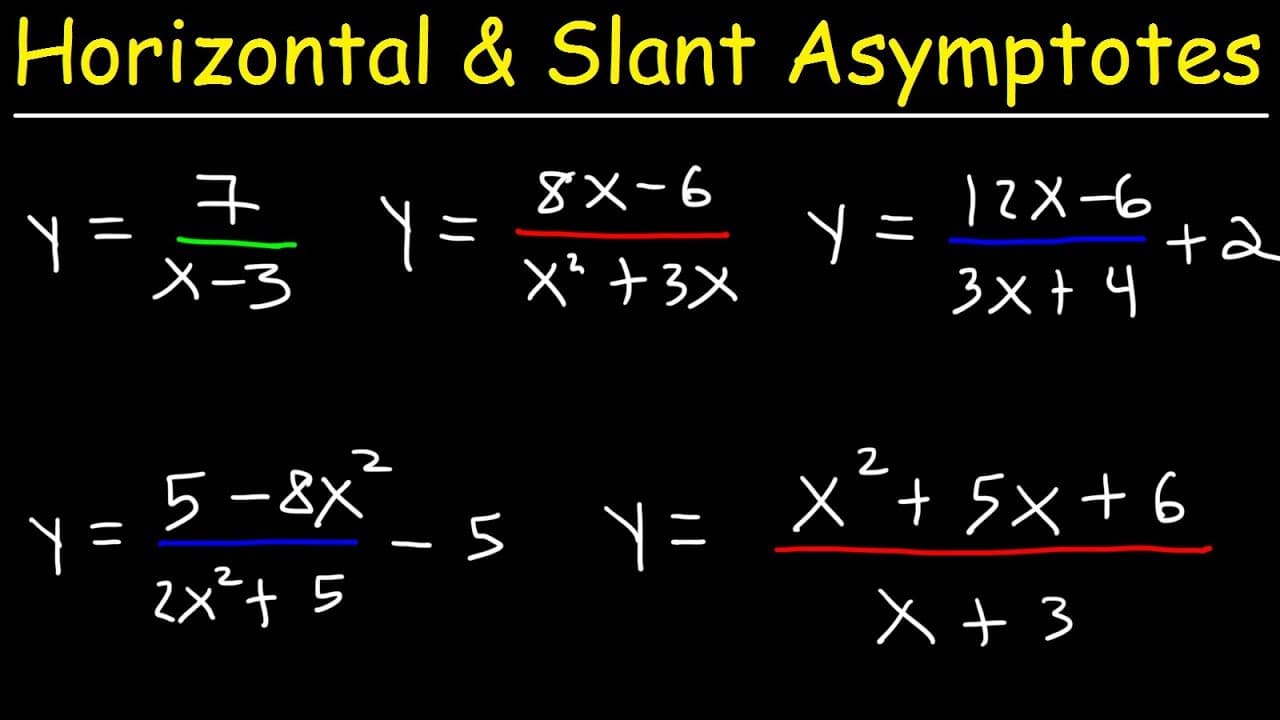
in this lesson we're going to talk about how to identify the horizontal asymptote and also the slant asymptote which is also known as the oblique asymptote so let's start with this one 1 over x based on the previous lesson you know that this graph has a horizontal asymptote of y equals zero anytime the function is bottom heavy meaning that the degr... Read More
Key Insights
- ❣️ Bottom-heavy fractions have a horizontal asymptote at y=0.
- ❣️ Adding a constant to a bottom-heavy fraction changes the horizontal asymptote.
- 🥳 Functions with the same degree in the numerator and denominator have a horizontal asymptote at the ratio of coefficients.
- 🪘 Long division is used to find slant asymptotes.
- ❓ Slant asymptotes exist only when the degree of the numerator exceeds the denominator by exactly one.
- 🅰️ The degree of the numerator and denominator determines the type of asymptotes.
- 🚥 Horizontal asymptotes can be determined by comparing the degrees of the numerator and denominator.
Install to Summarize YouTube Videos and Get Transcripts
Explore YouTube Video Summarizer or Get YouTube Transcript Extractor
Questions & Answers
Q: How do you identify the horizontal asymptote of a function with a higher degree in the denominator?
If the degree of the denominator is higher than that of the numerator, the horizontal asymptote is y=0.
Q: What happens when a constant is added to a bottom-heavy fraction?
The constant is added to the horizontal asymptote, resulting in a new horizontal asymptote at the sum of the constant and the previous asymptote.
Q: How do you find the horizontal asymptote of a function with the same degree in the numerator and denominator?
Divide the coefficients of the numerator and denominator, and the result is the value of the horizontal asymptote.
Q: How can you find a slant asymptote of a function?
Use long division to divide the numerator by the denominator. The quotient obtained will be the equation of the slant asymptote.
Summary & Key Takeaways
-
Functions with higher degree in the denominator compared to the numerator have a horizontal asymptote at y=0.
-
Functions with a constant added to the bottom-heavy fraction have a horizontal asymptote at the constant value.
-
Functions with the same degree in the numerator and denominator have a horizontal asymptote at the ratio of the coefficients.
-
Slant asymptotes can be found by using long division to divide the numerator by the denominator.
Read in Other Languages (beta)
Share This Summary 📚
Summarize YouTube Videos and Get Video Transcripts with 1-Click
Try YouTube Summary with ChatGPT & Claude or YouTube Transcript Generator
Explore More Summaries from The Organic Chemistry Tutor 📚




Summarize YouTube Videos and Get Video Transcripts with 1-Click
Try YouTube Summary with ChatGPT & Claude or YouTube Transcript Generator