What Is the Ratio Test for Series Convergence?
TL;DR
The ratio test determines series convergence by evaluating the limit of the ratio of consecutive terms. If the limit is less than 1, the series converges; if greater than 1, it diverges; and if equal to 1, the test is inconclusive. It effectively analyzes series with exponential terms, factorials, and alternating signs.
Transcript
in this video we're going to talk about the ratio tests and so here's the basic idea behind it let's say if we take the limit as n goes to infinity of the absolute value of a sub n plus 1 divided by a sub n and let's say we get some limit l and that limit is less than 1 then the series is going to be absolutely convergent now let's say if we take t... Read More
Key Insights
- 🥳 The ratio test provides a straightforward method to analyze series convergence or divergence based on the limit of the ratio of consecutive terms.
- 🥳 Series with exponential growth can be evaluated using the ratio test by simplifying terms and taking the limit.
- 🥳 The ratio test can handle series with alternating signs by comparing the limit of the ratio.
Install to Summarize YouTube Videos and Get Transcripts
Explore YouTube Video Summarizer or Get YouTube Transcript Extractor
Questions & Answers
Q: What is the basic idea behind the ratio test for series convergence?
The ratio test checks if the limit of the ratio of consecutive terms in a series is less than, equal to, or greater than 1, determining if the series converges absolutely, is inconclusive, or diverges, respectively.
Q: How does the ratio test handle series with exponential growth?
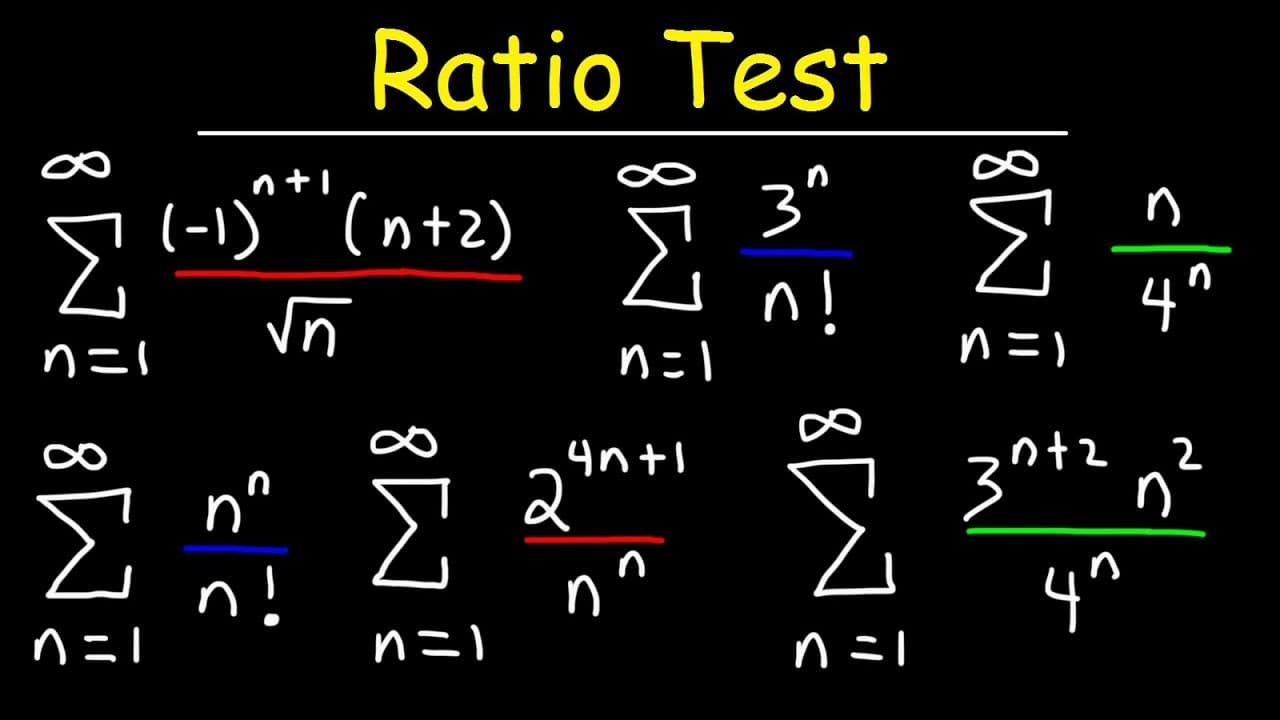
For a series with exponential growth, such as 3^n / n!, the ratio test can be applied by simplifying the terms and taking the limit. If the limit is less than 1, the series is absolutely convergent in this case.
Q: Can the ratio test be used for series with alternating signs?
Yes, the ratio test can be applied to series with alternating signs, such as (-1)^(n+1) * (n+2) / sqrt(n). The test still compares the limit of the ratio of consecutive terms to determine the convergence or divergence of the series.
Q: What does it mean if the ratio test yields an inconclusive result?
If the limit of the ratio test is equal to 1, no conclusion can be drawn about the convergence or divergence of the series using only the ratio test. Other tests or methods may need to be used to determine the series behavior.
Summary & Key Takeaways
-
The ratio test states that if the limit of the ratio of consecutive terms in a series is less than 1, the series is absolutely convergent. If the limit is greater than 1 or tends to infinity, the series is divergent. If the limit is equal to 1, the test is inconclusive.
-
Examples are provided to illustrate the application of the ratio test in determining convergence or divergence of series.
-
The ratio test can be used to analyze series with exponential growth, factorials, and alternating signs.
Read in Other Languages (beta)
Share This Summary 📚
Summarize YouTube Videos and Get Video Transcripts with 1-Click
Try YouTube Summary with ChatGPT & Claude or YouTube Transcript Generator
Explore More Summaries from The Organic Chemistry Tutor 📚
Summarize YouTube Videos and Get Video Transcripts with 1-Click
Try YouTube Summary with ChatGPT & Claude or YouTube Transcript Generator