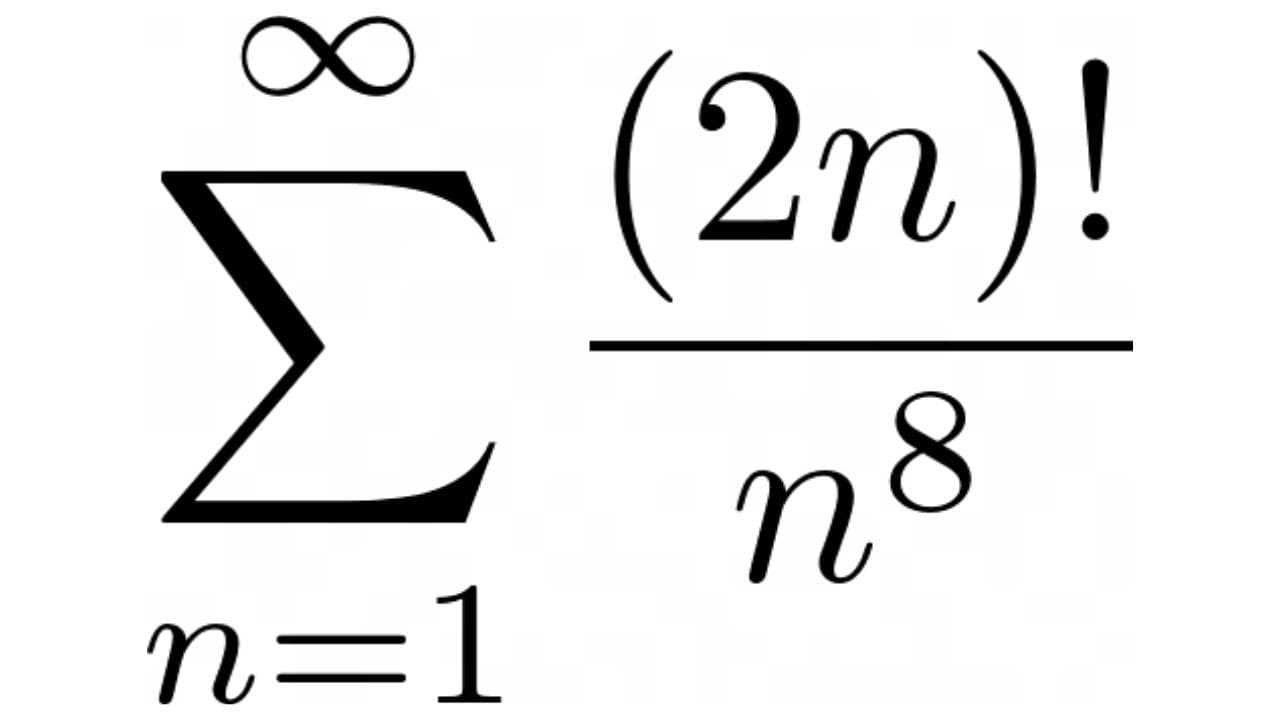
Ratio Test for Infinite Series SUM((2n)!/n^8)
TL;DR
Using the ratio test to analyze series convergence, illustrating factorials and polynomial growth comparisons.
Transcript
in this video we have to determine whether this infinite series converges or diverges we're going to do this using the ratio test so the motivation for using the ratio test is that we have factorials typically when you have factorials the ratio test is a good test to try the ratio test says that you take the limit as n goes to infinity of the absol... Read More
Key Insights
- 🥳 Factorials in series often signal the need for the ratio test due to their growth patterns.
- 🥳 The ratio test determines convergence or divergence by comparing series terms as n approaches infinity.
- 🥳 Simplification of factorials and polynomial terms is crucial for applying the ratio test accurately.
- 💭 The nth term test offers a simpler alternative to assessing divergence in infinite series.
- ☠️ Understanding the growth rates of factorials versus polynomials aids in interpreting test results for series convergence or divergence.
- 🏆 When unsure of which test to use, the nth term test is a reliable initial method for assessing convergence.
- 🏆 Conducting calculations for both the ratio test and the nth term test can provide a comprehensive evaluation of series behavior.
Install to Summarize YouTube Videos and Get Transcripts
Explore YouTube Video Summarizer or Get YouTube Transcript Extractor
Questions & Answers
Q: How does the ratio test help determine if an infinite series converges?
The ratio test involves taking the limit of the absolute value of a sub n+1 over a sub n as n approaches infinity to assess convergence or divergence.
Q: Why do factorials suggest applying the ratio test?
Factorials in series often indicate a suitable application of the ratio test due to its effectiveness in dealing with factorial growth patterns.
Q: What steps are involved in simplifying factorials during the ratio test?
To simplify factorials, replace n with n+1, distribute coefficients, and cancel out common terms in the ratio expression to ascertain convergence or divergence.
Q: How does the nth term test provide an alternative approach to determining series divergence?
The nth term test involves taking the limit as n approaches infinity of a sub n to assess divergence; if the limit is not zero, the series diverges.
Summary & Key Takeaways
-
Demonstrated the application of the ratio test to determine if an infinite series converges or diverges.
-
Showed how to replace n with n + 1 in the series expression and simplify the factorials involved.
-
Compared the results obtained using the ratio test with the results from the nth term test for convergence.
Read in Other Languages (beta)
Share This Summary 📚
Summarize YouTube Videos and Get Video Transcripts with 1-Click
Try YouTube Summary with ChatGPT & Claude or YouTube Transcript Generator
Explore More Summaries from The Math Sorcerer 📚


Summarize YouTube Videos and Get Video Transcripts with 1-Click
Try YouTube Summary with ChatGPT & Claude or YouTube Transcript Generator