Reflecting segments over line | Transformations | Geometry | Khan Academy
TL;DR
The video explains how to reflect line segments over a given line by finding the perpendicular line and determining the corresponding points on the other side.
Transcript
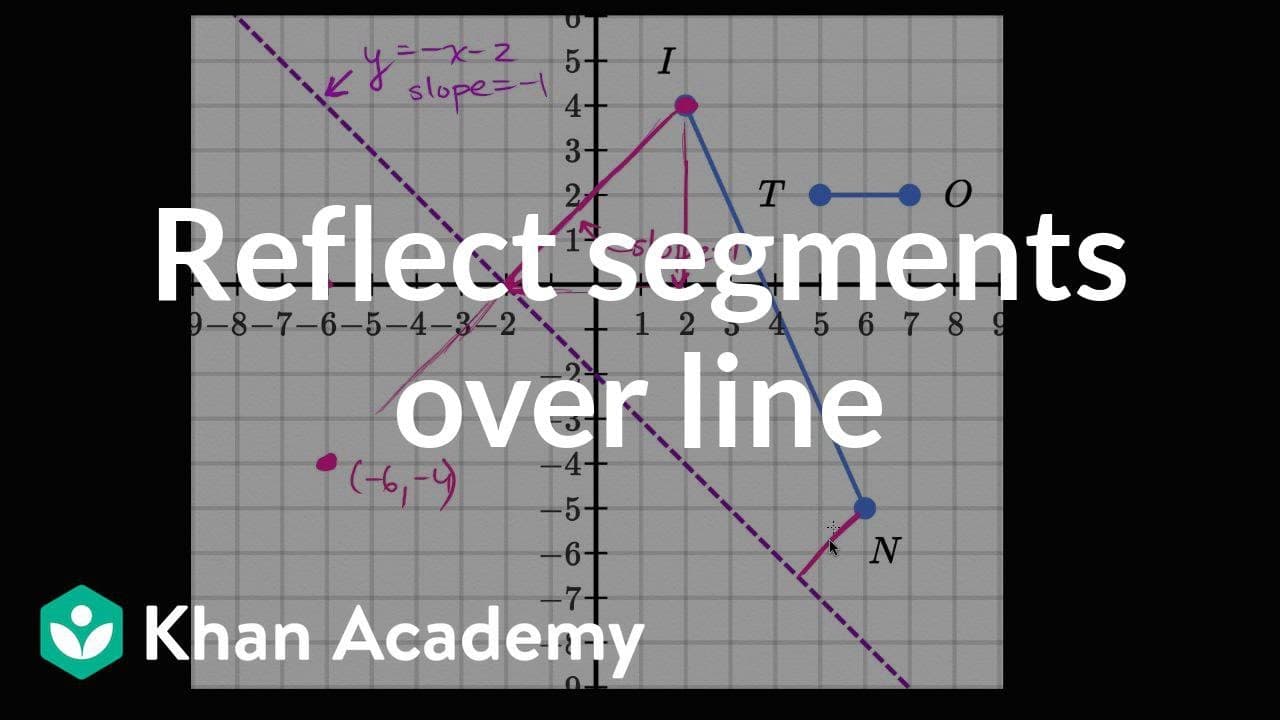
- Line segments IN, this is segment IN over here, and TO, this is TO here, are reflected over the line Y is equal to negative X minus two. So this is the line that they're reflected about this dashed, purple line. And it is indeed Y equals negative X minus two. This right over here is in slope intercept form. The slope should be negative one, and w... Read More
Key Insights
- 🫥 The reflection of line segments involves finding the perpendicular line passing through the point to be reflected.
- 🫥 The slope of the perpendicular line is the negative reciprocal of the given line's slope.
- 🫥 Reflecting involves dropping a perpendicular to the reflection line and going the same distance on the other side using the perpendicular line.
- 🏙️ Validating the reflection can be done by checking if the slope and Y-intercept of the given line match the calculations for the reflection points.
- ❓ Exact calculations are preferred to obtain accurate reflection results.
- 🫥 Perpendicular lines have slopes that multiply to give -1.
- 🫥 Reflections involve maintaining equal distances on either side of the reflection line.
Install to Summarize YouTube Videos and Get Transcripts
Explore YouTube Video Summarizer or Get YouTube Transcript Extractor
Questions & Answers
Q: How can line segments be reflected over a given line?
To reflect line segments over a given line, find the perpendicular line passing through the point to be reflected. Then, drop a perpendicular from that point to the line and go the same distance on the other side using the perpendicular line's slope.
Q: What is the significance of the slope of the perpendicular line?
The slope of the perpendicular line is the negative reciprocal of the slope of the given line. It ensures that the perpendicular line is perpendicular to the given line and helps determine the direction and distance for the reflection.
Q: How can we validate the slope and Y-intercept of the given line?
To validate the slope and Y-intercept of the given line, check if the slope matches the negative reciprocal of the desired perpendicular line and if the Y value is correct when X is zero.
Q: Is it possible to estimate the reflection points without using the exact calculations?
While estimations can be made, it is recommended to use exact calculations by finding the perpendicular line and determining the reflection points accurately.
Summary & Key Takeaways
-
The video demonstrates how to reflect line segments over a given line using the slope-intercept form of the line equation and the concept of perpendicular lines.
-
By finding the perpendicular line that passes through a given point, the video shows how to determine the reflection points on the other side of the line.
-
The process is illustrated by reflecting the line segments IN and TO over the line Y = -X - 2.
Read in Other Languages (beta)
Share This Summary 📚
Summarize YouTube Videos and Get Video Transcripts with 1-Click
Try YouTube Summary with ChatGPT & Claude or YouTube Transcript Generator
Explore More Summaries from Khan Academy 📚



Summarize YouTube Videos and Get Video Transcripts with 1-Click
Try YouTube Summary with ChatGPT & Claude or YouTube Transcript Generator