#4: Python map() & filter() | Python Best Practices
TL;DR
Learn how to use map and filter functions in Python to write cleaner and concise code.
Transcript
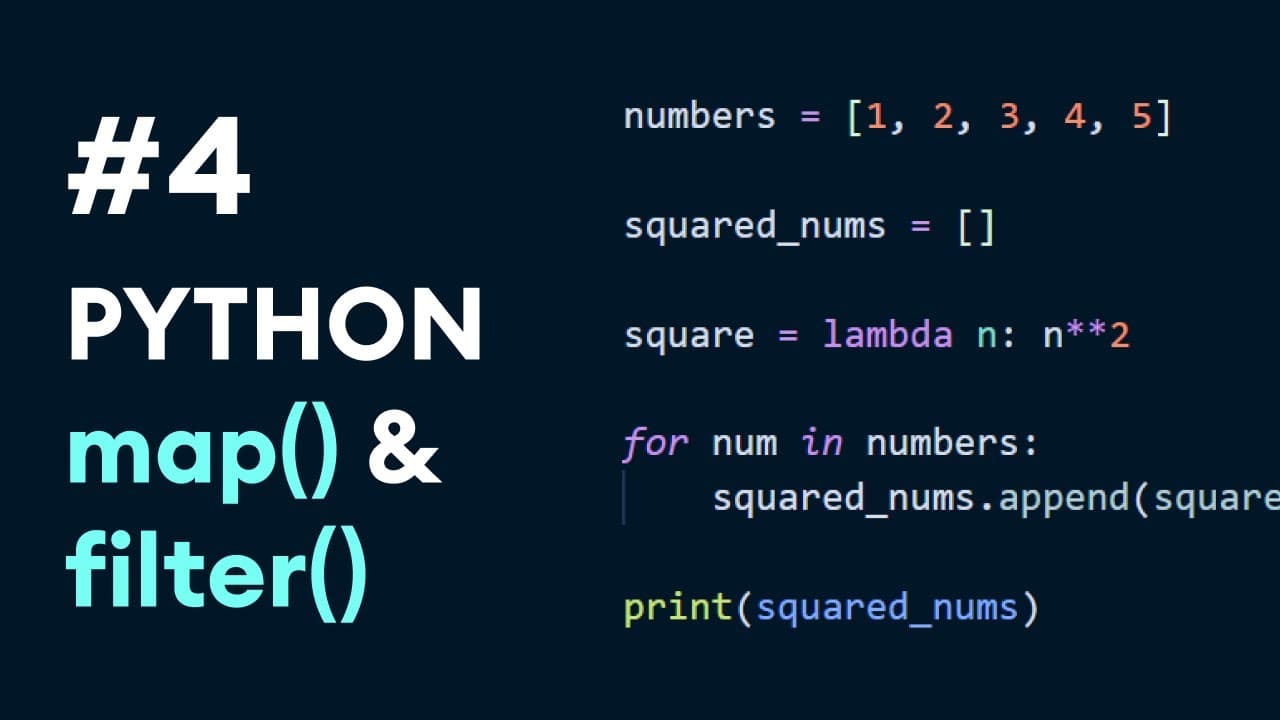
the built-in functions like map and filter allow us to write simpler shorter and more pythonic code in place of using loops and branching in this video we will learn to use map and filter in python with the help of examples so let's get started before we learn about map and filter functions let's brush up on lambda functions which we discussed in t... Read More
Key Insights
- 👨💻 Lambda functions are useful for writing concise and clean code in Python.
- 👻 The map function allows for simplification of tasks like transforming elements in a list.
- ⚾ The filter function enables filtering of elements based on a specified condition.
- 🥺 Map and filter functions lead to more pythonic and efficient code.
- 🍁 Multiple iterable arguments can be handled by the map function.
- ❓ The filter function removes elements that don't meet a condition from an iterable.
- 👂 The map and filter functions return iterator objects that can be converted to lists if needed.
Install to Summarize YouTube Videos and Get Transcripts
Explore YouTube Video Summarizer or Get YouTube Transcript Extractor
Questions & Answers
Q: What are lambda functions and how are they used in Python?
Lambda functions are single line functions without a name. They are used to create concise functions, and in this video, they serve as the basis for understanding map and filter functions.
Q: How does the map function work in Python?
The map function applies a given function to each item in an iterable. It simplifies tasks like creating a new list with modified elements, as shown in the video.
Q: Can map function handle multiple iterable arguments?
Yes, the map function can handle multiple iterable arguments. It applies the given function to the corresponding elements from the iterables and returns the result.
Q: How does the filter function work in Python?
The filter function filters out elements from an iterable based on a specified condition. It only keeps the elements for which the function returns true.
Key Insights:
- Lambda functions are useful for writing concise and clean code in Python.
- The map function allows for simplification of tasks like transforming elements in a list.
- The filter function enables filtering of elements based on a specified condition.
- Map and filter functions lead to more pythonic and efficient code.
- Multiple iterable arguments can be handled by the map function.
- The filter function removes elements that don't meet a condition from an iterable.
- The map and filter functions return iterator objects that can be converted to lists if needed.
- The video also mentions a Python learning app available on iOS and Android platforms.
Summary & Key Takeaways
-
The video introduces lambda functions, which are single line functions without a name, as they are essential for understanding map and filter functions.
-
The map function applies a given function to each item of an iterable, allowing for simplification of tasks like creating a new list with modified elements.
-
The filter function filters out elements from an iterable based on a specified condition, resulting in a new iterable with only the desired elements.
Read in Other Languages (beta)
Share This Summary 📚
Summarize YouTube Videos and Get Video Transcripts with 1-Click
Try YouTube Summary with ChatGPT & Claude or YouTube Transcript Generator
Explore More Summaries from Programiz 📚


Summarize YouTube Videos and Get Video Transcripts with 1-Click
Try YouTube Summary with ChatGPT & Claude or YouTube Transcript Generator