Dynamic Mode Decomposition (Code)
TL;DR
Dynamic Mode Decomposition (DMD) is a data-driven method to extract coherent structures and their temporal evolution from high-dimensional data in just a few lines of code.
Transcript
welcome back okay we're talking about dynamic mode decomposition which is a powerful data-driven method to extract spatial temporal coherent structures from high dimensional data and give you a linear model for how those evolve in time okay we recently wrote a book on this dynamic mode decomposition it's we have a website DMD book calm and so what ... Read More
Key Insights
- ✋ DMD is a powerful method for analyzing high-dimensional data and extracting coherent structures.
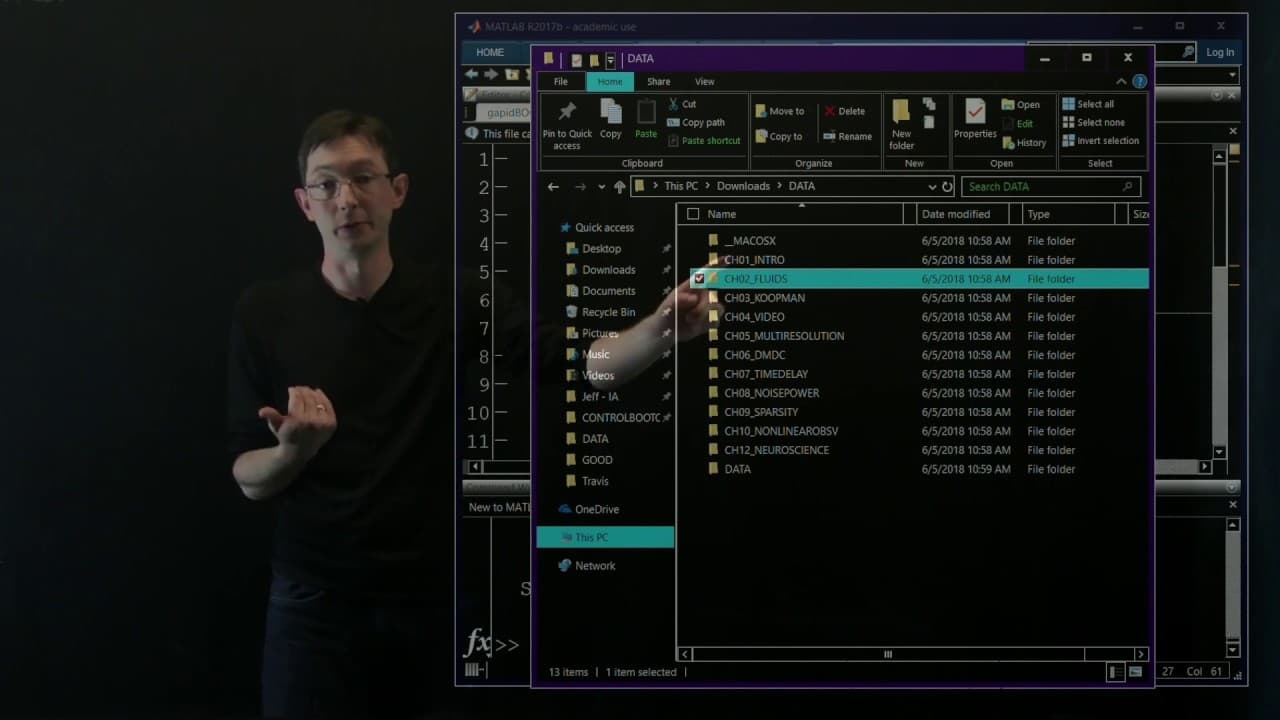
- 👨💻 The DMD analysis can be easily performed by downloading the code and data from DMD book website.
- 💻 The procedure involves stacking the data, computing a singular value decomposition, and determining dominant coherent structures.
- 👤 Users can visualize the results by plotting the DMD modes and analyzing the corresponding eigenvalues.
- 👻 DMD allows users to understand the time dynamics and spatial distribution of coherent structures in their data.
- 🫥 The DMD procedure is computationally efficient, requiring just a few lines of code.
- 👤 Users have the flexibility to choose the number of modes to keep based on their data and analysis requirements.
Install to Summarize YouTube Videos and Get Transcripts
Explore YouTube Video Summarizer or Get YouTube Transcript Extractor
Questions & Answers
Q: What is Dynamic Mode Decomposition (DMD)?
DMD is a data-driven method that extracts spatial-temporal coherent structures from high-dimensional data by analyzing their linear temporal evolution.
Q: How can users get started with DMD analysis?
Users can download the code and data from DMD book website and unzip them into the same folder to start their DMD analysis.
Q: What are the steps involved in the DMD procedure?
The DMD procedure involves stacking the data into matrices X and X prime, computing a singular value decomposition (SVD) to find dominant coherent structures, determining the rank and truncating unwanted modes, and finally building a linear model to identify the temporal evolution of the chosen modes.
Q: How can users visualize the results of DMD analysis?
Users can plot the DMD modes using the provided code, which shows the coherent structure pairs oscillating at different frequencies in time.
Key Insights:
- DMD is a powerful method for analyzing high-dimensional data and extracting coherent structures.
- The DMD analysis can be easily performed by downloading the code and data from DMD book website.
- The procedure involves stacking the data, computing a singular value decomposition, and determining dominant coherent structures.
- Users can visualize the results by plotting the DMD modes and analyzing the corresponding eigenvalues.
- DMD allows users to understand the time dynamics and spatial distribution of coherent structures in their data.
- The DMD procedure is computationally efficient, requiring just a few lines of code.
- Users have the flexibility to choose the number of modes to keep based on their data and analysis requirements.
- The DMD book website offers additional resources and a pre-built DMD function to simplify the analysis process.
Summary & Key Takeaways
-
Dynamic Mode Decomposition (DMD) is a powerful data-driven method for extracting spatial-temporal coherent structures from high-dimensional data.
-
By downloading the code and data from DMD book website, users can easily get started with DMD analysis.
-
The DMD procedure involves stacking the data, computing a singular value decomposition, and determining the dominant coherent structures and their temporal evolution.
Read in Other Languages (beta)
Share This Summary 📚
Summarize YouTube Videos and Get Video Transcripts with 1-Click
Try YouTube Summary with ChatGPT & Claude or YouTube Transcript Generator
Explore More Summaries from Steve Brunton 📚

Summarize YouTube Videos and Get Video Transcripts with 1-Click
Try YouTube Summary with ChatGPT & Claude or YouTube Transcript Generator