Dynamic Mode Decomposition (Overview)
TL;DR
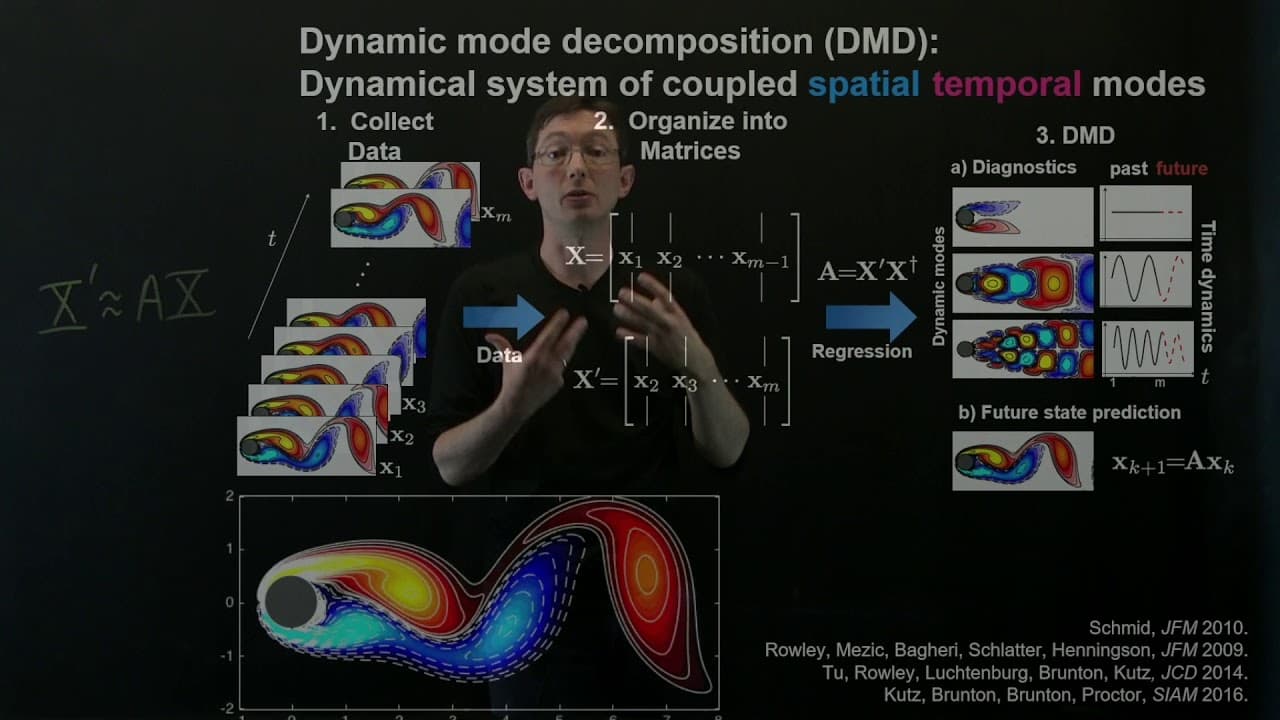
The dynamic mode decomposition (DMD) is a data-driven method that can obtain linear reduced order models for high-dimensional complex systems without requiring knowledge of the underlying equations. It can also extract spatial-temporal coherent structures from the data.
Transcript
hi everyone today I'm going to tell you about the dynamic mode decomposition or DMD which is an emerging data driven technique to obtain linear reduced order models for high dimensional complex systems and in addition to linear reduced order models we also can extract from from this data spatial temporal coherent structures or patterns that dominat... Read More
Key Insights
- ❓ DMD is a versatile method that can be applied to various systems without requiring prior knowledge of the underlying equations.
- ✋ It can be used for diagnostics, model extraction, and even control of high-dimensional systems.
- ❓ DMD combines the principles of principal component analysis and Fourier transform to capture the dominant patterns and temporal dynamics of a system.
- 😑 The singular value decomposition is utilized to find the dominant coherent structures, which are expressed as eigenmodes.
Install to Summarize YouTube Videos and Get Transcripts
Explore YouTube Video Summarizer or Get YouTube Transcript Extractor
Questions & Answers
Q: What is the main advantage of the DMD method?
The main advantage of DMD is that it is purely data-driven and does not require knowledge of the underlying equations of motion. It can be applied to any system for which data is available.
Q: How does DMD extract spatial-temporal coherent structures?
DMD approximates the leading eigenvalues and eigenvectors of a linear operator. These eigenvectors represent dominant spatial patterns, which can be reshaped into flow fields representing coherent structures.
Q: Can DMD be used for experimental fluids?
Yes, DMD can be directly applicable to experimental fluids. By using particle image velocimetry (PIV) images from an experiment, DMD can extract spatial-temporal coherent structures from the data.
Q: How does DMD handle high-dimensional data?
DMD organizes the high-dimensional data into tall column vectors evolving in time. It approximates the leading eigen decomposition of a large matrix without explicitly computing the matrix, making it scalable for high-dimensional data.
Key Insights:
- DMD is a versatile method that can be applied to various systems without requiring prior knowledge of the underlying equations.
- It can be used for diagnostics, model extraction, and even control of high-dimensional systems.
- DMD combines the principles of principal component analysis and Fourier transform to capture the dominant patterns and temporal dynamics of a system.
- The singular value decomposition is utilized to find the dominant coherent structures, which are expressed as eigenmodes.
- The DMD algorithm has scalability and efficiency advantages since it avoids computing large matrices.
Summary & Key Takeaways
-
DMD is a data-driven technique that can obtain linear reduced order models and spatial-temporal coherent structures from high-dimensional complex systems.
-
It is applicable to a wide range of systems, including fluid dynamics, disease modeling, neuroscience, robotics, finance, and plasmas.
-
DMD organizes the data into matrices and approximates the dominant eigenvalues and eigenvectors of a linear operator without explicitly computing the operator.
Read in Other Languages (beta)
Share This Summary 📚
Summarize YouTube Videos and Get Video Transcripts with 1-Click
Try YouTube Summary with ChatGPT & Claude or YouTube Transcript Generator
Explore More Summaries from Steve Brunton 📚
![AI/ML+Physics: Recap and Summary [Physics Informed Machine Learning] thumbnail](/_next/image?url=https%3A%2F%2Fi.ytimg.com%2Fvi%2FGCz6afDVy5Y%2Fhqdefault.jpg&w=750&q=75)

Summarize YouTube Videos and Get Video Transcripts with 1-Click
Try YouTube Summary with ChatGPT & Claude or YouTube Transcript Generator