Invertible and noninvertibles matrices
TL;DR
Matrices are invertible as long as their determinant is non-zero, otherwise they are not invertible.
Transcript
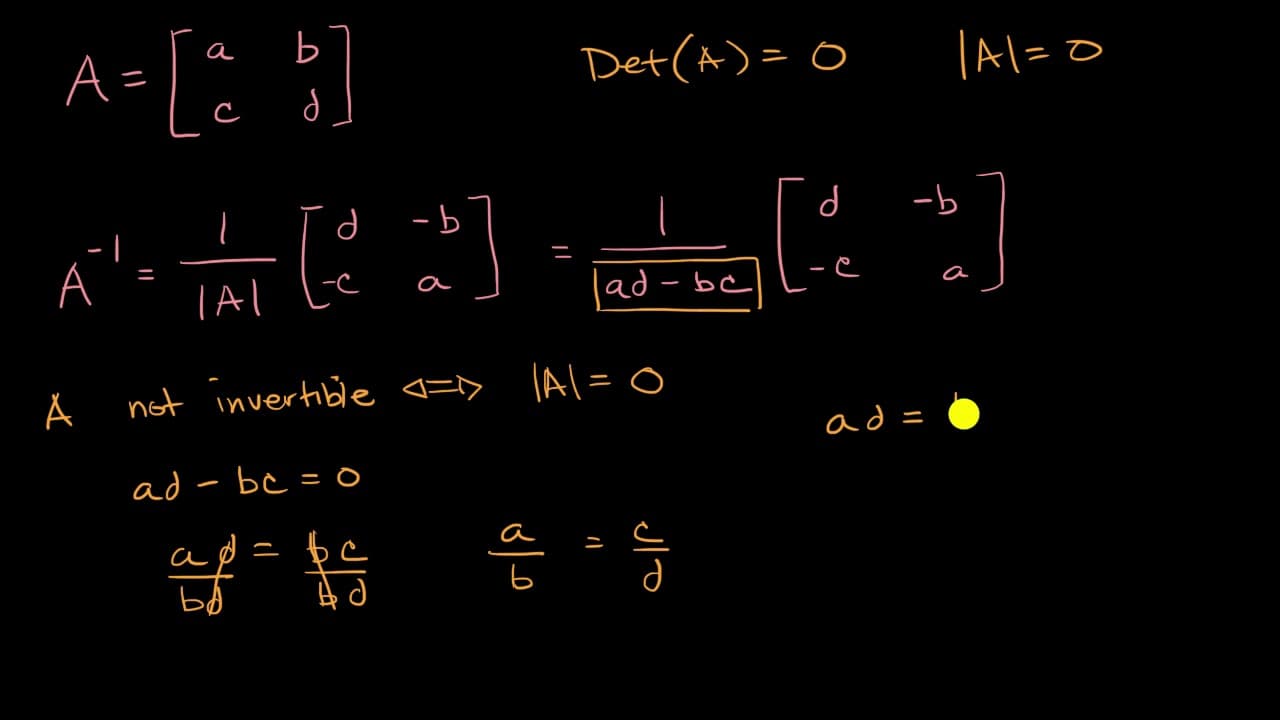
- [Instructor] So let me just write a general two-by-two matrix A. So let's just say its elements are a, b, c, and d. Now, from previous videos, we have learned how to find the inverse of our matrix A, the formula that we went over. The inverse of our matrix A is going to be equal to one over the determinant of our matrix A times what is often call... Read More
Key Insights
- ❓ The inverse of a matrix can be found using the formula: inverse of matrix A = (1/det(A)) * adjoint(A).
- 0️⃣ A matrix is not invertible if its determinant is zero.
- 🥳 If the ratio between the elements of a matrix satisfies certain conditions, the matrix will not have an inverse.
- 0️⃣ Invertible matrices have non-zero determinants, while noninvertible matrices have zero determinants.
- 🏑 The concept of matrix invertibility is essential in linear algebra and has applications in various fields, including computer graphics and physics.
- 🫤 The adjoint matrix swaps the main diagonal elements and negates the off-diagonal elements of the original matrix.
- 👻 Determining the invertibility of a matrix allows us to solve systems of linear equations and perform other mathematical operations.
Install to Summarize YouTube Videos and Get Transcripts
Explore YouTube Video Summarizer or Get YouTube Transcript Extractor
Questions & Answers
Q: How is the inverse of a matrix calculated?
The inverse of a matrix is found by taking the reciprocal of its determinant and multiplying it by the adjoint of the matrix. This process allows us to "undo" the matrix transformation.
Q: Under what condition is a matrix not invertible?
A matrix is not invertible when its determinant is equal to zero. In other words, if the expression ad - bc equals zero, the matrix cannot be inverted.
Q: Can you provide an example of an invertible matrix?
Consider the matrix 5 1 3 2. The determinant of this matrix is equal to (5 * 2) - (3 * 1), which is 7. Since the determinant is non-zero, this matrix is invertible.
Q: How do we determine if a matrix is invertible without calculating its determinant?
If the ratio between the elements of a matrix satisfies a specific relationship, the matrix will be noninvertible. This relationship can be expressed as a/b = c/d or a/c = b/d, where a, b, c, and d are the elements of the matrix.
Summary & Key Takeaways
-
The inverse of a matrix can be found by taking the reciprocal of its determinant and multiplying it by the adjoint of the matrix.
-
A matrix is not invertible if its determinant is equal to zero.
-
If the ratio between the elements of a matrix satisfies certain conditions, the matrix will be noninvertible.
Read in Other Languages (beta)
Share This Summary 📚
Summarize YouTube Videos and Get Video Transcripts with 1-Click
Try YouTube Summary with ChatGPT & Claude or YouTube Transcript Generator
Explore More Summaries from Khan Academy 📚



Summarize YouTube Videos and Get Video Transcripts with 1-Click
Try YouTube Summary with ChatGPT & Claude or YouTube Transcript Generator