pH of Weak Acids and Bases - Percent Ionization - Ka & Kb
TL;DR
Learn how to calculate pH, percent ionization, and other related problems for weak acid and base solutions.
Transcript
in this video we're going to talk about how to calculate the ph of a weak acid solution as well as the ph of a weak based solution we're also going to talk about percent ionization and some other problems associated with weak acid bases but let's review some basics now if you recall when a strong acid like hydrochloric acid reacts with water becaus... Read More
Key Insights
- 😥 Strong acids dissociate completely, simplifying pH calculation.
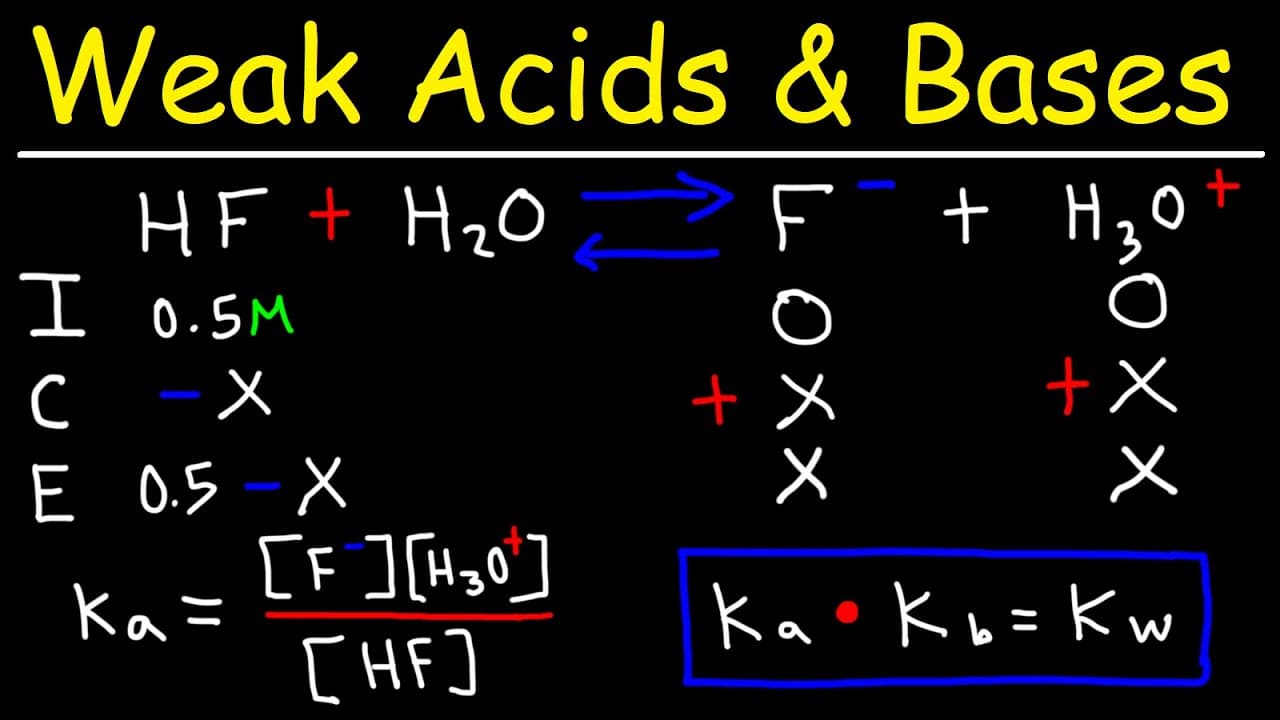
- 😥 Weak acids and bases require equilibrium constants (Ka and Kb) for pH calculation.
- 😑 Ka and Kb can be used to find the concentration of hydronium and hydroxide ions.
- 🇰🇿 Acid strength is determined by Ka values, and pKa is the negative logarithm of Ka.
- 🥳 Percent ionization is the ratio of dissociated acid or base concentration to the initial concentration.
- 😑 Equilibrium expressions and ice tables are helpful tools for weak acid and base calculations.
- 🪜 pH and pOH values are related and add up to 14 at 25 degrees Celsius.
Install to Summarize YouTube Videos and Get Transcripts
Explore YouTube Video Summarizer or Get YouTube Transcript Extractor
Questions & Answers
Q: How do strong acids differ from weak acids in terms of dissociation and pH calculation?
Strong acids dissociate completely in water, allowing for easy pH calculation using the hydronium ion concentration. Weak acids only partially dissociate, requiring the use of equilibrium constants and the concentration of hydronium ions to calculate pH.
Q: What are the equilibrium constants used for weak acid and base solutions?
For weak acids, Ka (acid dissociation constant) is used, which is the ratio of product concentration to reactant concentration. For weak bases, Kb (base dissociation constant) is used, which is the ratio of product concentration to reactant concentration.
Q: How can Ka and Kb be used to determine the pH of a solution?
By using ice tables and the equilibrium expression, we can find the concentration of hydronium or hydroxide ions, which can then be used to calculate the pH of the solution.
Q: How does acid strength relate to Ka and pKa values?
Acid strength increases as Ka values increase. pKa is the negative logarithm of Ka and is inversely related to acid strength. Lower pKa values indicate stronger acids.
Summary & Key Takeaways
-
Strong acids dissociate completely in water, allowing for easy pH calculation.
-
Weak acids and bases require the use of equilibrium constants (Ka and Kb) to determine pH and percent ionization.
-
Ka and Kb can be used to find the concentration of hydronium or hydroxide ions, which can then be used to calculate pH.
-
Acid strength is determined by Ka values, and pKa is the negative logarithm of Ka.
-
Percent ionization is the ratio of dissociated acid or base concentration to the initial acid or base concentration.
Read in Other Languages (beta)
Share This Summary 📚
Summarize YouTube Videos and Get Video Transcripts with 1-Click
Try YouTube Summary with ChatGPT & Claude or YouTube Transcript Generator
Explore More Summaries from The Organic Chemistry Tutor 📚





Summarize YouTube Videos and Get Video Transcripts with 1-Click
Try YouTube Summary with ChatGPT & Claude or YouTube Transcript Generator